Short answer: Foot drop after stroke means the muscles that lift the front of the foot are weak, so the toes catch the floor and falls become more likely. It can improve with physiotherapy, though for some people it stays. Safe home exercises, regular walking practice, a properly assessed ankle-foot orthosis (AFO) and a trip-free home all help. Functional electrical stimulation (FES) is another evidence-based option for some people. Sudden new weakness, numbness or slurred speech is an emergency: call 1122. Families in Islamabad and Rawalpindi can book a physiotherapist to visit at home with IRHC.
This guide is general information. It is not medical advice and does not replace an assessment by your doctor, a qualified physiotherapist or an orthotist.
Listen to a short overview
52 seconds · a spoken summary of this guide. It does not replace advice from your doctor or physiotherapist.
Key takeaways
- Foot drop after stroke comes from weakness, and often stiffness, in the muscles around the ankle. The toes drag, the leg swings out, and tripping becomes common.
- It can get better with treatment, but not always. Safety matters from day one either way.
- Home exercises help most when a physiotherapist has checked them first. Stop if anything feels wrong.
- An AFO should be assessed and fitted by a qualified professional. A brace bought from a market stall can rub, slip or make walking worse.
- IRHC sends a physiotherapist to your home in almost all areas of Islamabad and Rawalpindi, Monday to Sunday. See home physiotherapy.
In this guide
- What is foot drop after stroke?
- How it affects walking and falls
- Will it get better?
- Foot drop exercises at home
- Ankle braces (AFOs) compared (table)
- Electrical stimulation (FES) and other treatments
- Making a Pakistani home safer
- Common mistakes
- When to get help
- Foot drop physiotherapy in Islamabad and Rawalpindi
- FAQs
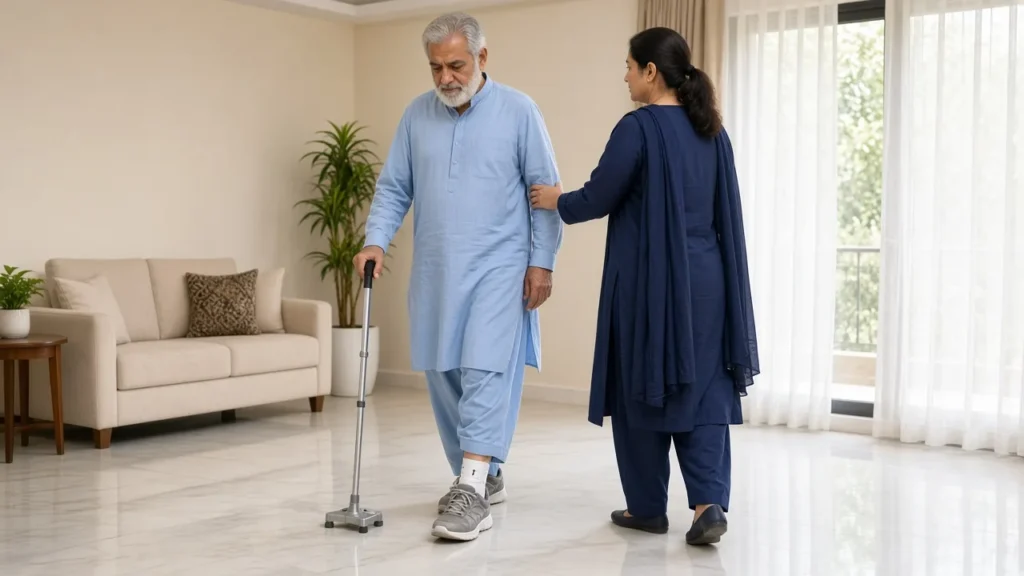
It often shows up in the first days of walking again. The patient is home from hospital, the arm is slowly coming back, and then the toes of one foot catch on the edge of a rug or the raised marble strip at the bathroom door. Families start holding an elbow everywhere, and the patient starts walking less. That catching foot has a name: foot drop after stroke. This guide explains why it happens, which exercises are usually safe at home, how ankle braces (AFOs) differ, and what you can change in the house this week to prevent a fall.
What is foot drop after stroke?
Foot drop, also called drop foot, is difficulty lifting the front of the foot and the toes. After a stroke it happens because the part of the brain that controls the leg on one side has been damaged, so the muscles at the front of the shin no longer lift the foot properly.
The Stroke Association describes it as muscle weakness in the foot and ankle that makes it harder to lift your toes and the front part of your foot. The leg nerves are usually fine; the problem is the signal from the brain. In many people a second problem joins in over the following weeks: the calf muscles become stiff and overactive, a condition called spasticity, and they pull the foot down even harder. That is why two people with “the same” foot drop can need very different treatment.
Signs families usually notice first
- The toes scuff or catch the floor, especially on rugs, door strips and steps.
- The foot slaps down instead of landing heel first.
- The person lifts the knee unusually high, or swings the leg out to the side to clear the foot. The Stroke Association lists both as ways people make up for a weak ankle.
- Steps are shorter on one side, walking is slower and tiring, and the front of one shoe wears out faster.
- The ankle rolls outwards, or the foot turns inwards, when standing.
Is it the stroke, or something else?
Stroke is only one cause. The NHS says the most common cause of foot drop overall is an injury to a nerve that runs down the leg, and it also lists long periods without moving, such as a hospital stay, and long spells of crossing the legs or squatting. A physiotherapist will look at the whole picture. If a weak foot appears suddenly, with or without face drooping, arm weakness or slurred speech, treat it as a possible new stroke and call 1122 straight away. Do not wait for the next therapy visit.
How does foot drop affect walking and the risk of falls?
A foot that does not lift clears the floor poorly while the leg swings forward, so the toes catch and the person trips. The ways people compensate, such as swinging the leg out, are tiring and unsteady. The Stroke Association notes that foot drop can lead to difficulty walking and an increased risk of falling.
Each step has two halves. While the foot carries weight, a weak or stiff ankle can make the knee buckle or snap back. While it swings through, the dropped toes catch. NICE’s stroke rehabilitation guideline names both problems, poor swing-phase foot clearance (for example tripping and falling) and poor stance-phase control (for example the knee or ankle collapsing), as reasons to consider an ankle-foot orthosis.
Falls are only part of the cost. After one near miss, many people walk less, the leg weakens and the calf stiffens. Breaking that cycle safely is the real goal of treatment.
Will foot drop get better after a stroke?
It can. Many people regain some ankle movement, especially with regular practice, but the Stroke Association says foot drop may be permanent in some cases. Nobody can promise a timeline, so the aim is to work on recovery and stay safe at the same time.
Foot drop recovery after stroke depends on things a family cannot control, such as the size and site of the stroke, and things it can, such as how often the person walks and practises. A brace is not a sign of giving up. Used properly, an AFO lets someone walk more today, and walking more is itself part of rehabilitation. If the foot improves, the brace can be changed or stopped on professional advice.
Which foot drop exercises are safe to do at home?
Gentle seated ankle and toe lifts, supported calf stretches, sit-to-stand practice and short supported walks are the usual starting points. Do only the exercises your physiotherapist has checked for this person, with a sturdy chair or counter to hold, and stop if anything listed in the warning box below happens.
NICE recommends strength training for people with muscle weakness after stroke, including simple body-weight exercises such as sit-to-stand repetitions, and repetitive practice of real tasks such as standing up, walking and using stairs. In plain terms, small movements done often rebuild control. The exercises below are common examples; repetitions, frequency and which ones to skip should come from the physiotherapist who has assessed the leg.
Stop the exercise and get advice if:
- there is chest pain, sudden breathlessness, fainting or severe dizziness (get emergency help);
- new weakness, numbness, a drooping face, slurred speech or a sudden severe headache appears (call 1122, this may be a new stroke);
- a joint hurts sharply, or the ankle or calf becomes hot, swollen or red;
- the person is too tired to keep good form, or feels unsteady even with support.
Seated exercises
- Toe and ankle lifts: sit in a firm chair with both feet flat. Keep the heel on the floor and try to lift the toes and front of the foot, then lower slowly. Even a small lift counts. If nothing moves yet, the helper can gently guide the foot up while the patient tries to help.
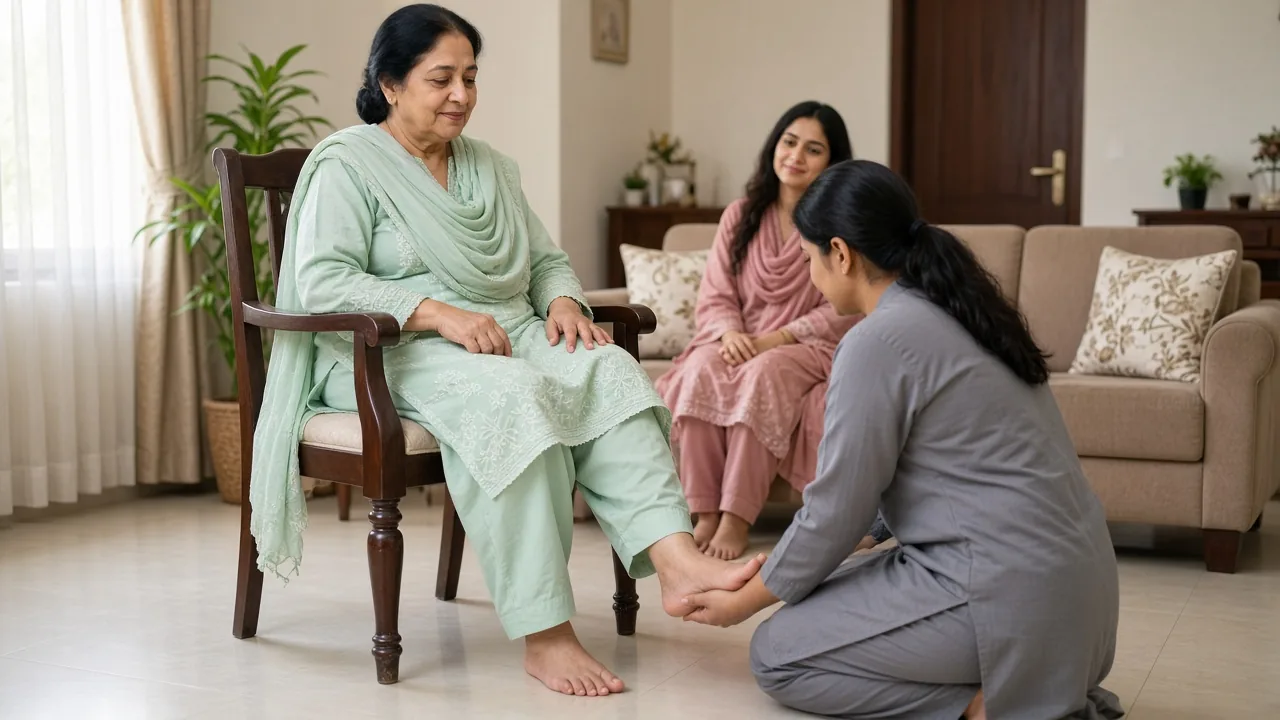
- Assisted ankle movement: a family member, taught by the physiotherapist, supports the heel and slowly moves the ankle up and down through a comfortable range. This keeps the joint from stiffening. It should never be forced or painful.
Standing exercises, with support
- Sit-to-stand: from a firm chair with armrests, feet slightly back, lean forward and stand up, then sit down slowly with control. NICE names this as a simple strength exercise.
- Weight shifts: holding a kitchen counter or sturdy table, move weight gently from one leg to the other. This builds trust in the weaker leg.
- Calf stretch: hands on the counter, weaker foot behind, heel down, knee straight, lean forward until a gentle stretch is felt in the calf. Hold, then relax. Your physiotherapist will say whether this suits someone with a stiff calf.
- Marching on the spot: holding on with both hands, lift one knee and then the other, aiming to land the foot flat rather than letting the toes slap.
Walking practice
Short, frequent walks are usually better than one long, exhausting one. Use the walking aid and brace the physiotherapist has advised, keep to a clear, well-lit route, and have someone walk on the weaker side.
What kinds of ankle braces (AFOs) help foot drop?
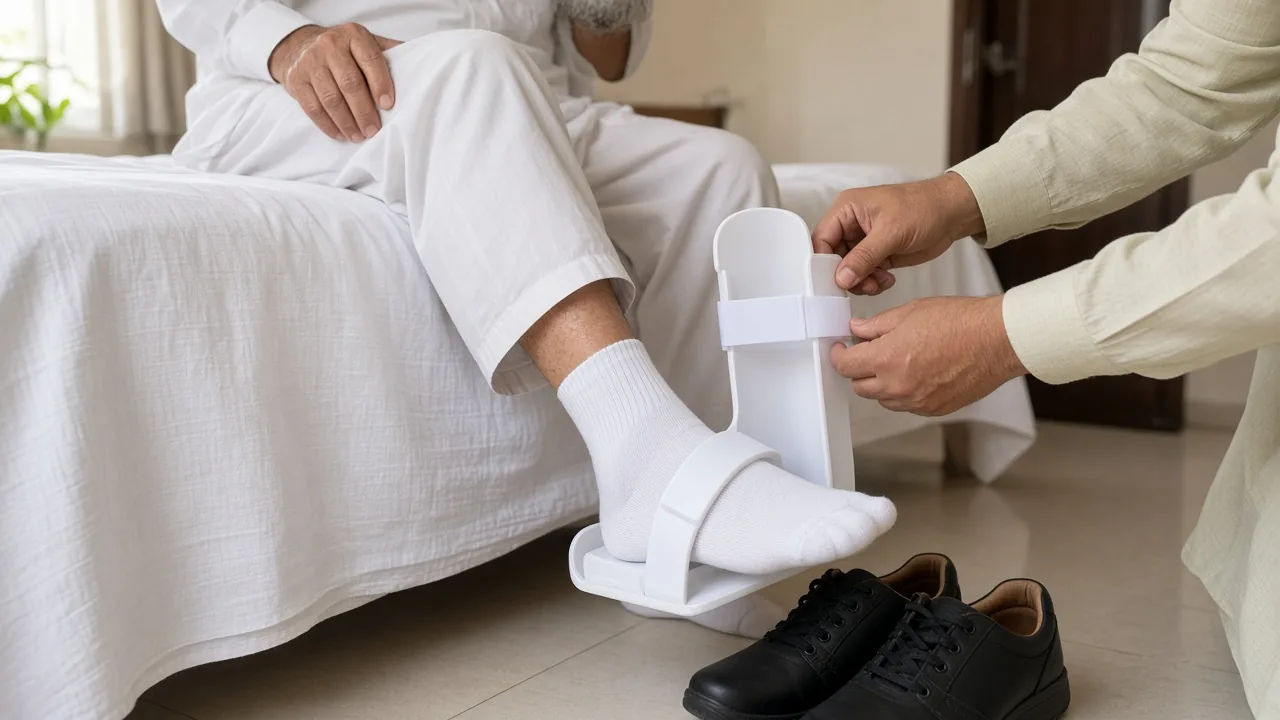
An ankle-foot orthosis (AFO) is a brace that holds the foot and ankle in a safer position so the toes clear the floor. Types range from ready-made plastic braces to custom-moulded, hinged, flexible and carbon-fibre designs. Which one suits a person can only be decided after an assessment by a qualified professional.
The Stroke Association explains that an AFO keeps the ankle and foot in one position to reduce the risk of tripping or falling, and can help walking speed, stability and balance. Research broadly supports this. A 2020 systematic review of 11 randomised trials, with 1,135 participants, found moderate-quality evidence that AFOs improve walking speed after stroke, though their effect on balance was unclear. NICE adds three practical rules: check whether the person can put the brace on, or has help to do so; judge the brace by comfort, speed and ease of walking; and have assessment and treatment carried out by qualified professionals as part of a rehabilitation programme.
If you are looking into a foot drop brace after stroke, the table below is a general guide to the types you may hear about. It is not a way to choose one yourself.
| Type of AFO | How it works | Who it may suit (only after assessment) | Things to watch |
|---|---|---|---|
| Off-the-shelf (ready-made) plastic AFO | A standard plastic shell behind the calf and under the foot holds the toes up while you step. | Sometimes used early on, or as a trial, when the foot drop is mild and the foot and ankle are a regular shape. | Fit is generic, so rubbing and pressure marks are more likely. Should still be chosen and checked by a professional. |
| Custom-moulded solid AFO | Made from a cast or scan of your own leg. It holds the ankle firmly in one position. | People with marked weakness, an unstable ankle, or a knee that buckles or snaps back when standing. | Feels rigid, especially on stairs and slopes. Needs a roomy closed shoe and regular fit checks. |
| Hinged (articulated) AFO | Has an ankle joint, so the ankle can bend for some movements while the brace still stops the toes dropping. | People who have some ankle control and need help mainly with lifting the foot. | Bulkier. The hinge setting is decided by the orthotist and should not be changed at home. |
| Flexible plastic or leaf-spring style AFO | A thinner, springier back section lifts the foot as it leaves the ground. | Weakness mainly in lifting the foot, with a reasonably stable ankle and little stiffness. | May not give enough control if the calf is very tight or the ankle rolls inwards. |
| Carbon-fibre or dynamic AFO | Light, strong material that stores and returns some energy as you walk. | Some active walkers who are steady on their feet. | Usually costs more, and is not suitable for everyone. Ask whether it fits your walking pattern. |
| Soft foot-up strap or elastic brace | A strap from the shoe laces to an ankle cuff gently pulls the front of the foot up. | Mild foot drop only, sometimes as a short-term or indoor option. | Gives little ankle stability. Not a substitute for an assessed AFO when the ankle rolls or the knee gives way. |
Names and designs vary, and some braces combine features. An orthotist can also tune the brace angle to how the knee behaves, which no ready-made product can do.
How to wear an AFO safely at home
- Socks first: a thin, smooth cotton sock between skin and plastic helps in our hot summers, when sweat makes rubbing worse.
- Heel right back: sit down, slide the heel fully into the back of the brace, then fasten the strap over the ankle before the calf strap.
- Closed shoes only: the brace goes inside a closed shoe with a firm heel and a removable insole. Many people need a wider or larger size on the brace side.
- Check the skin: each time the brace comes off, look at the heel, ankle bones, top of the foot and calf. A mark that does not fade, a blister or broken skin means the fit needs checking. People with poor feeling in the foot need a family member to look.
- Never reshape it yourself: heating, cutting or bending plastic at home can ruin the fit. Take it back to the orthotist.
Getting an AFO assessed in Islamabad and Rawalpindi
The usual route is a physiotherapy assessment of walking first, then referral to a qualified orthotist (often called a prosthetist-orthotist in Pakistan) at a hospital orthotics department or a private orthotics clinic in the twin cities. Take the discharge summary and scan reports. After fitting, the physiotherapist practises walking with the brace and checks it is really helping. If it hurts, go back for adjustments rather than leaving it in the cupboard.
Is electrical stimulation (FES) an option, and what else can doctors offer?
Functional electrical stimulation (FES) uses small electrical pulses to make the weak shin muscles lift the foot at the right moment while walking. NICE considers the evidence on its safety and its benefit for walking adequate to support its use. It needs a specialist assessment and is not available everywhere.
According to the Stroke Association, FES can help people walk more quickly, avoid falls and gain independence. Electrodes usually go on the skin; implanted versions exist but are not widely available. NICE’s guidance on FES for drop foot says current evidence on its safety and effectiveness in improving walking appears adequate, and that patient selection for implanted FES should involve a specialist rehabilitation team. The same 2020 review found that FES and AFOs improved walking speed by a similar amount.
FES is not for everyone. The Stroke Association notes it can cause skin redness and affect spasticity, so a specialist assessment is advised. Not every service offers it, so ask your stroke doctor or physiotherapist whether an FES assessment is available to you.
Other treatments depend on what is driving the foot drop. If calf stiffness is the main problem, a doctor may discuss medicines, injections or other spasticity treatments alongside stretching. The NHS adds that when loss of movement is permanent, surgery is sometimes considered. These are medical decisions to discuss with the stroke team, not home remedies.
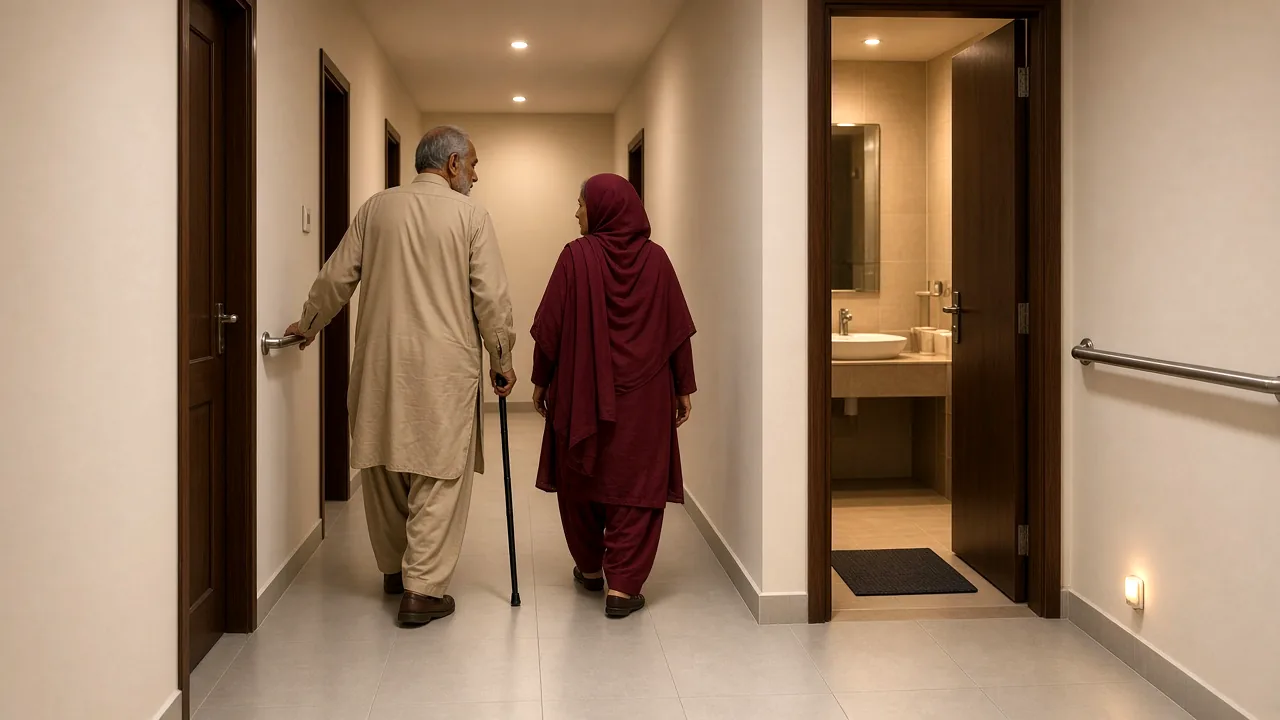
How can you make a Pakistani home safer for someone with foot drop?
Clear the floors, light the route to the bathroom, mark raised door strips and steps, fit grab bars and handrails, and swap loose chappals for closed shoes. Most changes cost little and can be done in a day.
The NHS advice for foot drop is to wear well-fitting supportive shoes, use a walking aid if needed, keep floors clear, remove loose rugs and cables, fit handrails on stairs, and mark the top and bottom step with glow-in-the-dark tape. In many homes in Islamabad and Rawalpindi, a few local hazards deserve extra attention:
- Polished marble and tiles: they turn slippery after pocha (mopping) or when water splashes during wudu. Mop when the patient is resting, dry the floor fully, and put a rubber non-slip mat in the bathroom.
- Raised door strips: the marble threshold at bathroom and kitchen doors is a classic toe-catcher. Mark it with bright tape or ask a mason about a small ramp.
- Rugs, dhurries and cables: clear them from the walking route.
- Load-shedding and night trips: a dark corridor is risky at 3 am. A rechargeable or UPS-powered light on the way to the bathroom is a cheap fix.
- Stairs and rooftops: use a handrail, ideally on both sides, and go up with the stronger leg first and down with the weaker leg first. It is the same “up with the good, down with the bad” rule we describe in our knee replacement physiotherapy guide.
- Footwear: loose chappals, khussas and walking in socks on tiles all make tripping more likely. A closed, well-fitting shoe is safer indoors too.
- Wudu, the toilet and prayer: a stool at the basin allows seated wudu, and a grab bar beside the toilet helps with standing up. If getting up from the floor is not yet safe, use a chair for now; the physiotherapist can practise floor transfers later.
What common mistakes slow recovery from foot drop?
The usual ones are buying a brace without an assessment, wearing it with chappals, doing everything for the patient so they stop walking, forcing a stiff ankle, and exercising only on physiotherapy days.
- Buying a brace off the shelf without advice. A brace that is the wrong type or size can rub the skin, slip, or block movement the person still has.
- Too much rest. NICE encourages people to take part in physical activity after stroke. Fetching everything for the patient feels kind, but it takes away the daily practice that rebuilds walking.
- Forcing the ankle. Pulling hard on a stiff foot, or vigorous massage to “open” it, can cause pain and skin damage. Stretch gently and as shown.
- Exercising only when the physiotherapist visits. A therapy visit is a starting point. Most of the practice has to happen between visits.
- Pulling on the weak arm. NICE lists shoulder pain among the complications of stroke. Support the person as the physiotherapist shows you, not by the weak arm.
- Ignoring skin marks. Red patches that do not fade under a brace are an early warning. For anyone who still spends much of the day in bed, our guide to preventing bedsores at home explains what to look for.
When should you get professional help for foot drop?
Call 1122 for any sign of a new stroke. Contact a doctor promptly after a fall with pain or injury, or if the calf becomes hot and swollen. Book a physiotherapy assessment if the toes keep catching, a brace hurts, or walking is not improving.
A physiotherapist can help when:
- the person trips or nearly falls more than once, or the family is afraid to let them walk;
- a brace rubs, slips or seems to make walking harder;
- the ankle is getting stiffer, or bathroom trips and stairs are not safe yet;
- progress has stopped and you want to know whether the plan, or the brace, should change.
Stroke often affects more than the leg. If speech, understanding or swallowing are also a problem, our guide to speech therapy after stroke at home explains how that side of recovery works.
Foot drop physiotherapy at home in Islamabad and Rawalpindi: how IRHC can help
IRHC sends a physiotherapist to your home in almost all areas of Islamabad and Rawalpindi, Monday to Sunday, 9 am to 9 pm. Neurological rehabilitation after a stroke is one of our services, and a female physiotherapist is available. Every booking is confirmed on WhatsApp.
Our home physiotherapy service includes rehabilitation after a stroke, working on movement, balance, walking and daily activities in your own home. The first visit is an assessment: the physiotherapist asks about the stroke and medical history, checks movement, strength and walking, agrees goals with you, and teaches a family member how to help between sessions. If a brace may help, they can advise on an orthotist’s assessment and then practise walking with it. Partner clinics in G-8 Markaz (Islamabad) and Saddar (Rawalpindi) and online video sessions are also available.
To book, call 051-8776556 (9 am to 6 pm), WhatsApp 0300-6844361 (answered 24/7), or use the online appointment form. It helps to tell us:
- when the stroke happened, which side is weak, and the hospital discharge summary;
- whether the patient walks now, and with what aid or brace;
- your area, and whether you prefer a home visit, a clinic visit or a video session.
Is a dropped foot making walking unsafe at home?
IRHC sends a physiotherapist to your home in Islamabad and Rawalpindi, Monday to Sunday. Our team confirms every booking on WhatsApp. For fees, timings and payment methods, see our FAQs, or read more about our home physiotherapy.
Book an appointment | WhatsApp 0300-6844361 | Call 051-8776556
Frequently Asked Questions
Quick answers to what families ask about foot drop after stroke, ankle braces and home physiotherapy. For fees, timings and payment, see our FAQs page.
Is foot drop after stroke permanent?
Not always. The Stroke Association says foot drop can improve with treatment but may be permanent in some cases. Even when the muscle weakness stays, physiotherapy, a well-fitted ankle brace and a safer home can make walking easier and lower the risk of falls.
Can I buy an ankle brace from a market stall for foot drop?
It is better not to. An AFO should be assessed and fitted by a qualified professional as part of a rehabilitation programme. A brace bought from a market stall can rub, slip or make walking worse. NICE also says to check whether the person can put the brace on, or has help to do so, and to judge it by comfort, speed and ease of walking.
How long does foot drop take to improve after a stroke?
There is no fixed timeline. It depends on how much the stroke affected the leg, how stiff the calf becomes, general health and how regularly the person practises. A physiotherapist reassesses walking over time and changes the plan, or the brace, as things improve or plateau.
Should an AFO be worn all day?
It depends on what the brace is for. Many people wear it whenever they are walking or standing, and build up wearing time slowly at first. Follow the plan from your orthotist or physiotherapist, and take the brace off to check the skin. A red mark that does not fade, a blister or broken skin means the fit needs checking.
What shoes work best with an ankle brace?
A closed shoe with laces or velcro, a firm heel and a removable insole usually works best. Many people need a slightly wider or bigger size to fit the brace. Loose chappals, slippers and khussas do not hold the brace in place and make tripping more likely.
Is FES better than an AFO for foot drop?
Neither is better for everyone. A 2020 review of randomised trials found that both ankle-foot orthoses and functional electrical stimulation improved walking speed after stroke, with no clear difference between them, and their effect on balance was unclear. Suitability depends on an individual assessment.
Should someone with foot drop keep walking?
Yes, as safely as they can. Short, frequent walks are usually better than one long, exhausting one. Use the walking aid and brace the physiotherapist has advised, keep to a clear, well-lit route, and have someone walk on the weaker side. A brace is not a sign of giving up; used properly, it can make walking safer today.
Can foot drop happen without a stroke?
Yes. The NHS says the most common cause overall is an injury to a nerve in the leg that controls the muscles lifting the foot. Other causes include nerve problems, lying still for a long time and some brain or spinal conditions. Sudden new weakness in a leg should always be checked by a doctor straight away.
How much does home physiotherapy cost in Islamabad or Rawalpindi?
At IRHC, a first or single physiotherapy home visit is Rs 3,000. Packages are discounted: 10% off 5 sessions and 15% off 10 sessions. Payment is made in advance, once your appointment is confirmed, by Easy Paisa, JazzCash, U Paisa, Raast ID, bank transfer or cash.
How long is a home physiotherapy session?
A standard physiotherapy session at your home lasts 45 minutes. Visits run Monday to Sunday, 9 am to 9 pm, in almost all areas of Islamabad and Rawalpindi.
How do I book physiotherapy for foot drop at home?
Call 051-8776556 (9 am to 6 pm), WhatsApp 0300-6844361 (answered 24/7), or use the online appointment form. Tell us when the stroke happened, which side is weak, whether the patient already has a brace, and your area. A female physiotherapist is available if you prefer. Every booking is confirmed on WhatsApp.
Medical disclaimer: This article is for general information only and does not replace an assessment by a doctor, a qualified physiotherapist or an orthotist. Recovery after stroke varies, and no result is guaranteed. If you notice sudden weakness, numbness, a drooping face, slurred speech, chest pain or a fall with injury, get emergency medical help immediately by calling 1122.