Short answer: Can AI replace speech therapist sessions? Not on the evidence available in 2026. Apps and AI tools can add useful practice between sessions, and in trials with adults after stroke they improved the specific skills people practised. But those gains rarely carried over into everyday conversation, most children’s speech apps are of average quality, and few popular apps support Urdu. An app cannot assess your child, diagnose a problem or adjust therapy as they change. The best approach is a therapist who sets the goals and, where it helps, chooses an app for home practice. IRHC offers speech therapy at home in Islamabad and Rawalpindi and by online video.
This guide is general information. It is not medical advice and does not replace an assessment by a qualified speech and language therapist. App details were checked on official pages in November 2026 and may change.
Listen to a short overview
58 seconds · a spoken summary of this guide. It does not replace advice from a qualified speech therapist.
Key takeaways
- Apps are practice tools, not therapists. They cannot assess, diagnose or plan therapy for an individual.
- The strongest app evidence is in adults with aphasia after stroke: more practice and better trained skills, but limited carry-over to real conversation.
- For children, app quality varies widely, and we found no published trials of Urdu speech apps.
- Online video therapy with a live therapist is not the same as an app, and has better evidence behind it.
- Check what happens to your child’s voice recordings before you download anything.
In this guide
Every week, parents ask us some version of the same question. A cousin has shared an app that “teaches kids to talk”, a relative suggested asking an AI chatbot, or the waiting list for therapy looks long and the fees add up. If a phone can now hold a conversation, surely it can help a child who is slow to speak, or a father learning to talk again after a stroke? Type “can AI replace speech therapist” into a search bar and you will find confident answers in both directions. It is a fair question. This guide looks at what the research actually shows, which apps work in Urdu, how to use one well, and where a trained therapist still makes the difference.
Can AI replace speech therapist sessions?
No, not on current evidence. AI tools and apps can provide extra, well-structured practice, but they cannot assess or diagnose, set individual goals, judge swallowing safety, or adapt therapy to a person’s progress and daily life the way a trained therapist can.
A speech and language therapist does much more than run exercises. At IRHC, as on our speech therapy page, every plan starts with an assessment of the person’s speech, language and communication. The therapist then sets goals and chooses activities that suit the person’s age and needs, and reviews progress as sessions continue. That assessment matters because the same symptom can have very different causes. A child who is not talking may have a hearing problem, a language delay, autism or something else, and each needs a different approach.
Apps are improving quickly, and an AI speech therapy app may now use speech recognition or adaptive software to adjust difficulty. That is genuinely useful for practice. But an app only knows what it was built to measure. It cannot notice that a child is frustrated, that a stroke survivor is coughing when he drinks, or that a family needs a different strategy at mealtimes. The fairest way to see these tools is as a helper for the work a therapist plans.
What does the evidence say about speech therapy apps for adults after a stroke?
This is where the evidence is strongest. A 2025 review of five trials found AI-assisted apps helped adults with aphasia practise far more and improved the skills they trained, but the gains rarely transferred to everyday conversation. A small 2024 trial found a smartphone app improved speech clarity after stroke.
The 2025 systematic review in Brain Sciences looked at randomised trials of AI-assisted digital therapy for adults with long-term aphasia after stroke. Five trials with 366 people in total were included, all from high-income Western countries, and one of the platforms studied was Constant Therapy. The apps solved one real problem: people could practise much more than typical outpatient therapy allows, and they improved on trained tasks such as word finding and understanding. But the authors found a consistent “generalisation gap”: those improvements rarely carried over into functional, real-world communication. They also note that the platforms were built and tested mainly in English-speaking populations and may not transfer easily to low- and middle-income countries without localisation.
A 2024 pilot randomised trial in the Journal of Medical Internet Research tested a smartphone speech therapy app for dysarthria (slurred speech) in the early weeks after stroke. Forty patients were enrolled and 32 completed the trial (16 in each group). Those who used the app for an hour a day, five days a week for four weeks, alongside standard stroke care, showed better speech intelligibility than those who had standard care alone. Adherence was 64%, and the authors describe the app as a useful assistant in care, not a stand-alone treatment. It was a small pilot, so the results need confirming in larger studies.
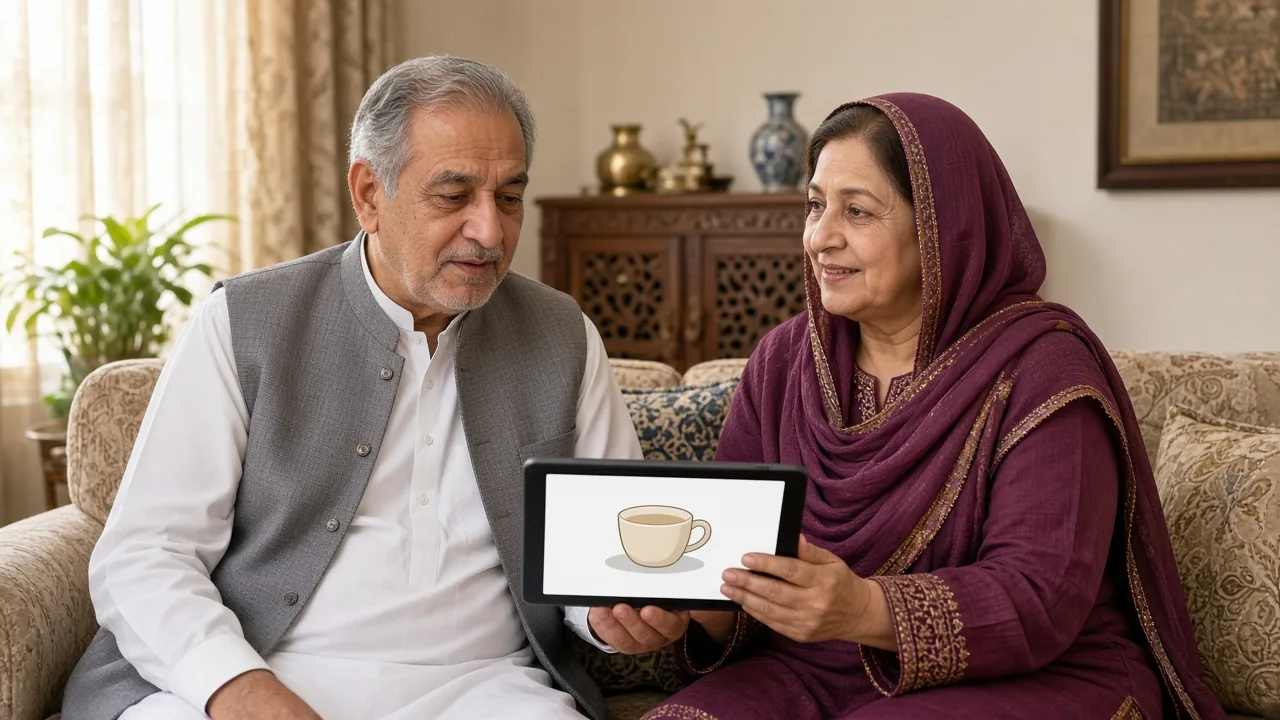
For families, the practical message is that an app can add valuable practice time, especially between visits, but a therapist is still needed to turn trained words into real conversation and to manage swallowing safely. Our guide to speech therapy after a stroke at home explains aphasia, dysarthria and swallowing in more detail.
What does the evidence say about speech therapy apps for children?
The evidence for children is thinner. A 2018 review of 132 children’s speech apps found none of excellent quality and only a minority likely to help. Some small studies show therapist-run digital activities can work as well as traditional materials, but we found no published trials of Urdu speech apps for children.
The most useful starting point is a 2018 review in PLOS ONE that searched the Google Play and Apple app stores between November 2016 and May 2017 for speech therapy apps for children. Out of more than 5,000 apps, 132 met the criteria for a full review. Two raters scored them on a standard app quality scale: none were rated excellent, 25 were good, 105 were average and 2 were poor. Only 19 were judged to have potential therapeutic benefit. The authors also noted that an app’s price did not always match its quality. The review is from 2018 and the app market has changed since, but the lesson still applies: popularity and polish do not guarantee that an app follows good therapy principles.
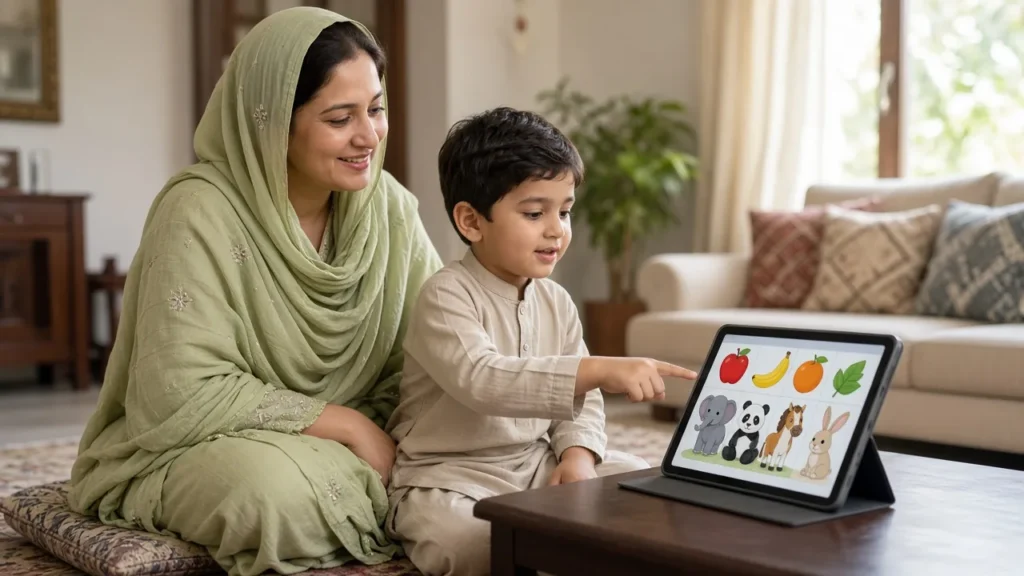
That does not mean apps are useless for children. It means the app has to be chosen for a clear goal and used with an adult, ideally guided by a therapist. The evidence from adult stroke trials should not be stretched to children, whose needs and development are different. And none of the trials we found tested Urdu-language apps. If you are unsure whether your toddler’s speech is on track, our guide on whether a child is a late talker or needs speech therapy explains what is typical at each age.
Is online video speech therapy the same as using an app?
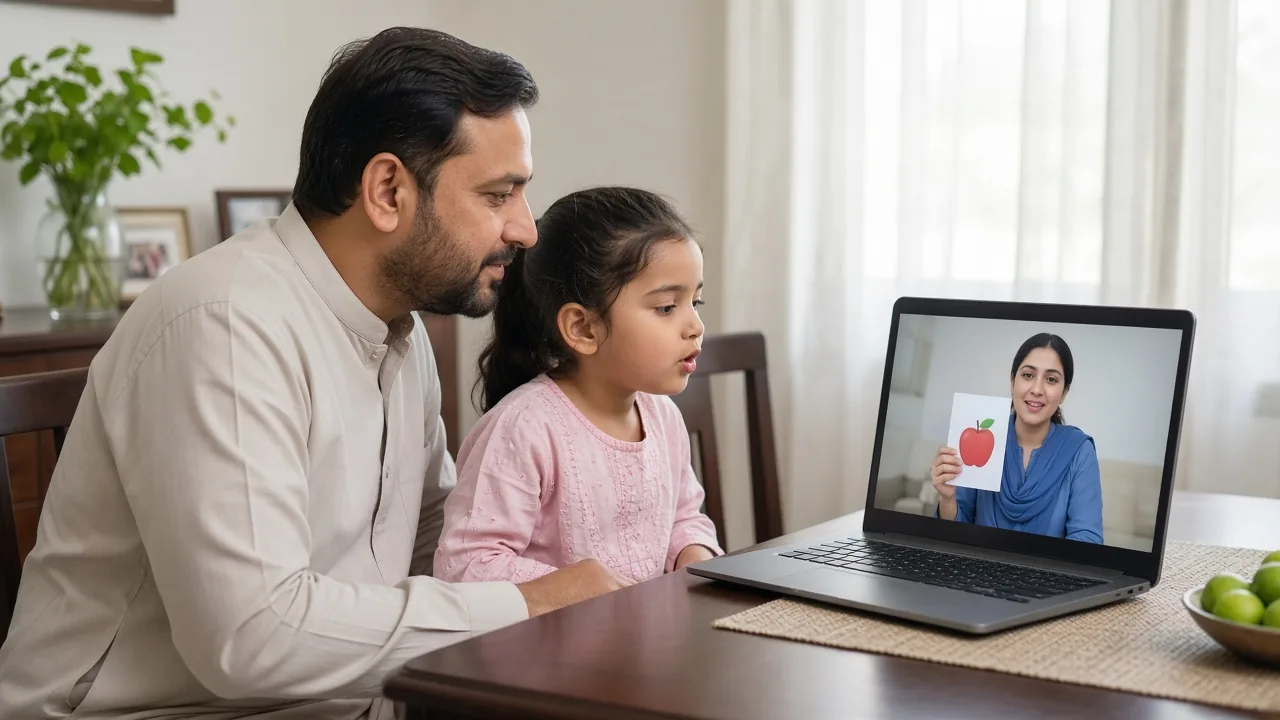
No. Online speech therapy is a live session with a qualified therapist over video, so it includes assessment, feedback and parent coaching. Research suggests it can work about as well as in-person therapy for many children, which is a different claim from saying an app works.
People often mix these up. With telepractice, the therapist is still doing the therapy; only the setting changes. A systematic review of telehealth speech and language therapy for primary school-age children found that children receiving therapy by telehealth and in person made significant and similar improvements on five of six outcome measures. The authors call the evidence limited but promising and ask for more rigorous studies.
The American Speech-Language-Hearing Association (ASHA) says therapists are responsible for making sure telepractice is safe, effective and equal in quality to in-person care, and that platforms protect client privacy. ASHA also asks therapists to consider whether telepractice suits each client, looking at physical and sensory, cognitive and behavioural, communication, and support and environmental factors. In practice, that means a child’s attention, comfort with a screen and the help of a parent or carer all matter.
Do speech therapy apps work in Urdu?
Most popular international apps do not offer Urdu as of November 2026. A small number of Pakistani tools do, mainly picture-card and AAC tools rather than full therapy programmes. For a child who hears Urdu at home, practising in English only can make an app less useful.
Language matters because children learn words from the people and routines around them. An app that teaches “apple” and “bus” in an American accent may not connect with a child who hears “seb” and “gaari” at home. We checked a few well-known and local tools on their official pages. The table below records what each says about itself, not our own testing.
| Tool | What it is (from its official page) | Urdu? | Cost shown on official site | Best used for |
|---|---|---|---|---|
| Speech Blubs | A speech practice app for children aged 1 to 8, with over 1,500 activities. Children watch and copy videos of other children; the app listens for words and rewards attempts. | No. English (US and UK) and 12 other languages, mostly European. | US$14.99 a month or US$59.99 a year, with a 7-day free trial. Store prices in Pakistan may differ. | Extra practice of sounds and first words for children learning English, alongside therapy. |
| Constant Therapy | Speech, language and thinking exercises for adults, for example after a stroke. The app adjusts difficulty to the person’s results. It was one of the platforms in the 2025 review. | No. English (US), English (India) and Spanish (US). | US$29.99 a month after a two-week free trial (US pricing). | Daily practice for English-speaking adults with aphasia, with a therapist setting goals. |
| My Avaaz | A web-based picture-and-word card board (AAC) for children with autism and special needs. Works on phones, tablets and computers. | Yes. Urdu audio, plus Sindhi and English after signing in. | Urdu audio is free without an account. No paid plan was listed. | Helping a child who speaks little to point and be heard in Urdu, alongside spoken language. |
| SLP Resource Hub | A Pakistani platform for therapists and parents: over 700 Urdu (Nastaliq) and English picture cards, AAC boards, screening forms and online sessions. | Yes. Urdu and English. | No prices shown on the home page. | Therapist-chosen Urdu and English practice materials. |
| Sitara AAC | An open-source hackathon project on GitHub that uses an AI model to adapt an AAC game for non-verbal autistic children in Pakistan. | Aimed at Pakistani children; language support not confirmed. | Code is public; not a finished app. | Not ready for family use. Shows where the field is heading. |
IRHC has no link with any of these tools and receives nothing for mentioning them. Features, languages and prices change, so check the official page before you pay. This is not a ranking or a recommendation for any individual child.
Two points stand out. First, the Urdu options available today are mostly AAC and picture-card tools, which support communication and vocabulary practice but are not complete therapy programmes. Second, the field is moving. a research project called Rehnuma, described as interactive companions for speech-delayed children, was presented at a 2025 international conference on children’s interaction design, and student projects such as Sitara are experimenting with AI. None of these has published evidence of effectiveness for children yet, so treat new claims with healthy caution.
Are apps helpful for autistic children who speak little?
Picture-based communication apps (AAC) can help some autistic children be understood, and research summarised by ASHA shows AAC does not stop children developing speech. They work best as part of a therapy plan, alongside spoken language and play, not as screen time on their own.
An AAC app is different from an entertainment or “learning” app. It gives a child a way to ask for water, say they are tired or choose a toy, by tapping a picture that speaks. Our guide to autism and speech therapy at home explains how AAC, signs and picture boards support communication and why they do not replace spoken words. A therapist can help choose the right vocabulary, set up the board, and coach the family to model it during daily routines. Tools with Urdu audio, such as My Avaaz, make this easier for families who speak Urdu at home.
How should families choose and use a speech therapy app?
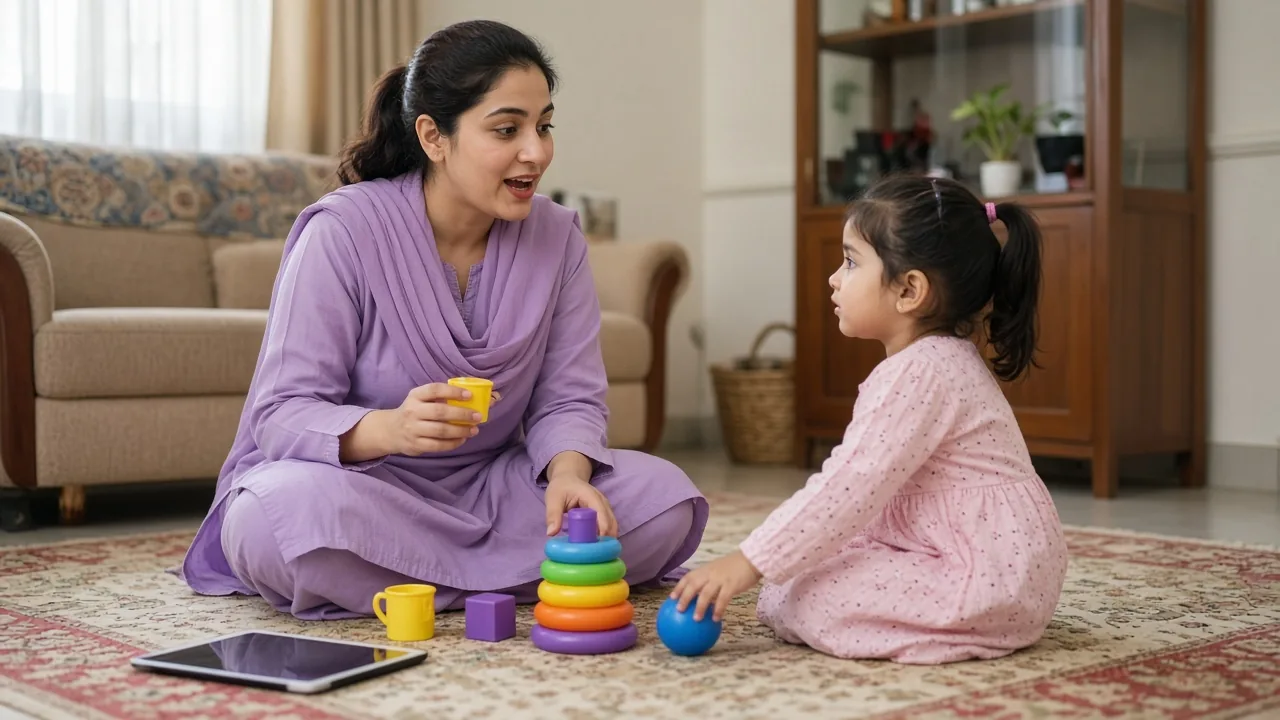
Choose an app with your therapist, use it for short sessions with an adult sitting alongside, and link what it practises to real conversations. Stop or change it if your child becomes frustrated, or if it does not match their goals.
- Start with an assessment. Know what your child or family member actually needs to work on before you pick a tool.
- Ask your therapist which app, if any. They can match it to the goals, the language spoken at home and the person’s attention span.
- Use it together. Sit with your child, copy the words, and talk about the pictures. Turn the screen off and use the same words at meals, bath time and play.
- Keep sessions short and regular. A short, focused session with you is worth more than a long one alone.
- Share progress. Show the therapist what your child is doing in the app so they can adjust the plan.
- Check the cost before the trial ends. Many apps start a paid subscription automatically after a free trial.
What about privacy and children’s voice data?
Many speech apps use the microphone to listen to your child, and some store recordings or usage data. Before you download, read the privacy policy, check what is recorded and where it goes, and avoid sharing your child’s recordings with general AI chatbots.
A child’s voice is personal data. Speech recognition features, such as an app that listens for a correct word and gives a star, process your child’s voice to work. That can be helpful, but families deserve to know what happens next. A short checklist:
- Read the privacy policy. Look for what is recorded, whether recordings are stored, who they are shared with, and how to delete them.
- Set up the account yourself, with a parent email, and avoid using your child’s full name or photo.
- Turn off features you do not need, such as sharing or social functions.
- Do not upload videos or voice notes of your child to a general AI chatbot for “assessment”. It cannot assess reliably, and you may lose control of the recording.
- When you stop using an app, delete the account as well as the app.
The same applies to online therapy. ASHA expects telepractice platforms to protect client privacy, so it is reasonable to ask any therapist which video platform they use.
When is an app not enough?
See a speech and language therapist rather than relying on an app if your child is not meeting speech milestones, loses words they used to say, stammers with distress, or if an adult has new speech or swallowing problems. Coughing or choking with food or drink needs prompt medical advice.
- a toddler who is talking much less than other children their age, or not understanding simple instructions;
- a child who loses words or skills they already had;
- stammering that is causing distress or avoidance;
- speech that is very hard for family members to understand;
- after a stroke, any coughing, choking or chest infections linked to eating or drinking;
- a voice change that lasts, which should also be checked by an ENT doctor.
Sudden new difficulty speaking or understanding in an adult can be a sign of stroke. Call 1122 or go to hospital immediately.
How can you get speech therapy in Islamabad, Rawalpindi or online?
IRHC provides speech and language therapy for children and adults at home in almost all areas of Islamabad and Rawalpindi, Monday to Sunday, and through online video sessions for families elsewhere. A therapist can also advise on apps that fit your goals.
According to our speech therapy page, IRHC therapists work with delayed speech and language, stammering, unclear speech, voice and swallowing problems, and communication needs linked to autism, stroke, cleft lip and hearing loss. Online sessions run on WhatsApp, Microsoft Teams, Zoom or another suitable app, so families looking for online speech therapy in Pakistan outside the twin cities can also work with the team. Families can also see the team at partner clinics in G-8 Markaz, Islamabad and Saddar, Rawalpindi. If you are already using an app, bring it to the first session so the therapist can see whether it fits the plan.
Want a therapy plan, with or without an app?
IRHC’s speech therapists visit homes in Islamabad and Rawalpindi, Monday to Sunday, and also offer online video sessions. Every booking is confirmed on WhatsApp. For fees, timings and payment methods, see our FAQs, or read more about our speech therapy service.
Book an appointment | WhatsApp 0300-6844361 | Call 051-8776556
Frequently Asked Questions
Quick answers to what families ask about speech therapy apps, AI tools and online therapy. For fees, timings and payment, see our FAQs page.
Can AI replace a speech therapist?
Not on current evidence. Apps and AI tools can give extra practice, but they cannot assess or diagnose a speech, language or swallowing problem, set goals for an individual, or adjust therapy the way a trained therapist does. Research supports apps as practice tools, not replacements.
Can a speech therapy app replace a therapist after a stroke?
No. A 2025 review of five trials found AI-assisted apps helped adults with aphasia practise more and improve the skills they trained, but the gains rarely transferred to everyday conversation. Those trials were all done in high-income Western countries. A therapist is still needed to turn practised words into real conversation and to manage swallowing safely.
Are speech therapy apps good for toddlers with speech delay?
They can help with practice if an adult sits with the child and turns the app into a conversation. A 2018 review of 132 children’s speech apps found none of excellent quality and only a minority with likely therapeutic benefit. A toddler with speech delay should have a proper assessment first.
Are speech therapy apps helpful for autistic children who speak little?
Picture-based communication apps (AAC) can help some autistic children be understood, and they do not stop children developing speech. They work best as part of a therapy plan, alongside spoken language and play, not as screen time on their own. A therapist can help choose the vocabulary and show the family how to use the board in daily routines.
Is there a speech therapy app in Urdu?
As of November 2026, a few Pakistani tools offer Urdu. My Avaaz has free Urdu audio for its AAC picture board, and SLP Resource Hub has Urdu and English picture cards. Popular international apps such as Speech Blubs and Constant Therapy do not list Urdu. We found no published trials of Urdu speech apps for children.
Is online speech therapy effective?
Online speech therapy by video with a live therapist is different from an app. A systematic review of school-age children found that telehealth and in-person therapy led to similar improvements on most measures, although the evidence was limited. ASHA expects online therapy to match the quality of in-person care.
Can ChatGPT or an AI chatbot help with my child’s speech?
A chatbot can suggest general ideas, but it cannot hear your child properly, diagnose a problem or know whether advice suits your child. It may also give wrong information confidently. Avoid uploading your child’s voice recordings or personal details unless you know how they will be used.
Are speech therapy apps safe for my child’s privacy?
It depends on the app. Many use the microphone to listen to your child. Read the privacy policy, check whether recordings are stored or shared, use a parent account, turn off features you do not need, and delete the account when you stop using it.
How much does speech therapy cost at IRHC?
A first or single speech therapy home visit is Rs 3,000. Packages are discounted: 10% off 5 sessions and 15% off 10 sessions. Payment is made in advance by Easy Paisa, JazzCash, U Paisa, Raast ID, bank transfer or cash.
How long is a speech therapy session?
A standard speech therapy session at your home lasts 45 minutes. Home visits run Monday to Sunday, 9 am to 9 pm, in almost all areas of Islamabad and Rawalpindi.
Does IRHC offer online video speech therapy?
Yes. Speech therapy is also available through online video sessions on WhatsApp, Microsoft Teams, Zoom or another suitable app, which suits families outside Islamabad and Rawalpindi. Call 051-8776556 (9 am to 6 pm) or WhatsApp 0300-6844361 to arrange one. Every booking is confirmed on WhatsApp.
Disclaimer: This article is for general information only and does not replace an assessment by a qualified speech and language therapist or doctor. App names, features, languages and prices are taken from each tool’s official website in November 2026 and may change; IRHC is not affiliated with any app mentioned. If an adult suddenly has trouble speaking or understanding, call 1122 immediately.