
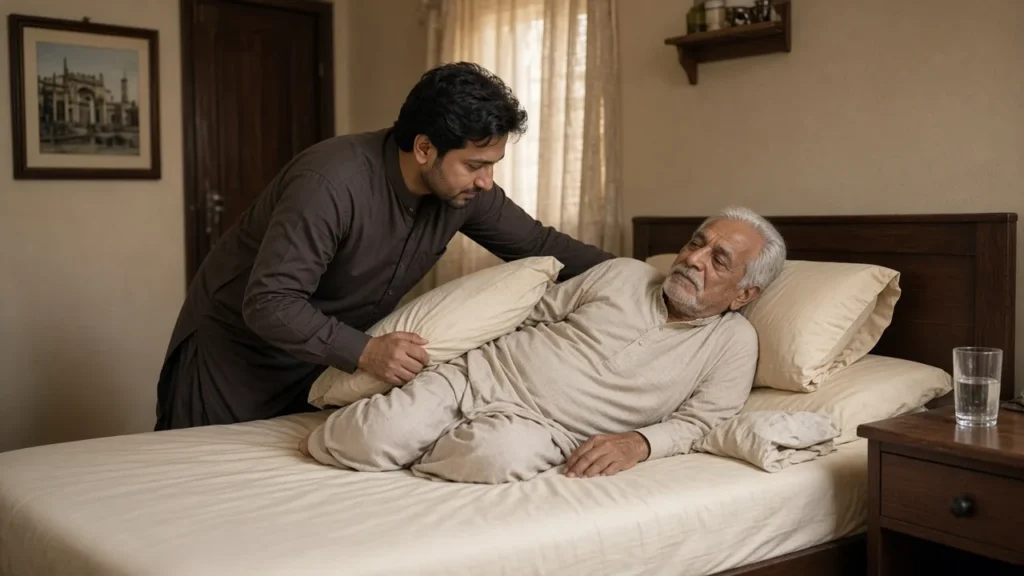
Short answer: How to prevent bedsores in a bedridden patient at home comes down to four habits. Change the patient’s position at least every two hours, or as the doctor or nurse advises. Keep the heels, hips and tailbone off hard pressure with pillows and a suitable mattress. Check the skin every day. Keep it clean, dry and well fed. Never rub or massage a red patch. A red patch that does not fade, a blister, an open sore, pus, a bad smell or a fever needs a doctor. Families in Islamabad and Rawalpindi can arrange a home nurse with IRHC.
This guide is general information. It is not medical advice and does not replace an examination by a doctor or a nurse who has seen the patient.
Listen to a short overview
49 seconds · a spoken conclusion of this guide. It does not replace your doctor’s advice.
Key takeaways
- Bedsores form where bone presses on skin for too long, mostly at the heels, hips, tailbone, elbows and shoulder blades.
- Turn at least every two hours, tilt about 30 degrees, and keep the heels floating with a pillow under the calves.
- Look at the skin every day. A patch that stays red or purple when you press it is a warning sign.
- Do not massage red skin, use ring cushions, or drag the patient across the sheet.
- A home nurse can look after bedbound patients and teach the family. See home nursing at IRHC in almost all areas of Islamabad and Rawalpindi.
In this guide
- What bedsores are and why they form
- Who is most at risk
- The daily routine
- How often to turn the patient
- Positions and pillows
- Daily skin checks
- Mattresses and cushions
- Keeping skin clean and dry
- Food and drink
- Bedsore stages (table)
- A red patch: what to do
- What to avoid
- When to call a doctor
- Turning day and night as a family
- Home nursing in Islamabad and Rawalpindi
- FAQs
It is late, your father is finally comfortable, and you hesitate to wake him just to turn him. Most families caring for a bedridden parent have been there. The trouble is that skin can start to break down within hours when it stays pressed against a bed. This guide explains how to prevent bedsores in a bedridden patient at home, what to check every day, and when a red patch needs a doctor.
What are bedsores, and why do they form in bedridden patients?
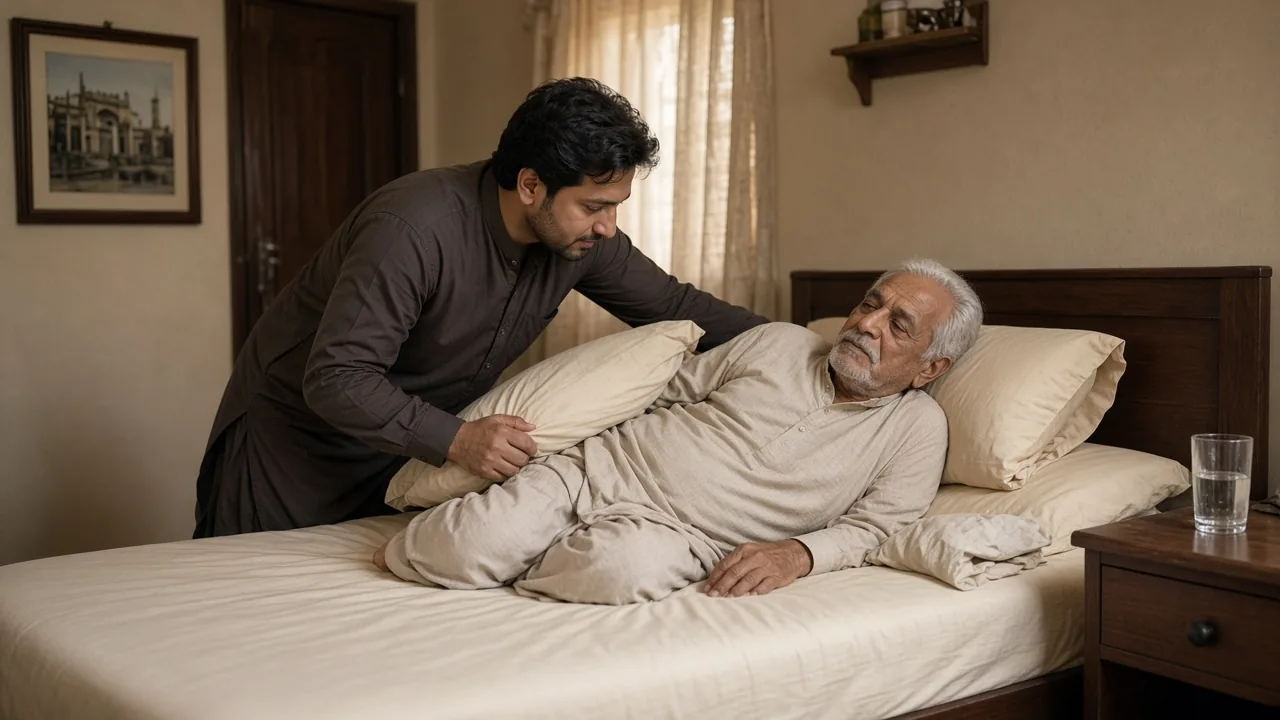
Bedsores, also called pressure sores or pressure ulcers, are damage to the skin and the tissue under it. They form when pressure, rubbing or sliding cuts off blood flow to skin over a bony area.
The Mayo Clinic names three causes. Pressure from lying in one place reduces blood flow, so the skin gets less oxygen. Friction is skin rubbing on sheets or clothes, worse when the skin is damp. Shear happens when the skin stays put while the body slides, for example when the head of the bed is raised and the patient slips down. Pressure sores in bedridden patients can appear slowly, but the NHS notes they can sometimes show up within a few hours. Left alone, they can turn into blisters and open wounds that reach deeper layers.
Who is most at risk, and where do bedsores start?
Anyone who cannot easily change position is at risk: people after a stroke, a fracture or surgery, with dementia or a long illness, and many older adults. Bedsores start over bony areas such as the heels, tailbone, hips, shoulder blades and elbows.
The NHS lists these things that raise the chance: trouble moving, a previous pressure sore, a recent serious illness or surgery, being underweight, swollen, sweaty or broken skin, poor circulation, and reduced feeling. Mayo adds leaking urine or stool, poor nutrition and fluids, diabetes and being over 70. So if you are wondering how to prevent bedsores in elderly parents, the answer starts here: the more of these that apply, the more closely you need to watch.
Where to look, for a patient who stays in bed:
- Heels and ankles
- Tailbone and lower back
- Hips
- Shoulder blades and spine
- Elbows, the back of the knees and the back of the head
- Ears, if the patient lies on one side
A patient who has just come home from hospital often fits several of these at once. Our guide to home nursing after hospital discharge covers the rest of that first week.
How to prevent bedsores in a bedridden patient at home: the daily routine
Change position often, protect the heels and bony areas, check the skin every day, keep it clean and dry, and keep up food and fluids. Each step is explained below.
Bedsore prevention at home is mostly small habits, repeated every day. Here is the whole routine in one place:
- Turn or reposition at least every two hours, or on the schedule your doctor or nurse gives you.
- Use pillows to keep the heels off the bed and stop knees and ankles pressing together.
- Check the skin from head to toe once a day, and at every wash or pad change.
- Keep skin clean and dry, and change damp sheets, clothes and pads promptly.
- Feed and hydrate well, with help at mealtimes if needed.
- Tell the doctor or nurse about any new red patch, blister or sore, without waiting.
How often should you turn a bedridden patient?
At least every two hours is the usual starting point. Some patients need it more often, and your nurse or doctor can set a schedule, including for the night.
The MedlinePlus advice is to change position every 1 to 2 hours, and Mayo suggests every two hours. The National Pressure Injury Advisory Panel says the right gap depends on the mattress, how well the skin tolerates pressure and what the patient prefers, and that the night schedule can sometimes be longer so the patient can sleep. Do not stretch the gap on your own. Let the doctor or nurse decide, and turn more often if there is any redness.
A simple pattern to follow through the day, for a patient in bed:
- On the back, with a pillow under the calves.
- Tilted to the left side, about 30 degrees.
- Back again.
- Tilted to the right side, about 30 degrees.
If the patient spends part of the day in a chair or wheelchair, change position more often, about every hour for someone who cannot shift their own weight. MedlinePlus suggests a weight shift every 15 to 20 minutes in a wheelchair.
Which positions and pillows protect the heels, hips and tailbone?
Tilt the patient about 30 degrees onto the side, not straight onto the hip bone. Put a pillow under the calves to lift the heels, and a pillow between the knees and ankles. Keep the head of the bed low unless the patient is eating.
- Lying on the side: a pillow behind the back to hold the tilt, and one between the knees and ankles so the bones do not press on each other. The NPIAP suggests checking with your hand that the tailbone area is off the bed.
- Lying on the back: a pillow under the calves so the heels float. Do not put the pillow under the knees, as MedlinePlus warns it presses on the heels.
- Head of the bed: no higher than about 30 degrees, except for meals. A steeper angle makes the patient slide down and pulls at the skin on the tailbone. If the patient has breathing, swallowing or feeding-tube needs, follow the doctor’s advice on how high to raise the head.
- Moving the patient: lift, do not drag. A folded cotton sheet placed under the patient can work as a draw sheet to help with lifting. Ask a nurse to show you, and get a second person to help. Do not try to lift an adult alone.
If the patient can still move a little, a home physiotherapist can show safe ways to shift in bed and sit up.
How do you check the skin every day?
Look at the whole body once a day, head to toe, with good light. Press any red or dark patch gently. If it stays red, purple or blue after you let go, it is a warning sign.
MedlinePlus recommends a daily head-to-toe check by the patient or the caregiver, with extra attention to the heels, ankles, hips, tailbone, elbows, shoulder blades, back of the head and ears. The easiest time is during a wash or a pad change, so it becomes a habit. Use daylight or a phone torch, and look at:
- Colour: red on lighter skin, or purple, blue or darker than the skin around it on brown or black skin (NHS).
- Feel: warm, hard or spongy compared with the skin next to it.
- Pain: a spot that is sore or itchy, or that the patient flinches from.
- Breaks: a blister, a scrape or an open patch.
Redness is harder to see on darker skin, so also compare the temperature and firmness with the skin next to it. The NPIAP gives the same advice for darker skin tones: look for changes in tone, warmth and texture.
Do you need a special mattress or cushion?
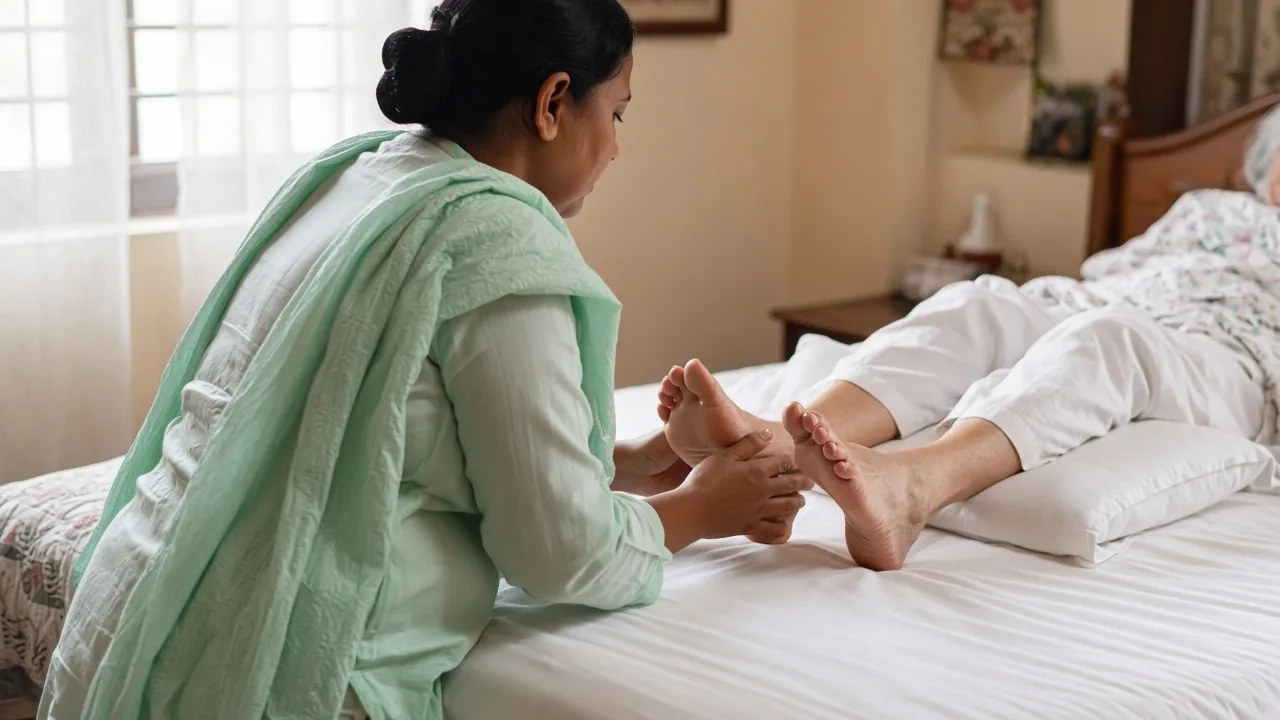
It helps a lot, especially for a patient who is in bed most of the day. A pressure-relieving foam, gel or air mattress spreads the weight better than a standard mattress, but you still need to turn the patient.
The NHS lists specially designed mattresses and cushions as part of prevention, and MedlinePlus mentions foam, gel or air-filled mattresses. The NPIAP is clear that repositioning continues on any support surface. A few practical points for families here:
- Ask first. A doctor or nurse can tell you which type suits the patient’s weight and risk. Mattresses and cushions are usually bought from medical equipment suppliers.
- Check it every time. For an air mattress, check that it is inflated and the pump is running. If power cuts are frequent where you live, ask the supplier or nurse what to do when the pump stops.
- Keep the heels free with a pillow under the calves even on a special mattress.
- No ring cushions. Mayo advises against doughnut-shaped cushions, as they put pressure on the tissue around the ring.
How do you keep the skin clean and dry?
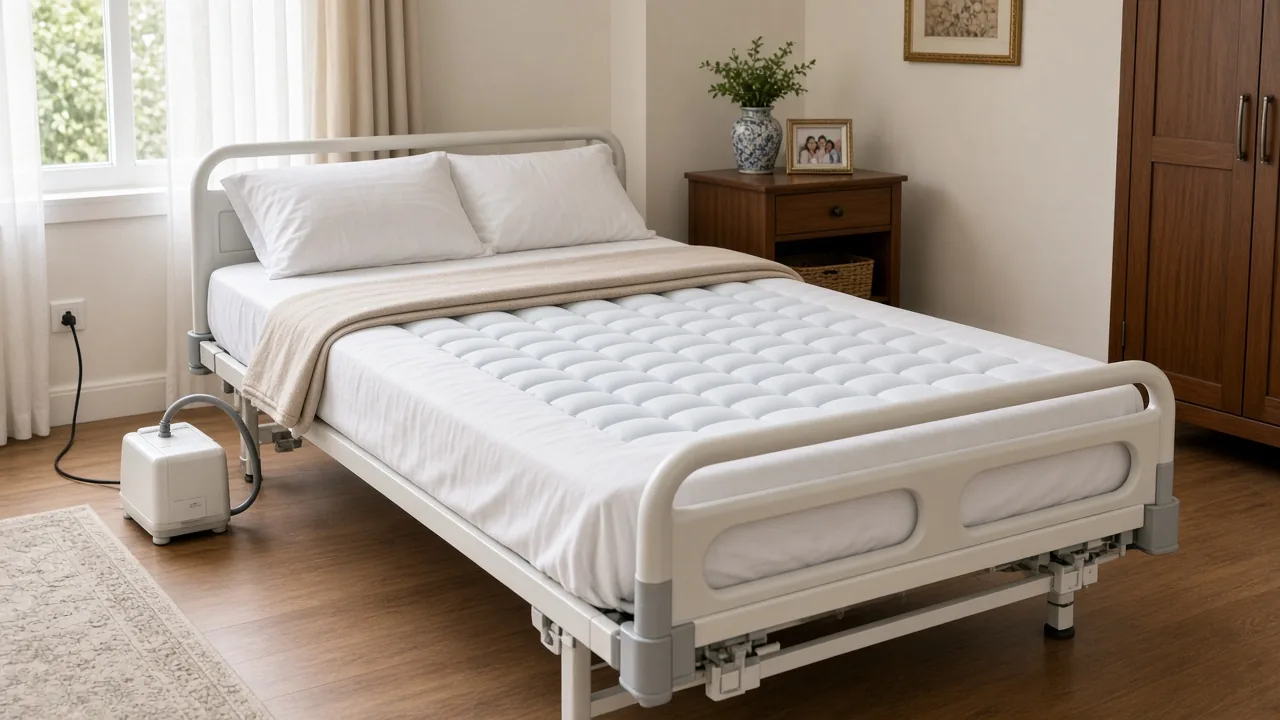
Wash gently with a mild cleanser, pat dry, clean up straight away after urine or stool, and change damp sheets, clothes and pads promptly. Keep the bedding smooth and free of wrinkles and crumbs.
- Be gentle. Use a soft cloth, do not scrub, and avoid strong soaps and talc powder (MedlinePlus). A full wash does not have to happen every day, but soiled skin should be cleaned at once.
- After toileting or leaks, clean right away and dry well. Mayo suggests a barrier cream to protect skin from urine and stool. Ask your nurse or doctor which one to use.
- Dry skin can be moisturised daily, as the NPIAP advises.
- In hot weather, sweat is as much of a problem as leaks. Choose light cotton clothes and change damp clothes and sheets quickly. Summers in the twin cities are hot, so this matters more.
- Bedding: keep the sheet smooth and tight. Take away crumbs, pins or anything hard from the bed. Avoid clothes with thick seams, zips or buttons under the patient.
One more rule: do not massage red skin or bony areas. It can add damage to skin that is already under strain.
What should a bedridden patient eat and drink?
Enough fluids, calories and protein help skin stay healthy. Offer small, regular meals and drinks, and help with eating if needed. If the patient has a medical diet or fluid limits, follow the doctor’s advice.
Mayo lists fluids, calories, protein, vitamins and minerals as part of keeping skin healthy, and MedlinePlus says to eat enough calories and protein and to drink plenty of water. The NPIAP also suggests helping patients at mealtimes and getting advice from a dietitian if the patient is losing weight or not eating enough. At home, this can be as simple as daal, eggs, yogurt, milk, chicken or fish, soft roti and water through the day.
Some patients cannot follow general advice. If the patient has diabetes, kidney or heart disease, or limits on fluids, ask the doctor before changing the diet. If chewing or swallowing is hard, tell the doctor, and do not force food or drink.

What do bedsore stages look like, and what should you do?
Doctors describe four stages. Stage 1 is red skin that is not broken. Stage 2 is a blister or shallow open patch. Stages 3 and 4 are deeper sores. A doctor or nurse decides the stage, but you can use the table to know when to call.
The earlier a bedsore is found, the simpler it is to manage. Stage 1 can be missed if nobody looks.
| Stage | What you may see | What to do |
|---|---|---|
| Stage 1 (earliest) | Skin is not broken, but a patch looks red, or purple or blue on darker skin, and stays that colour when you press it. It may feel warm, hard or spongy, or be sore or itchy. | Take all pressure off the area. Do not rub or massage it. Keep it clean and dry and tell the doctor or nurse. If it has not improved in 24 to 48 hours, call your doctor. |
| Stage 2 | A blister, or a shallow open patch where the top layer of skin has come away. | Keep pressure off. Do not burst a blister and do not put creams, powders or home remedies on it. Ask a doctor or nurse to look at it and dress it. |
| Stage 3 | A deeper open sore that goes through the skin into the tissue beneath. | Needs medical care. Contact a doctor promptly. A nurse can then do the dressings as the doctor advises. |
| Stage 4 | A very deep sore that can reach muscle or bone. | Needs urgent medical care. The patient may need to be seen in hospital. |
| Any stage with signs of infection | Warm, swollen or spreading red skin around the sore, pus, a bad smell, pain that is getting worse, or fever. | Do not wait. Contact a doctor the same day or go to the nearest hospital. Go to hospital first if the patient is confused, shivering or breathing fast. |
Mayo warns that infected bedsores can lead to cellulitis and, rarely, to bone infection or sepsis, which is why signs of infection are never a wait-and-see matter.
Can bedsores be treated at home? What to do for a red patch
For bedsore treatment at home, only a red patch with unbroken skin can be handled at home, and only by taking pressure off it and telling the doctor or nurse. A blister or open sore needs a doctor or nurse to assess it.
If you see a red patch that does not fade when you press it:
- Take the weight off it. Reposition the patient so they are not lying on that spot, and do not lie them on it again.
- Do not rub or massage it.
- Keep it clean and dry, and keep the area free of wrinkles and crumbs.
- Turn more often, and check whether the mattress and pillows are doing their job.
- Tell the doctor or nurse. Mayo says to call if the area has not improved within 24 to 48 hours. MedlinePlus says to call if redness or a skin change lasts more than a few days or becomes painful, warm or starts to drain pus.
The NHS lists dressings, cleaning, creams, specially designed mattresses and, if infected, antibiotics as the treatments a doctor may use. Those decisions depend on the sore, so please do not start any of them on your own.
What should you avoid?
Avoid massaging red skin, ring cushions, dragging the patient across the sheet, pillows under the knees, and putting pastes, oils, powders or other home remedies on an open sore.
- Massage: do not rub or massage red skin or bony areas.
- Ring or doughnut cushions: they put pressure on the tissue around the ring.
- Dragging: sliding the patient on the sheet pulls at the skin. Lift or use a draw sheet.
- A pillow under the knees: it pushes the heels down onto the bed.
- Leaving the patient on a red spot: keep the weight off any red area.
- Home remedies on open sores: pastes, oils, powders and similar products can trap dirt or irritate. Let the doctor or nurse advise on what goes on a sore.
- Waiting: if you are unsure, ask early. A phone call costs less than a deep wound.
When should you call a doctor or go to hospital?
Call a doctor for any blister, open sore, or red patch that does not improve. Get help the same day for signs of infection: warm, swollen or spreading red skin, pus, a bad smell, fever or worsening pain.
Contact a doctor soon if:
- A red patch has not improved after 24 to 48 hours of taking the pressure off.
- There is a blister, a scrape or an open sore, even a small one.
- The skin is a dark purple or black patch, or feels hard or spongy.
Get medical help the same day if you notice:
- Fever or shivering.
- Pus, or drainage with a bad smell.
- Skin around a sore that is hot, swollen or turning redder, or pain that is getting worse (these follow NHS and Mayo advice).
- The patient is confused, very drowsy or breathing fast. Go to hospital first.
For chest pain, breathing difficulty, heavy bleeding, sudden weakness or loss of consciousness, call emergency services or go to a hospital first.
How can a family keep up turning day and night?
Make it a shared routine. Write the turning times on a chart or set phone alarms, split the night between two people, and ask a nurse to show everyone the safe way to turn and lift.
- Write it down. A sheet on the wall with times and positions (back, left, right) and who did it, helps when several people share the care.
- Use alarms. A phone alarm every two hours is easier than trying to remember.
- Share the night. One person cannot turn a patient every two hours for weeks. Split the shifts, and ask the doctor or nurse whether a longer gap at night is safe for this patient.
- Learn the technique together. Everyone who helps should know how to lift without dragging and how to place the pillows.
- Protect your own back. Lower the bed head before moving the patient, and get help for heavier lifts.
- Know when to get help. If the family is exhausted, extra help for some of the hours is worth considering.
Home nursing for bedbound patients in Islamabad and Rawalpindi: how IRHC helps
IRHC’s registered nursing staff visit homes in almost all areas of Islamabad and Rawalpindi, Monday to Sunday. For bedbound patients, care includes washing, dressing, eating, changing position and moving safely, and wound care as the doctor advises.
Our home nursing service can be booked by the hour, by 12-hour or 24-hour shift, or monthly. A 24-hour shift covers day and overnight care. The care plan is agreed with the family at the start and reviewed as needs change, and our nursing staff can show family members how to help safely between visits. Female nurses are available for female patients on request. Nurses work from the treating doctor’s advice. They do not replace it, and no one can promise that a bedsore will never form.
What to expect and how to book:
- Care for bedbound patients: washing, dressing, eating, changing position and moving safely.
- Wound care: dressings for wounds, including pressure sores, as advised by the patient’s doctor, and the nurse tells the family if a doctor should see it.
- Vital signs and other nursing tasks: blood pressure, pulse and temperature, injections and other tasks as prescribed.
- Other options: partner clinics in G-8 Markaz, Islamabad and Saddar, Rawalpindi, by appointment, or an online video nursing consultation.
If you want help with how to prevent bedsores in a bedridden patient at home, a nurse can do the care and also teach your family the routine. Not sure what the difference is between a nurse and a patient attendant? Read what a home nurse does. To book, call 051-8776556 (9 am to 6 pm), WhatsApp 0300-6844361 (answered 24/7) or use the online appointment form. Tell us the patient’s age and condition, what the doctor has advised, the care needed, your area and the days you need us. Keep discharge papers and prescriptions ready for the first visit. Not sure we cover your area? Send your location on WhatsApp and we will confirm before booking. Fees depend on distance and time, so we give a quote. See our FAQs for payment methods.
Caring for a bedridden family member?
Need help with how to prevent bedsores in a bedridden patient at home? IRHC arranges home nursing in Islamabad and Rawalpindi, Monday to Sunday. Our team confirms every booking on WhatsApp. For fees, timings and payment methods, see our FAQs, or read more about our home nursing services.
Book an appointment | WhatsApp 0300-6844361 | Call 051-8776556
Frequently Asked Questions
Quick answers to what families ask most about bedsores at home. For fees and payment, see our FAQs page.
How often should a bedridden patient be turned?
At least every two hours is the usual starting point. Some patients need it more often, for example if a red patch has appeared or the mattress is basic. Ask the doctor or nurse for a schedule that fits the patient, including a plan for the night.
What is the best position for a bedridden patient to prevent bedsores?
Lying on the side, tilted about 30 degrees with a pillow behind the back and a pillow between the knees and ankles, is better than lying flat on the hip. On the back, put a pillow under the calves so the heels do not touch the bed. Change between positions through the day and night.
How can I prevent bedsores in elderly parents at home?
Use the same habits: change position often, check the skin every day, keep it clean and dry, and keep up food and fluids. Older skin is thinner and more fragile, so be extra gentle and lift, do not drag, when moving them.
Can bedsores be treated at home?
Only the very earliest stage, a red patch with unbroken skin, can be managed at home, and only by taking all pressure off it and telling the doctor or nurse. An open sore, a blister or any sign of infection needs a doctor or nurse. They decide on dressings and treatment.
Should I massage a red patch of skin?
No. Do not rub or massage reddened skin or bony areas. It can damage skin that is already under strain. Take the pressure off the area instead and ask the doctor or nurse to check it.
Does an air mattress replace turning the patient?
No. A pressure-relieving mattress or cushion helps, but the patient still needs to be repositioned, and the heels still need to be kept off the bed. Check that the mattress and pump are working each time you use them.
Can a home nurse help prevent bedsores?
Yes. At IRHC, registered nursing staff look after bedbound patients, including washing, dressing, eating and changing position, and they can show the family how to help safely between visits. They follow the treating doctor’s advice and cannot guarantee that a sore will never form.
How much does home nursing cost in Islamabad or Rawalpindi?
At IRHC there is no fixed price for home nursing. Fees depend on distance and time, so we quote when you call or WhatsApp with your area and the care needed. A nurse can be booked by the hour, by 12-hour or 24-hour shift, or monthly. Payment is in advance, once the booking is confirmed, by Easy Paisa, JazzCash, U Paisa, Raast ID, bank transfer or cash.
How do I book a home nurse in Islamabad or Rawalpindi?
Call 051-8776556 (9 am to 6 pm), WhatsApp 0300-6844361 (answered 24/7), or use the online appointment form. Home nursing runs Monday to Sunday in almost all areas of both cities, and every booking is confirmed on WhatsApp. Female nurses are available for female patients on request.
Medical disclaimer: This article is for general information only and does not replace an examination by a doctor or the advice of a nurse who has seen the patient. Every patient is different, and no routine can promise that a bedsore will never form.