Short answer: Cerebral palsy exercises at home usually combine gentle stretching, strengthening through play, good sitting and standing positions, and walking or movement practice, done little and often by parents. They cannot cure cerebral palsy, but they help a child stay as strong, flexible and independent as possible. A 2024 trial from Islamabad found that children whose parents gave a trained home programme for 12 weeks improved on motor tests, and that adding gentle massage lowered muscle stiffness. The programme should be planned and checked by a physiotherapist who has assessed your child. Families in Islamabad and Rawalpindi can book a physiotherapist to visit at home with IRHC.
This guide is general information. It is not medical advice and does not replace an assessment by your child’s doctor or a qualified physiotherapist.
Listen to a short overview
53 seconds · a spoken summary of this guide. It does not replace advice from your child’s doctor or physiotherapist.
Key takeaways
- There is no cure for cerebral palsy. Home exercise is about strength, flexibility, comfort and independence, not a fix.
- An Islamabad trial of 68 children found motor gains in both groups after 12 weeks of parent-led home exercise, and less stiffness when gentle massage was added. It was one trial, with limits.
- The best home programme is one set for your child, built into daily routines, and reviewed regularly.
- Pain, a stiff or painful hip, feeding problems or losing skills need a doctor’s review.
- IRHC physiotherapists visit children at home in almost all areas of Islamabad and Rawalpindi, Monday to Sunday. See home physiotherapy.
In this guide
- What exercise can and cannot do
- The Islamabad trial (table)
- What wider research says
- Which cerebral palsy exercises at home are usually part of a programme?
- Fitting it into family life
- What a home physiotherapist adds
- Common mistakes
- When to get help
- Physiotherapy for children in Islamabad and Rawalpindi
- FAQs
Search for cerebral palsy treatment in Pakistan and you will quickly find the word ilaj, often next to promises that sound too good to be true. Most parents are not looking for miracles. They want to know what they can do at home, every day, that will actually help their child. This guide looks at cerebral palsy exercises at home honestly: what a recent trial run in Islamabad found when parents delivered a home programme, what it did not prove, and why a physiotherapist’s assessment is what turns a list of exercises into a plan that fits your child.
What can exercise realistically do for a child with cerebral palsy?
Exercise cannot cure cerebral palsy, but it is one of the most important treatments. It helps keep muscles strong, stops them shortening into painful contractures, and supports a child to be as active and independent as possible.
Cerebral palsy is a group of lifelong conditions affecting movement and coordination, caused by a problem in the developing brain before, during or soon after birth. The NHS says there is currently no cure, and describes physiotherapy as one of the most important treatments. Its main goals are to increase strength and stop muscles becoming weak, and to prevent contractures, where muscles shorten and lose their range of movement. Contractures can be painful and affect how bones and muscles grow.
The injury in the brain does not get worse, but a growing body can still run into trouble: stiff muscles pull on joints, and a child who sits in one position all day can lose movement over time. That is why home practice matters. A weekly therapy visit is a small slice of a child’s week. What happens at home, on the other days, decides much of the result.
Spastic cerebral palsy and GMFCS levels, in plain words
In spastic cerebral palsy, some muscles are stiff and tight. When it mainly affects the legs it is called spastic diplegia, the type studied in the Islamabad trial. Doctors and physiotherapists also describe a child’s movement with the Gross Motor Function Classification System (GMFCS), from level I to V. As the trial paper explains, levels I to III describe children who walk, with or without aids, and levels IV and V describe children who do not walk. Knowing your child’s level helps you read research and set realistic goals.
What did the Islamabad trial on home exercise programmes find?
In a randomised trial of 68 children with spastic diplegia, both groups improved on gross motor tests after 12 weeks of parent-delivered home exercise. The group that also received gentle massage had significantly less muscle stiffness than the exercise-only group, but no better motor scores.
The study was published in 2024 in the Journal of Pediatric Rehabilitation Medicine by researchers from Riphah International University and the National Institute of Rehabilitation Medicine in Islamabad. You can read the full open-access paper. The trial ran from November 2021 to June 2022, and the starting point is familiar to many Pakistani families: the authors note that daily hands-on physiotherapy by qualified professionals is not always feasible, available or affordable for every child, so they tested whether trained parents could carry a simple programme at home.
| Question | What the paper reports | What it means for parents |
|---|---|---|
| Who took part? | 68 children aged 4 to 12 with spastic diplegia (stiffness mainly in the legs), referred to a physiotherapy department and randomly split into two groups of 34. Children with fixed contractures, deformities, uncontrolled seizures, severe learning disability or behavioural conditions were excluded. | The results apply most closely to school-age children with this type of cerebral palsy. They may not apply to babies, teenagers or children with more complex needs. |
| What did families do? | Parents gave a simple home exercise programme for 30 minutes a day, 5 days a week, for 12 weeks: stretching, strengthening, handling, positioning and walking practice. | This is a real daily commitment. The programme was planned and taught by professionals, not improvised. |
| What was added for one group? | A 30-minute gentle oil massage before the exercises: light, slow strokes along the arms, legs, chest and back, with no deep pressure or kneading. | This is not the same as vigorous traditional maalish. Ask your physiotherapist before adding massage. |
| How were parents prepared? | Supervised hands-on practice, written handouts, pictures and video recordings. | Good training mattered enough that the authors built it into the study design. |
| How was progress measured? | Muscle stiffness (Modified Ashworth Scale), gross motor skills (GMFM-88) and motor level (GMFCS), at the start, 6 weeks and 12 weeks, by assessors who did not know each child’s group. | These are standard clinical tools. Your physiotherapist may use the same ones. |
| Main finding on stiffness | The massage-plus-exercise group had significantly lower stiffness scores than the exercise-only group at 6 and 12 weeks. | Gentle massage, added to exercise, may help with stiffness. One trial is not proof. |
| Main finding on movement | Gross motor scores and GMFCS levels improved from the start to 12 weeks in both groups, with no significant difference between the groups. | Children in both groups improved, but there was no group without exercise, so the study cannot show how much of the change came from the programme itself. |
The home programme itself was practical. Spastic muscles were stretched to the point of gentle discomfort and held for 30 seconds, five times a session. Weak muscles were given resistance exercises, 10 repetitions each. Parents were shown how to seat their children on a bench or block with legs apart and both heels on the ground, with a straight back, and to avoid scissoring and W-sitting on the floor. Standing against a wall with the legs apart for 15 minutes was also advised. Three children in the exercise-only group and two in the massage group dropped out, mainly because of travel from distant areas, loss of interest, phone problems or surgery.
What the trial does not tell us
Results like these are encouraging, but they need careful reading:
- There was no group without exercise. Both groups did the home programme, so the study cannot separate the effect of exercise from normal development or the effect of being assessed repeatedly. It shows that children improved while doing it.
- It is one trial, in one setting. The authors themselves say the results cannot be generalised beyond ages 4 to 12, and that the amount and quality of exercise parents actually gave was outside the researchers’ control.
- Some children were left out. Children with fixed contractures, deformities, uncontrolled seizures or severe learning disability were excluded, so the findings may not apply to them.
- The massage was specific. It was light, slow and superficial, with no deep pressure or kneading. Vigorous traditional maalish was not what was tested.
The authors also make a point that matters for families here: home programmes work best when caregivers are well trained and receive regular follow-up, including by phone. They note that clinical guidelines on the right intensity and frequency of home exercise do not yet exist.
What does wider research say about home programmes for cerebral palsy?
Large reviews list home programmes, goal-directed training, strength training and task-specific practice among the allied health approaches with good evidence for children with cerebral palsy. Guidelines stress programmes tailored to each child’s goals and reviewed regularly.
A 2020 systematic review by Novak and colleagues graded the evidence for cerebral palsy treatments. Among allied health interventions it judged effective were home programmes, goal-directed training, strength training, task-specific training, mobility training and weight-bearing. The Islamabad trial fits into that picture rather than standing alone.
NICE’s guideline on spasticity in children and young people gives practical rules that match what good physiotherapists do. It recommends a programme tailored to the child’s needs and aimed at specific goals, such as building everyday skills or preventing pain and contractures. It asks professionals to consider whether parents can deliver the therapy and what training they need. It encourages building therapy into daily life, giving the example of standing at the sink while brushing teeth to stretch the leg muscles. And it recommends reassessing the programme at regular intervals.
Which cerebral palsy exercises at home are usually part of a programme?
Most home programmes mix gentle stretching, strengthening through play, good sitting and standing positions, and walking or movement practice. Which ones your child needs, how many and how often should come from a physiotherapist who has assessed them.
The groups below reflect what the Islamabad programme and the guidelines describe. They are examples to discuss with your child’s physiotherapist, not a programme to start on your own.
Stop and contact your physiotherapist or doctor if:
- your child cries in pain, or pain continues after the exercise;
- a joint looks swollen, hot or newly misshapen, or a hip seems painful or one leg looks shorter or turned;
- your child has a seizure, or breathing becomes difficult (follow the seizure plan from your doctor and get emergency help if needed);
- splints or braces leave red marks that do not fade, or the skin breaks.
Gentle stretching
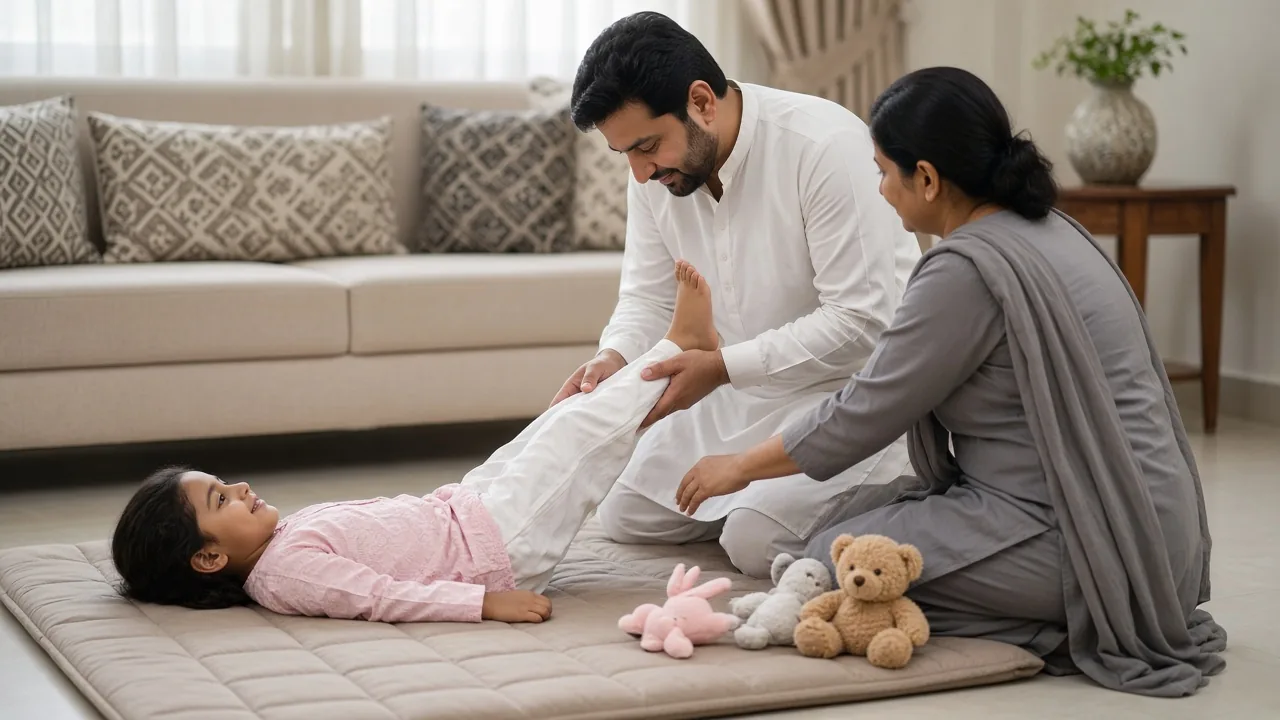
Stretching keeps tight muscles from shortening further, often the calves, hamstrings and the inner thigh muscles. In the trial, stretches were held for 30 seconds and repeated five times, to gentle discomfort. Stretch slowly, with the child relaxed, never with a jerk or bounce, and never through crying or pain. Your physiotherapist will show exactly where to place your hands.
Strength through play
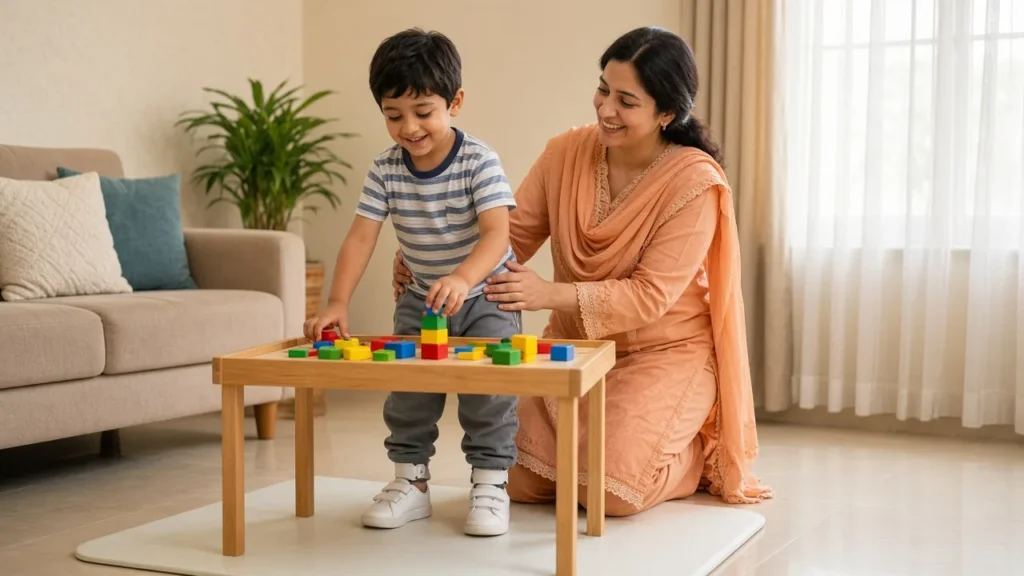
Children rarely enjoy repetitions, but they enjoy games. Standing up from a small stool to reach a toy, stepping onto a low step, lifting the hips off the floor in a “bridge”, or pushing a heavy box can all build strength. NICE recommends strengthening where weakness is limiting function, using progressive, repetitive exercise against resistance aimed at a specific goal.
Positioning through the day
How a child sits, stands and lies for hours matters as much as a 30-minute session. The Islamabad programme taught parents to seat children on a bench or block with feet flat and legs apart, and to avoid W-sitting and scissoring. NICE calls this kind of approach 24-hour postural management. For some children it includes standing frames, special seating or night positioning, which a physiotherapist should set up.
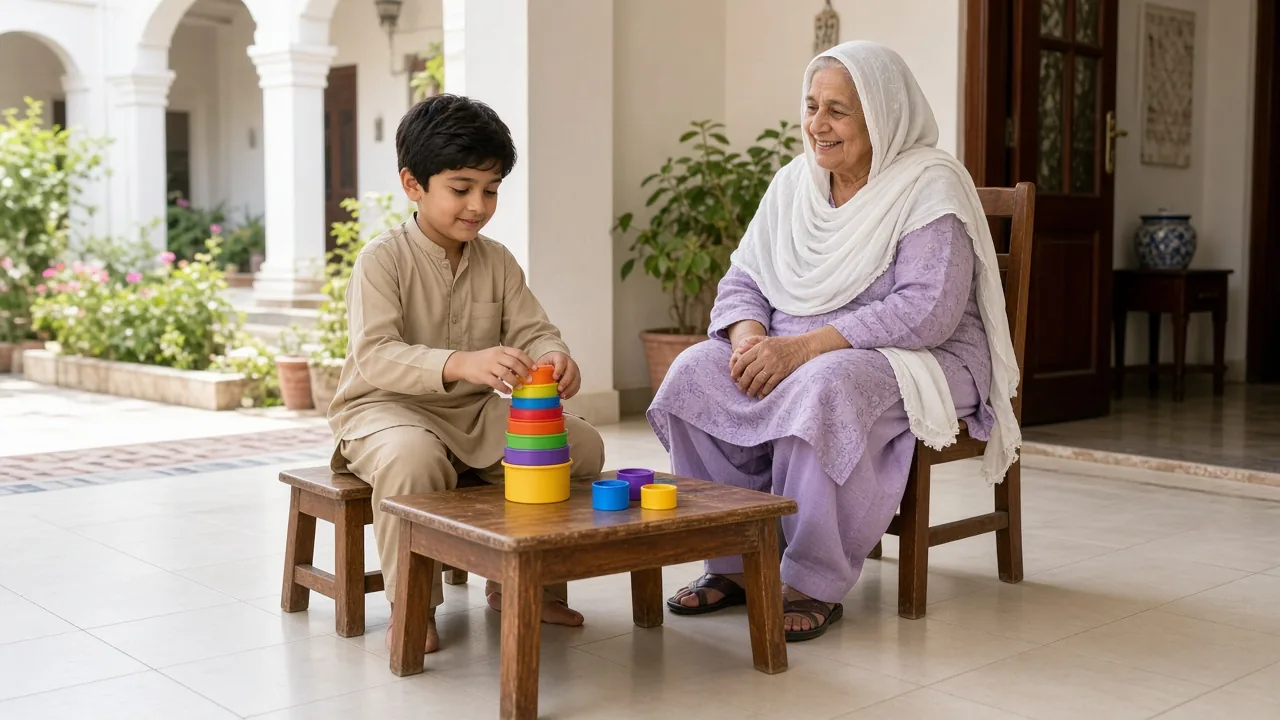
Standing and walking practice
Supported standing, walking with a frame or crutches, and practising steps all build function. The NHS notes that physiotherapists may advise on walking aids and on leg braces called orthoses. Only use standing positions, durations and equipment your physiotherapist has recommended, because the right choice depends on your child’s hips, muscle tone and level of control.
How can a home programme fit into busy family life in Pakistan?
Tie exercises to things that already happen every day, keep sessions short and playful, and make sure everyone who helps does it the same way. A simple notebook or short video for the physiotherapist keeps everyone on track.
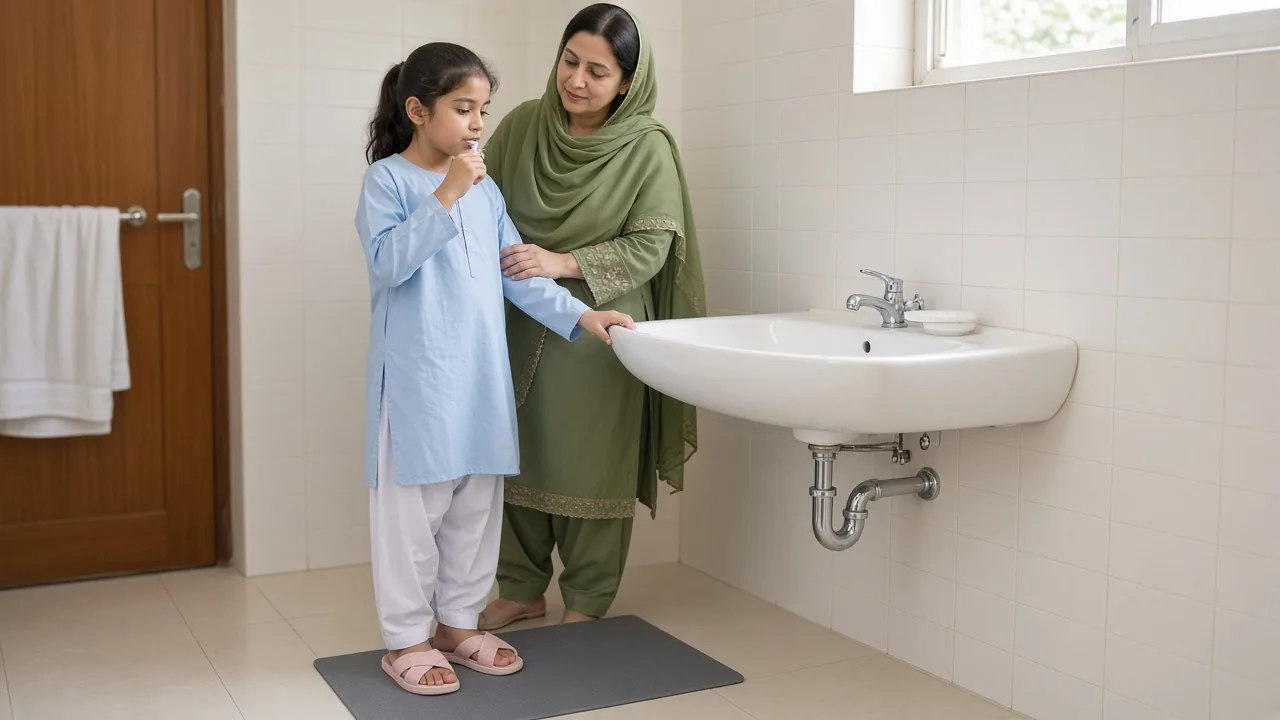
- Use daily routines. Standing at the washbasin to brush teeth, sitting well at meals, stretching after a bath, or practising steps on the way to the courtyard all count, as NICE suggests.
- Little and often. Two or three short, cheerful sessions can be easier than one long struggle, if your physiotherapist agrees.
- One method, many helpers. In joint families, grandparents, aunts and older siblings often help. Ask the physiotherapist to show everyone, so a stretch is done the same way whoever is at home.
- Keep a record. A notebook of what was done, and how the child coped, helps the physiotherapist adjust the plan. A short phone video of an exercise lets them check technique, which echoes the trial authors’ advice on regular follow-up by phone.
- Plan for school and heat. Pick a calm time of day, avoid the hottest afternoons in summer, and keep water nearby.
- Look after yourself. A programme that exhausts the parent will not last. Tell the physiotherapist if it is too much; a smaller plan you can keep up is better than a perfect one you cannot.
What does a home physiotherapist add that a printed exercise sheet cannot?
A physiotherapist assesses your child, sets goals with you, chooses and adjusts the exercises, teaches the right hand placement, checks your technique, and spots problems early. At home, they also see the real floor, chairs, bathroom and stairs your child uses.
The trial parents did not work from a sheet alone. They had supervised hands-on practice, handouts, pictures and videos. In everyday care, that teaching role belongs to the physiotherapist. In practice, it means:
- Assessment: checking muscle tone, range of movement, strength, sitting, standing and walking, and how your child moves around the home.
- Goals that matter to your family: sitting for meals, standing to dress, walking to the school gate. NICE recommends goal-focused programmes.
- The right dose: deciding which stretches to hold, which muscles to strengthen and when to progress, then changing the plan as your child grows.
- Early warning: noticing increasing tightness, hip pain or posture changes, and advising you to see the doctor.
- Working with the wider team: after treatments such as botulinum toxin injections or orthopaedic surgery, NICE says an adapted physiotherapy programme is an essential part of care.
Movement is only one part of cerebral palsy. If your child also has difficulty speaking, swallowing or controlling saliva, our speech therapy service covers communication, swallowing and drooling.
What common mistakes should parents avoid?
The usual ones are chasing promised cures, copying online videos without an assessment, forcing stretches through pain, letting a child sit in one position all day, and stopping the programme once progress slows.
- Chasing a cure. Expensive treatments that promise to make cerebral palsy disappear take money and time from therapy that helps. Ask your doctor about any treatment before paying for it.
- Copying videos. An exercise that suits a child at GMFCS level II may be unsafe for a child at level IV.
- Forcing stretches. Pain makes muscles tighten more and turns therapy into a fight. Slow and gentle wins.
- Long hours in one position. Even good sitting becomes a problem if it never changes. Vary positions through the day.
- Stopping too early, or never reviewing. Plateaus are normal, and a growing child’s needs change. Regular review, as NICE recommends, keeps the programme useful.
- Missing pain. NICE notes that pain is common in cerebral palsy and that parents have a key role in recognising it, especially when a child cannot easily say what hurts.
When should you contact a doctor or physiotherapist?
See a doctor promptly for ongoing pain, hip problems, coughing or choking with feeds, poor weight gain, new seizures or any loss of skills your child had before. Book a physiotherapy review if stiffness is increasing or the programme no longer fits.
- Pain or distress that you cannot explain, or changes in sleep.
- Hip concerns: pain when changing nappies or clothes, one leg looking shorter, or difficulty sitting. NICE lists hip subluxation and dislocation among common causes of pain.
- Feeding problems: the NHS warns that swallowing difficulty can lead to choking or chest infections from food going the wrong way.
- Loss of skills: the brain injury in cerebral palsy does not get worse, so losing abilities your child had should always be checked by a doctor.
Cerebral palsy physiotherapy at home in Islamabad and Rawalpindi: how IRHC can help
IRHC sends a physiotherapist to your home in almost all areas of Islamabad and Rawalpindi, Monday to Sunday, 9 am to 9 pm. Our physiotherapy covers children with cerebral palsy or delayed development, and a female physiotherapist is available. Every booking is confirmed on WhatsApp.
Our home physiotherapy service includes paediatric physiotherapy and cerebral palsy rehabilitation, working on stretching, strength, sitting, standing and walking, with advice on positioning and equipment. Sessions use play and activities suited to the child’s age, and parents are shown exercises to continue at home. The first visit is an assessment: the physiotherapist asks about your child’s history, checks movement and strength, agrees goals with you and explains the plan. Partner clinics in G-8 Markaz (Islamabad) and Saddar (Rawalpindi) and online video sessions are also available.
To book, call 051-8776556 (9 am to 6 pm), WhatsApp 0300-6844361 (answered 24/7), or use the online appointment form. It helps to tell us:
- your child’s age, the diagnosis and any reports or letters from the doctor;
- what your child can do now, such as sitting, standing or walking, and any braces or aids;
- your area, and whether you prefer a home visit, a clinic visit or a video session.
Looking for a home programme planned around your child?
IRHC sends a physiotherapist to your home in Islamabad and Rawalpindi, Monday to Sunday. Our team confirms every booking on WhatsApp. For fees, timings and payment methods, see our FAQs, or read more about our home physiotherapy.
Book an appointment | WhatsApp 0300-6844361 | Call 051-8776556
Frequently Asked Questions
Quick answers to what parents ask about cerebral palsy exercises at home and physiotherapy for children. For fees, timings and payment, see our FAQs page.
Can exercise cure cerebral palsy?
No. The NHS says there is currently no cure for cerebral palsy. Exercise and physiotherapy aim to keep muscles strong and flexible, prevent painful tightness and help a child be as active and independent as possible. Be wary of anyone who promises a cure.
Does cerebral palsy get worse over time?
The injury in the brain does not get worse. A growing body can still run into trouble, though, if stiff muscles pull on joints or a child sits in one position all day and loses movement. That is one reason regular, well-taught home practice matters. Losing abilities your child already had should always be checked by a doctor.
How often should my child do cerebral palsy exercises at home?
There is no single answer. The authors of the Islamabad trial note that guidelines on the right amount of home exercise do not yet exist. In their study, parents gave 30 minutes a day, 5 days a week, for 12 weeks. Your child’s physiotherapist should set a schedule that suits your child and your family.
Is massage good for children with cerebral palsy?
In the Islamabad trial, adding a gentle 30-minute oil massage to home exercises lowered muscle stiffness scores more than exercise alone, but did not change motor scores. The massage was light and slow, with no deep pressure or kneading. It is one trial, so ask your physiotherapist first.
Can I do cerebral palsy exercises at home without a physiotherapist?
Parents deliver most of the practice, but the programme should be planned and checked by a physiotherapist. In the trial, parents had supervised practice, handouts and videos first. A stretch or position that suits one child can be wrong, or painful, for another.
What did the Islamabad home exercise trial find?
In a 2024 randomised trial of 68 children with spastic diplegia, both groups improved on gross motor tests after 12 weeks of parent-delivered home exercise. The group that also received a gentle oil massage had significantly less muscle stiffness, but no better motor scores. There was no group without exercise, so the study cannot show how much of the change came from the programme itself.
What does a home physiotherapist add that a printed exercise sheet cannot?
A physiotherapist assesses your child, sets goals with you, chooses and adjusts the exercises, teaches the right hand placement, checks your technique, and spots problems early. At home, they also see the real floor, chairs, bathroom and stairs your child uses. In the Islamabad trial, parents did not work from a sheet alone; they had supervised hands-on practice, handouts, pictures and videos.
Will my child with cerebral palsy be able to walk?
It is hard to predict, and the NHS notes that cerebral palsy affects each child differently. Your child’s doctor and physiotherapist can explain what is realistic based on their assessment, and walking aids or leg braces may help some children move more independently.
How much does home physiotherapy cost in Islamabad or Rawalpindi?
At IRHC, a first or single physiotherapy home visit is Rs 3,000. Packages are discounted: 10% off 5 sessions and 15% off 10 sessions. Payment is made in advance, once your appointment is confirmed, by Easy Paisa, JazzCash, U Paisa, Raast ID, bank transfer or cash.
How long is a home physiotherapy session?
A standard physiotherapy session at your home lasts 45 minutes. Visits run Monday to Sunday, 9 am to 9 pm, in almost all areas of Islamabad and Rawalpindi.
How do I book physiotherapy at home for my child?
Call 051-8776556 (9 am to 6 pm), WhatsApp 0300-6844361 (answered 24/7), or use the online appointment form. Tell us your child’s age, the diagnosis, what they can do now, any reports, and your area. A female physiotherapist is available if you prefer. Every booking is confirmed on WhatsApp.
Medical disclaimer: This article is for general information only and does not replace an assessment by your child’s doctor or a qualified physiotherapist. Every child with cerebral palsy is different, and no result is guaranteed. If your child has a prolonged seizure, difficulty breathing or choking, get emergency medical help immediately by calling 1122.