

Short answer: Good catheter care at home comes down to clean hands, a clean catheter and free-flowing urine. Wash your hands before and after touching the catheter or bag, wash the skin where the catheter enters with mild soap and water every day, and keep the bag below the level of the bladder with no kinks in the tube. Empty the bag when it is half to three-quarters full, change leg bags as advised (the NHS says every 7 days), and encourage enough fluids to keep urine pale. Contact a nurse or doctor for fever, shivering, new confusion, lower tummy pain, a catheter that stops draining, leaking, or blood in the urine.
This guide is general information for families. Always follow the instructions of the doctor or nurse who placed the catheter. Do not remove, reinsert or clamp a catheter unless you have been trained and told to.
Listen to a short overview
71 seconds · a spoken summary of this guide. It does not replace instructions from your doctor or nurse.
Key takeaways
- Urinary tract infection is the main risk of a catheter, and the risk grows the longer it stays in.
- Clean hands, daily skin washing and cleaning the tube away from the body are the core of good care.
- Keep the bag below the bladder, never on the bed or held up high, and stop kinks in the tubing.
- Fever, shivering, confusion, a catheter that stops draining, or bright red blood need prompt medical advice.
- IRHC’s home nursing team looks after urinary catheters as prescribed by the patient’s doctor, in Islamabad and Rawalpindi.
In this guide
Nani came home from hospital with a drip mark on her hand, a box of medicines, and a tube leading from under her blanket to a bag hanging on the side of the bed. Nobody in the family had looked after a urinary catheter before. Should the bag hang from the bed or sit on the floor? Can she be washed normally? Is cloudy urine an emergency? How often should the bag be changed, and who takes the catheter out?
A urinary catheter is one of the most common things patients bring home after surgery, a stroke, a fracture or a long illness, particularly older men with prostate problems and bedbound elderly patients. Looked after well, it causes few problems. Looked after poorly, it can lead to painful infections, blockages and repeated hospital trips. This guide explains catheter care at home in plain language: how catheters work, the daily routine, how to handle bags, how to prevent infection and blockage, what warning signs mean, and when to call for help in Islamabad and Rawalpindi.
What is a urinary catheter, and what types are there?
A urinary catheter is a flexible tube that drains urine from the bladder into a bag. It goes in either through the urethra (urethral catheter) or through a small opening in the lower tummy (suprapubic catheter). Most people cared for at home have an indwelling catheter that stays in place, held by a small balloon inside the bladder.
The NHS explains that catheters are used when people cannot pass urine normally, for example because of an enlarged prostate, nerve damage, or before and after some operations. They may be needed for a few days or for the long term.
| Type | How it works | Notes for home care |
|---|---|---|
| Indwelling urethral (often called a Foley) | Passed through the urethra and held in the bladder by a balloon | Most common at home. Needs daily cleaning where it enters the body |
| Suprapubic | Passes through a small opening in the lower tummy into the bladder | Clean the opening daily; often used long term |
| Intermittent | Inserted to empty the bladder, then removed | Usually done by the person themselves after training |
Based on NHS information. Your nurse will explain the type your family member has.
The NHS notes that indwelling catheters are more convenient than repeated intermittent insertion but are more likely to cause problems such as infection. That is why a catheter should only stay in for as long as it is needed. It is reasonable to ask the doctor at each review: “Does he still need the catheter?”
What does daily catheter care at home involve?
Every day: wash your hands, wash the skin where the catheter enters with mild soap and water, clean the tube moving away from the body, dry well, secure the catheter to the thigh, check the tubing for kinks, and keep the bag below the bladder.
MedlinePlus, the US National Library of Medicine’s patient site, gives a clear routine (MedlinePlus):
- Wash your hands with soap and water, including between the fingers and under the nails. Wash them again afterwards.
- Clean the skin at least once a day. Using a soapy, warm washcloth, gently wash around where the catheter goes in. For women, wipe from front to back. For men, wipe from the tip of the penis downward. Rinse and pat dry.
- Clean the tube twice a day. Holding the catheter gently, wash it starting at the end near the body and moving down, away from the body. Never wipe from the bag end towards the body.
- Skip creams, powders and sprays near the area unless a doctor has prescribed them.
- Secure the catheter to the inner thigh with a fixing strap or device so it does not pull.
- Check the flow. Look for kinks or twists, and make sure the person is not lying on the tube.
For suprapubic catheters, the same principles apply: clean the skin around the opening daily with mild soap and water and dry well. Your nurse may advise a light dressing for the first weeks.
Bathing and personal hygiene
Ask the doctor or nurse whether showering is allowed. Many people can shower with the catheter and bag in place. Avoid soaking in a tub unless advised. Washing after using the toilet still matters; clean the back passage from front to back and away from the catheter. Families sometimes ask about wudu, ghusl and prayer with a catheter. Those are questions for a local scholar; from a health point of view, keeping the catheter clean and the system closed is what matters most.

How do you empty and change a catheter bag?
Empty the bag through its tap when it is half to three-quarters full, without disconnecting it. Use a leg bag by day and connect a larger night bag at bedtime. The NHS says leg bags and valves should be changed every 7 days and single-use night bags are usually used.
The NHS page on living with a urinary catheter sets out the basics:
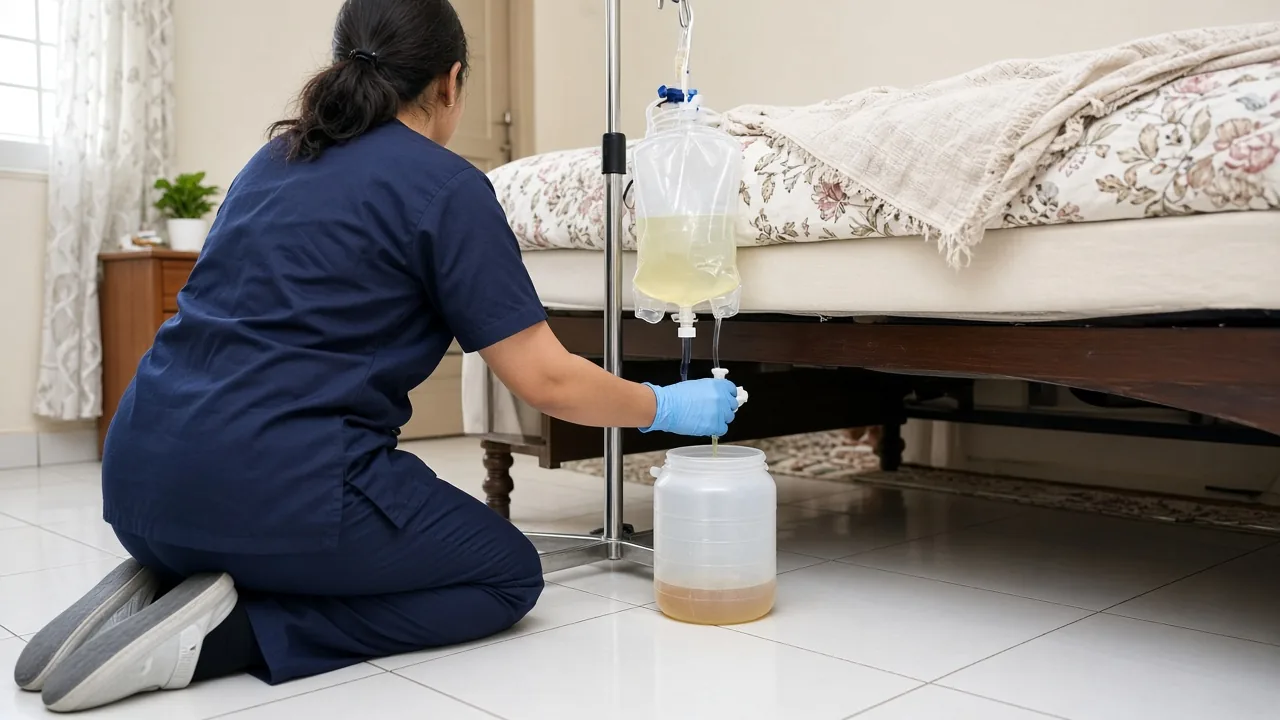
- Empty before it is full. Around half to three-quarters full. Wash hands, open the tap at the bottom over the toilet or a clean container kept only for this purpose, let it drain, close the tap and wipe it.
- Leg bag by day, night bag at night. At bedtime, attach the night bag to the leg bag outlet (or to the valve) so the system stays closed. Place the night bag on a stand near the floor beside the bed.
- Change leg bags and valves every 7 days, or as your nurse advises. Write the date on a calendar.
- Keep it closed. MedlinePlus advises disconnecting the catheter from the bag as little as possible, because each disconnection lets germs in.
- Keep the bag below the bladder at all times so urine cannot flow back. Do not lay the bag on the bed or lift it above the hips when moving the person.
- Do not let the bag or tap touch the floor. A stand or a hook on the side of the bed or charpai works well.
The NHS adds that the catheter itself usually needs to be removed and replaced at least every 3 months, usually by a doctor or nurse. Some catheter types need changing more often; ask what applies to yours and note the due date.
How do you prevent a catheter infection and blockage at home?
Clean hands, daily washing, a closed drainage system, the bag below the bladder, good fluid intake and avoiding constipation are the main defences against infection and blockage. Remove the catheter as soon as it is no longer needed.
The NHS lists these steps to cut the risk of urinary tract infection (UTI) and blockage:
- wash the skin where the catheter enters with mild soap and water every day;
- wash your hands before and after touching the catheter equipment;
- drink enough fluids that the urine stays a pale colour;
- avoid constipation with fluids and high-fibre foods such as fruit, vegetables and wholegrains;
- avoid kinks in the catheter and keep collection bags below the level of the bladder.
Fluids in a hot climate
In an Islamabad summer, or a Rawalpindi house without steady electricity for fans and air conditioning, people lose more fluid through sweat. Older people often drink less because they feel less thirsty or worry about the bag filling. Offer drinks through the day, such as water, lassi, soups and fruit, unless the doctor has limited fluids for heart or kidney reasons. Dark, strong-smelling urine is a sign to offer more.
Constipation matters
A full bowel can press on the catheter, cause leaks around it and contribute to blockage. The NHS risks page notes that leaking can happen when opening the bowels. Fibre, fluids, movement and, if needed, a laxative prescribed by the doctor help.

What are the signs of a catheter infection or blockage?
Signs of infection include fever or feeling hot, cold or shivery, pain low in the tummy or the sides, new confusion and feeling generally unwell. A blocked catheter shows as little or no urine in the bag, tummy discomfort or leaking around the catheter.
| What you notice | Possible cause | What to do |
|---|---|---|
| Fever, shivering, feeling hot or cold | Urinary tract infection | Contact the doctor or nurse the same day |
| New or worse confusion, drowsiness, falls | Infection is a common cause in older people | Contact the doctor the same day |
| No urine in the bag for a few hours, tummy swelling or pain | Blocked or kinked catheter | Check kinks and bag position; if still no flow, get urgent nursing or medical help |
| Urine leaking around the catheter | Blockage, bladder spasm or constipation | Check drainage; contact the nurse |
| Cramping pain low in the tummy | Bladder spasms | Tell the doctor; medicine can help if spasms are frequent |
| Bright red blood or clots | Bleeding, possibly from a pulled catheter | Contact the nurse or doctor promptly |
| Cloudy or smelly urine on its own | May be infection, but also common with catheters | Offer fluids; tell the nurse, especially if other symptoms appear |
| Catheter falls out | Balloon problem or pulling | Do not push it back in. Contact the doctor or nurse; urgent if the person cannot pass urine |
Based on NHS and MedlinePlus advice. When in doubt, contact your doctor or nurse.
The NHS risks page notes that catheter-associated UTIs are one of the most common infections in hospital patients, especially with indwelling catheters, and that confusion can be a symptom. In older people, sudden confusion may be the only sign, so families should not dismiss it as age or tiredness.
What should you not do with a urinary catheter at home?
Do not pull on the catheter, raise the bag above the bladder, disconnect the system without need, clamp the tube unless instructed, push a fallen catheter back in, or give antibiotics without a doctor’s advice.
- Do not pull or tug. The balloon holds the catheter in the bladder; pulling can injure the urethra and cause bleeding. Secure the tube to the thigh.
- Do not lift the bag above the hips when turning or moving the person. Empty it first if needed.
- Do not keep disconnecting the bag to empty or swap it. Use the tap.
- Do not clamp the tube unless the doctor has asked you to.
- Do not try to reinsert a fallen catheter unless you have been trained to.
- Do not start leftover antibiotics. Antibiotics should be prescribed by a doctor who has assessed the person.
- Do not put creams or powder around the catheter unless prescribed.
- Do not reuse single-use bags. Washing and reusing them raises infection risk.
How do you look after a catheter in an elderly or bedbound patient?
For bedbound patients, turn them regularly while keeping the tube free and the bag low, check the skin, keep the genital area clean after any bowel movement, and watch closely for confusion or fever.
Many catheter patients at home are frail, bedbound or living with dementia. This brings extra jobs:
- Turning. When changing the person’s position, move the tubing and bag with them, keep the bag below the bladder, and make sure they are not lying on the tube. Regular turning also protects the skin; see our guide on preventing bedsores at home.
- Bowel care. After any bowel movement, clean from front to back, away from the catheter, then wash the catheter area again.
- Confusion and pulling. People with dementia or delirium may pull at the tube. A securing device, loose clothing over the tube and gentle supervision help. Tell the doctor if pulling happens often.
- Record keeping. A simple chart of fluid given, bag emptied, bag change dates and catheter change date helps everyone, especially when several relatives share care.
When should you call a nurse or doctor about a catheter?
Call for urgent help if the person cannot pass urine and the bladder area is swelling or painful, is very unwell with fever or confusion, or passes bright red blood or clots. Contact a nurse for blockage, leaks, bag or catheter changes and skin soreness.
The NHS advises contacting a nurse immediately for severe or ongoing bladder spasms, a blocked or leaking catheter, blood in the urine, symptoms of a UTI, or an indwelling catheter that has fallen out. In Islamabad and Rawalpindi, if the person is very unwell, call Rescue 1122 or go to the nearest emergency department.
Where can you get catheter care at home in Islamabad and Rawalpindi?
Islamabad Rehabilitation and Hearing Center (IRHC) provides home nursing across Islamabad and Rawalpindi. Our nurses look after urinary catheters, NG tubes, injections and IV lines, as prescribed by the patient’s doctor.
Our home nursing service can help families in the first days after discharge or provide regular support by the hour, by 12-hour or 24-hour shift, or monthly. A nurse can check the catheter and drainage, help with hygiene and skin care, monitor temperature and other vital signs, watch for early signs of infection, and show family members the daily routine. Female nurses are available for female patients on request. You may also find our guides on home nursing after hospital discharge and what a home nurse does useful.
When you contact us, have the discharge summary, the type of catheter and the date it was placed, and the patient’s area ready.
Need a nurse for catheter care at home?
Book home nursing in Islamabad or Rawalpindi for catheter care, hygiene and early warning checks. For fees, timings and payment, see our FAQs. For fees, timings and payment, see our FAQs.
Book an appointment | WhatsApp 0300-6844361 | Call 051-8776556
Frequently Asked Questions
Answers to common questions about urinary catheter care at home. For fees, timings and payment, see our FAQs page.
How do you clean a urinary catheter at home?
Wash your hands, then wash the skin where the catheter enters with mild soap and warm water at least once a day. Clean the tube twice a day, starting near the body and moving away from it. Rinse, pat dry and avoid creams or powders unless prescribed.
How often should a catheter bag be changed?
The NHS says leg bags and valves should be changed every 7 days, and single-use night bags are usually used. Empty bags when they are half to three-quarters full. Follow your nurse’s instructions.
How often should a long-term catheter be changed?
The NHS says long-term catheters usually need replacing at least every 3 months, normally by a doctor or nurse. Some types need changing sooner; ask which applies.
What are the signs of a catheter infection?
Fever or shivering, pain low in the tummy, groin or sides, new confusion, and feeling generally unwell. Cloudy or smelly urine can also occur. Contact the doctor or nurse the same day.
Is cloudy urine in a catheter bag dangerous?
Not always. Cloudy or smelly urine is common with catheters and may improve with more fluid. If it comes with fever, pain, confusion or feeling unwell, contact a doctor.
What should I do if the catheter is not draining?
Check for kinks, make sure the person is not lying on the tube, and that the bag is below the bladder. If no urine flows after that, or the tummy is swelling or painful, get urgent nursing or medical help.
Why is urine leaking around the catheter?
Leaking can be caused by a blockage, bladder spasms or constipation, or can happen during a bowel movement. Check that the catheter is draining and contact your nurse.
How much should a person with a catheter drink?
Enough to keep the urine pale, unless the doctor has limited fluids. Offer drinks through the day, especially in hot weather.
Can a person with a catheter shower?
Often yes, but ask the doctor or nurse first. Keep the drainage system connected, clean the area afterwards and dry well.
How much does home nursing for catheter care cost in Islamabad?
Home nursing fees depend on distance and time, so there is no fixed price. Call 051-8776556 or WhatsApp 0300-6844361 with your area and the care needed for a quote. A nurse can be booked by the hour, by 12-hour or 24-hour shift, or monthly. Payment is made in advance via Easy Paisa, JazzCash, U Paisa, Raast ID, bank transfer or cash.
How do I book a home nurse for catheter care?
Call 051-8776556 (9 am to 6 pm), WhatsApp 0300-6844361 (answered 24/7), or use the online appointment form. Tell us the type of catheter, the date it was placed, the patient’s condition and your area. Female nurses are available on request, and every booking is confirmed on WhatsApp.
Medical disclaimer: This article is for general information only. It does not replace instructions from your doctor or nurse. A person who cannot pass urine, is very unwell, or is passing bright red blood needs urgent medical help.