
Short answer: Safe NG tube feeding at home rests on a few non-negotiable steps. Before every feed, medicine or water flush, check that the tube has not moved: the centimetre mark at the nostril should match the record, and fluid drawn from the tube should test pH 5.5 or below on pH paper. Feed with the person sitting up at least 30 to 45 degrees and keep them raised for about an hour afterwards. Flush the tube with water before and after feeds and medicines, clean the nose and mouth daily, and stop at once if the person coughs, chokes, struggles to breathe or vomits.
This guide is general information for families. Always follow the feeding plan and training given by your doctor, nurse or dietitian. Do not put anything down a tube you are not sure is in the stomach.
Listen to a short overview
75 seconds · a spoken summary of this guide. It does not replace the training and instructions from your doctor, nurse or dietitian.
Key takeaways
- An NG tube (often called a Ryle’s tube in Pakistan) carries feed, water and medicines through the nose into the stomach.
- The biggest danger is a tube that has slipped so that feed goes into the lungs. Check the position before every use.
- Use pH paper: 5.5 or below is reassuring. Never rely on the “whoosh” test of pushing air and listening.
- Keep the person upright at 30 to 45 degrees during feeding and for about an hour afterwards.
- Flushing, nose care and mouth care prevent many problems. IRHC’s home nursing team cares for NG tubes as prescribed by the patient’s doctor.
In this guide
The discharge papers say “Ryle’s tube feeding, 200 ml every three hours”. A nurse showed the family how to use the syringe once, quickly, on the ward. Now Abba is home after his stroke, propped up on pillows, a thin tube taped to his cheek, and the family is gathered around the bed holding a bottle of milk, a syringe and a lot of questions. How do we know the tube is still in the right place? What if he coughs? Can we give his tablets through it? What do we do at 3 am if it comes out?
Caring for someone with a nasogastric tube is one of the most common reasons families in Islamabad and Rawalpindi call for nursing help after a hospital stay. It is very manageable once you understand the logic behind each step. This guide explains NG tube feeding at home in plain language: how to check the tube’s position, how to give feeds, water and medicines safely, how to care for the nose and mouth, what to do when things go wrong, and when to call for help. It is not a substitute for hands-on training, but it will help you ask the right questions and spot problems early.
What is an NG tube, and why do some patients go home with one?
A nasogastric (NG) tube is a thin, soft tube passed through the nose, down the back of the throat and food pipe into the stomach. It is used when someone cannot eat or drink enough, or cannot swallow safely, but their stomach and gut still work.
MedlinePlus, the US National Library of Medicine’s patient site, describes an NG tube as a special tube that carries food and medicine to the stomach through the nose (MedlinePlus). It can provide all of a person’s nutrition or top up what they manage to eat.
Common reasons for going home with an NG tube include:
- a stroke that has affected swallowing;
- advanced dementia, Parkinson’s disease or motor neurone disease;
- head and neck cancer or its treatment;
- recovery from a serious illness or operation when the person is too weak to eat enough;
- reduced consciousness after a brain injury.
“Ryle’s tube” and fine-bore feeding tubes
In Pakistan most families hear the term “Ryle’s tube”. Strictly, a Ryle’s tube is a wider tube originally designed for draining the stomach. The Royal College of Physicians (RCP) in the UK advises that Ryle’s tubes should not be used routinely for feeding and recommends narrower feeding tubes with length markings (RCP guidance). Your doctor decides which tube is used, but it is reasonable to ask whether a fine-bore feeding tube would be more comfortable if feeding is expected to continue for some time.
Can the person still eat by mouth?
Some people with an NG tube are “nil by mouth” because swallowing is unsafe; others can take small tastes or certain textures. This is decided after a swallowing assessment, usually by a speech and language therapist. Never give food or drink by mouth unless the medical team has said it is safe. Our article on soft food for swallowing problems explains how texture levels work once some eating is allowed.
How do you check NG tube position before feeding at home?
Check the external centimetre mark at the nostril against your record, then draw back a small amount of stomach fluid and test it on pH indicator paper. A reading of 5.5 or below means it is reasonable to proceed. If you cannot get fluid or the pH is higher, do not use the tube; contact your nurse or doctor.
The Kent Community Health NHS Foundation Trust patient leaflet (NHS leaflet) says to check the position before giving any feed, medicines or water flush, and any time the tube may have moved, for example after a coughing fit, vomiting, retching, difficulty breathing or reflux. A tube that has moved may look longer, may have come out of the nose, or may be coiled in the throat.
Step by step
- Wash your hands with soap and water.
- Look at the tube. Is the tape secure? Has the centimetre mark at the nostril changed from the number recorded by the hospital? Write this number somewhere visible.
- Ask the person to open their mouth if they can, and check the tube is not coiled at the back of the throat.
- Attach a clean enteral syringe and gently draw back a small amount of fluid.
- Put a drop on the pH paper and compare the colour with the chart on the pack.
- If the pH is 5.5 or below, the tip is very likely in the stomach and you can proceed.
- If you get no fluid, try changing the person’s position (for example onto the left side), wait a little and try again. The leaflet also suggests a drink if the person is allowed to drink safely.
- If you still cannot get fluid, or the pH is above 5.5, do not put anything down the tube. Contact your nurse, doctor or the hospital team.
| What you find | What it means | What to do |
|---|---|---|
| Mark unchanged, pH 1 to 5.5 | Tip very likely in the stomach | Go ahead with feed, flush or medicine |
| pH above 5.5 | Could be in the wrong place; some medicines and recent feeds also raise pH | Do not use. Wait and retest if your nurse has taught you to, otherwise get advice |
| No fluid can be drawn back | Position cannot be confirmed | Change position and retry; if still none, do not use and get advice |
| Mark has changed, tube longer, or coiled in mouth | Tube has moved | Do not use. Do not push it back in. Get advice |
| Coughing, breathlessness or colour change during feeding | Feed may be entering the airway | Stop at once and seek urgent help |
Based on NHS trust and Royal College of Physicians guidance. Follow your own team’s instructions.
Methods you should never rely on
The RCP guidance is explicit: the “whoosh” test (pushing air down the tube and listening with a stethoscope) and litmus paper should never be used to confirm position. Blowing bubbles into water, or “it looks fine”, are not checks either. These methods can seem reassuring when the tube is actually in the lung. Use pH indicator paper designed for this purpose; your nurse or pharmacy can advise where to get it.
What are the steps for safe NG tube feeding at home?
Prepare the prescribed feed at room temperature, sit the person up at 30 to 45 degrees, confirm the tube position, flush with water, give the feed slowly by gravity or pump as instructed, flush again, and keep them upright for about an hour.
- Prepare. Wash your hands and clean the work surface. Use the feed type and amount prescribed by the doctor or dietitian, at room temperature.
- Position. Sit the person upright or raise the head of the bed so they are at least 30 to 45 degrees. Pillows that only bend the neck do not count; the chest should be raised.
- Check the tube. Follow the position check above.
- Flush. Flush with the amount of water your team advised, using an enteral syringe.
- Feed slowly. For a syringe (bolus) feed, remove the plunger and let the feed run in by gravity, raising or lowering the syringe to control the speed rather than pushing hard. For a pump feed, set the rate prescribed.
- Watch the person. Stop if they cough, choke, become breathless, vomit or look uncomfortable.
- Flush again with water, close the cap or clamp, and wash the syringe in warm soapy water.
- Stay upright. The RCP advises keeping patients raised for one hour after feeding to reduce the risk of reflux and aspiration.
A note on home-blended feeds
Many families in Pakistan are told to give milk, soups, daal water or blended food through the tube. If the doctor or dietitian has prescribed this, ask exactly what, how much and how often, because homemade feeds vary widely in calories and protein. Blend and strain them very well, since thick or lumpy feeds block narrow tubes. Prepare them fresh with clean water and utensils, store as advised, and never add anything new without asking. Sudden weight loss, swelling or diarrhoea means the plan needs review.

How do you flush an NG tube and give medicines through it?
Flush with water before and after every feed and every medicine. Give medicines one at a time, in liquid or properly dispersed form, flushing between each. Ask a pharmacist before crushing any tablet.
The RCP recommends flushing with water using a 50 ml enteral syringe before starting a feed, between medicines, after feeding, and every 4 to 6 hours during continuous feeding. The Kent leaflet adds that if the tube is not being used for feeding, it should still be flushed at least once a day to stop it blocking. Your dietitian will tell you how much water to use, which also counts towards the person’s daily fluid.
Medicines
- Ask first. Not every medicine can go down a tube. Some slow-release or coated tablets must not be crushed. Ask the doctor or pharmacist for a liquid or dispersible version where possible.
- One at a time. Give each medicine separately and flush between them. Mixing medicines can make them clump or interact.
- Never mix medicines into the feed bag.
- Keep a chart. Write down what was given and when, especially when several family members share care.
How do you care for the nose, mouth and skin with an NG tube?
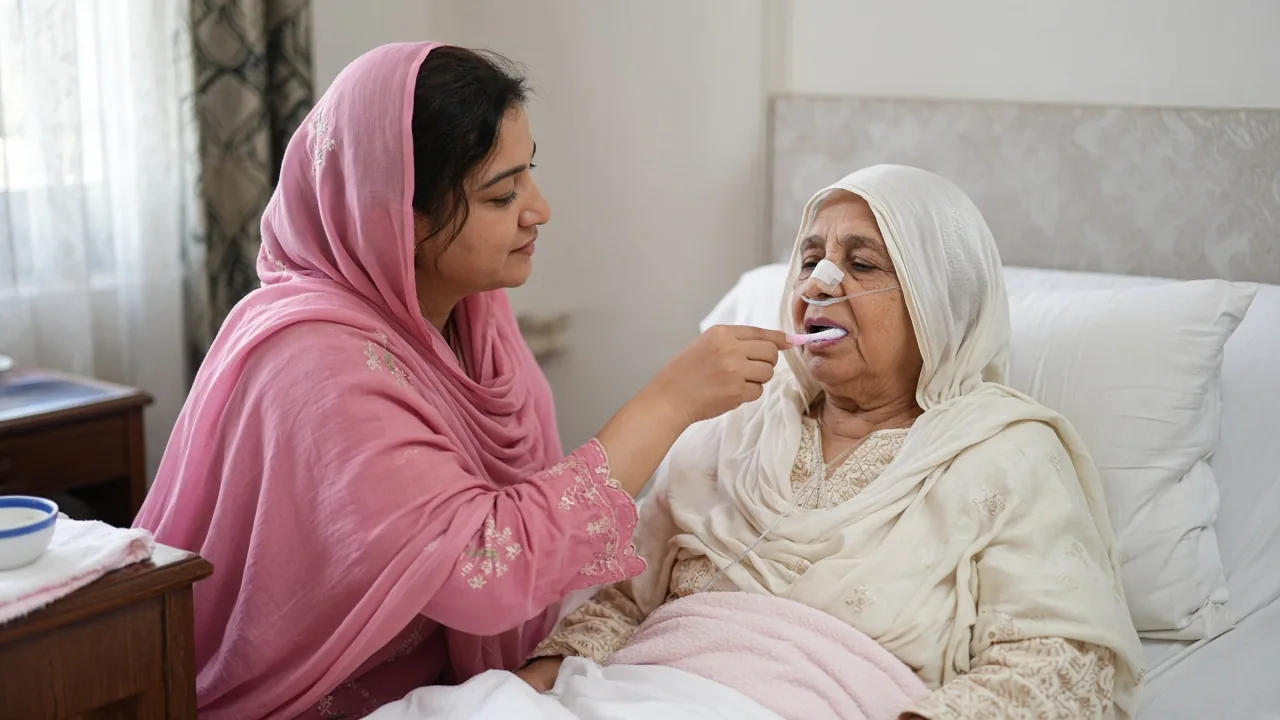
Clean the skin around the nostril daily, change the tape regularly and move it slightly to avoid sores, and clean the mouth, teeth and lips at least twice a day, even if the person eats nothing by mouth.
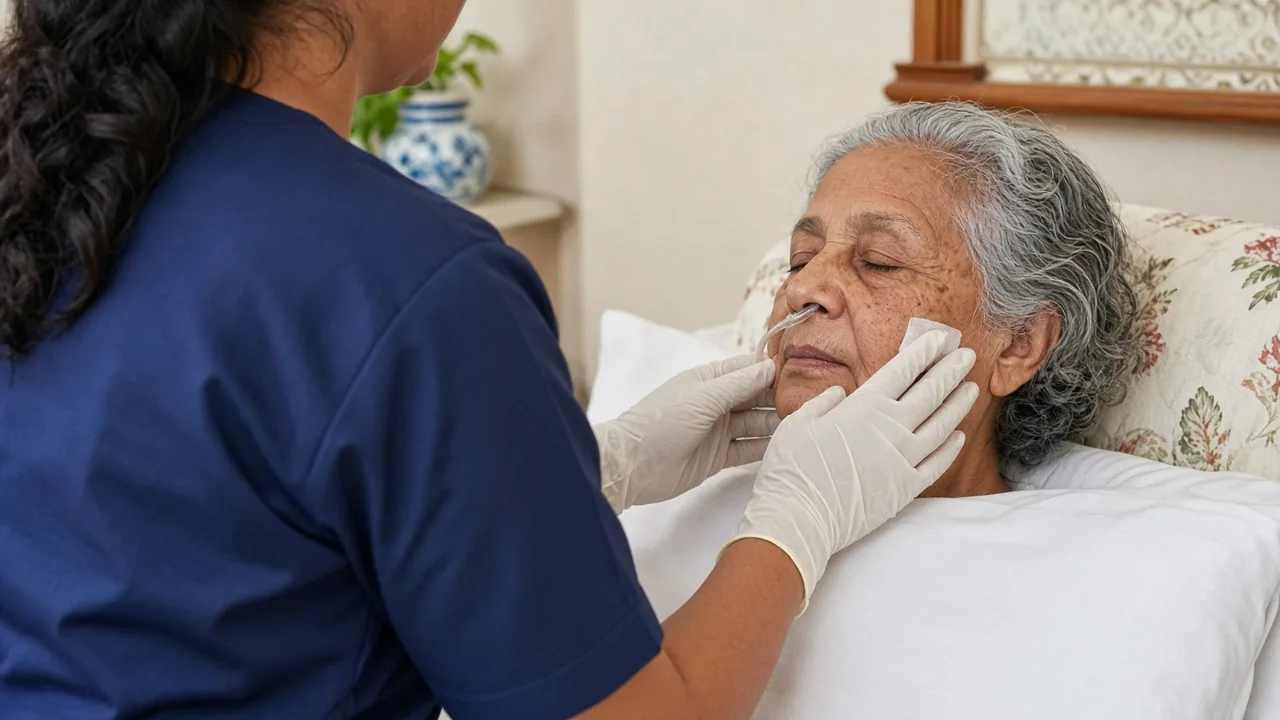
MedlinePlus advises cleaning the skin around the tube with warm water and a clean cloth, removing crusts from the nose, and contacting the provider if both nostrils become red, swollen and irritated. The Kent leaflet recommends replacing the tape daily, drying the skin well, and slightly changing where the tape sits to reduce soreness.
Mouth care matters more than families expect
When someone is not eating by mouth, saliva drops, the mouth dries and bacteria build up. Good mouth care keeps the person comfortable and is widely recommended to help lower the risk of chest infections in frail patients. Brush teeth or dentures gently twice a day with a soft brush and a small smear of toothpaste, wipe the tongue and gums with a clean damp swab, and keep lips moist. If the person cannot swallow safely, use very little water and keep them upright while you do it.
Positioning and skin
People who need tube feeding often spend long periods in bed. Change position regularly and check heels, hips and the lower back for redness. Our guide to preventing bedsores in a bedridden patient covers this in detail.
What should you do if the NG tube is blocked, comes out or causes vomiting?
For a blockage, use warm water with a gentle push-pull technique and never force it. If the tube comes out or moves, do not push it back; contact the team that placed it. For coughing, breathlessness or vomiting during a feed, stop immediately.
| Problem | What to do | Avoid |
|---|---|---|
| Blocked tube | Squeeze and roll the tube gently; use warm (cooled boiled) water with a push-pull syringe action; it may take time | Forcing the syringe; cola, juice or sugary drinks |
| Tube partly or fully out | Stop feeding. Remove it fully if it is hanging out, as your team advised, and contact the doctor or hospital to replace it | Pushing it back in yourself |
| Coughing, choking or breathlessness during feed | Stop the feed at once, sit the person up, seek urgent medical help if it does not settle quickly | Continuing “to finish the bottle” |
| Vomiting or swollen, hard tummy | Stop feeding, keep upright, recheck position before any further use, contact the doctor | Restarting at the same rate without advice |
| Diarrhoea | Check hygiene and feed temperature; tell the doctor or dietitian, who may review the feed or medicines | Stopping fluids |
| Fever, fast breathing, new chest rattle | Could be a chest infection, possibly from aspiration; see a doctor promptly | Waiting several days |
General guidance only. Your own team may give different instructions.
Kent’s leaflet specifically warns against flushing a blocked tube with sugary drinks such as cola, which can make the blockage worse. The RCP also lists repeated tube displacement as a reason for the medical team to consider other options, such as a tube placed directly into the stomach (gastrostomy or PEG) if feeding will be needed for a long time.
How long can someone stay on NG tube feeding, and what comes next?
NG tubes are usually meant for short to medium-term feeding. If feeding is needed for many weeks or longer, doctors may discuss a gastrostomy (PEG) tube. Swallowing therapy, where suitable, aims to return the person to eating by mouth.
How long an NG tube stays in depends on why it was placed and how the person recovers. After a stroke, for example, swallowing often improves over weeks, and a speech and language therapist reassesses whether eating can restart. Our article on speech therapy after stroke at home explains how therapy supports this.
For people with advanced dementia or at the end of life, decisions about tube feeding can be difficult and emotional. These are conversations for the family and the medical team together, considering the person’s wishes, comfort and dignity. There is no single right answer for every family.
Whatever the plan, regular review matters. Ask the doctor or dietitian to check weight, hydration, blood tests where needed, and whether the feeding plan still fits.
What are the most common mistakes families make with NG tube feeding?
The riskiest mistakes are skipping the position check, feeding a person lying flat, pushing a displaced tube back in, crushing unsuitable tablets, and giving food by mouth when swallowing is unsafe.
- Skipping the check “because it was fine this morning”. Tubes move with coughing, vomiting and restlessness.
- Feeding lying flat or slumped. Raise the chest to at least 30 to 45 degrees.
- Using the whoosh test. It is not reliable.
- Pushing the feed fast with the plunger. Let it flow by gravity unless your nurse has taught otherwise.
- Putting a displaced tube back in. Only trained staff should pass or replace a tube.
- Crushing all tablets together. Ask the pharmacist and give medicines one at a time.
- Giving tea or water by mouth “just a sip”. If the person is nil by mouth, even sips can go into the lungs.
- Neglecting the mouth. Mouth care is part of feeding care.
When should you call a nurse or doctor about NG tube feeding?
Get urgent help for breathing difficulty, choking, chest pain or a sudden change in colour or alertness. Contact your nurse or doctor the same day for a tube that has moved or come out, pH you cannot confirm, a blockage you cannot clear, repeated vomiting, fever, or sore nostrils.
In Islamabad and Rawalpindi, call Rescue 1122 or go to the nearest emergency department for breathing difficulty or choking that does not settle quickly. For tube problems that are not emergencies, contact the hospital team that placed the tube or a qualified nurse. MedlinePlus also lists repeated clogging, the tube falling out, vomiting and a bloated stomach as reasons to contact the provider.
Where can you get home nursing for NG tube care in Islamabad and Rawalpindi?
Islamabad Rehabilitation and Hearing Center (IRHC) provides home nursing across Islamabad and Rawalpindi. Our nurses look after NG tubes, urinary catheters, injections and IV lines, as prescribed by the patient’s doctor.
Our home nursing service can support families in the first days after discharge, when confidence is lowest, or provide longer-term help by the hour, by 12-hour or 24-hour shift, or monthly. A nurse can check the tube and feeding routine, monitor vital signs, help with mouth and skin care, and show family members the safe steps. Female nurses are available for female patients on request. Read more in our guides on home nursing after hospital discharge and what a home nurse does.
When you contact us, please have the discharge summary, the feeding plan and the list of medicines ready, and tell us the patient’s area.
Need a nurse to help with NG tube feeding at home?
Book home nursing in Islamabad or Rawalpindi for safe tube care, feeding support and family training. For fees, timings and payment, see our FAQs. For fees, timings and payment, see our FAQs.
Book an appointment | WhatsApp 0300-6844361 | Call 051-8776556
Frequently Asked Questions
Answers to common questions families ask about NG tube feeding at home. For fees, timings and payment, see our FAQs page.
How do I know the NG tube is in the right place?
Check that the centimetre mark at the nostril has not changed, then draw back a little stomach fluid and test it on pH indicator paper. A reading of 5.5 or below is reassuring. If you cannot get fluid or the pH is higher, do not use the tube and get advice.
Is the air “whoosh” test safe for checking an NG tube?
No. UK Royal College of Physicians guidance says the whoosh test and litmus paper should never be used to confirm tube position. Use pH indicator paper.
What position should a patient be in during NG feeding?
Sitting up or with the head of the bed raised to at least 30 to 45 degrees, and kept raised for about an hour after the feed.
How often should an NG tube be flushed?
Before and after every feed and every medicine. During continuous feeding, the RCP suggests flushing every 4 to 6 hours. An unused tube should still be flushed at least once a day. Your dietitian will set the amount.
What should I do if the NG tube comes out?
Stop feeding and do not push it back in. Contact the doctor, hospital team or a trained nurse to replace it.
How do I unblock an NG tube?
Use warm, cooled boiled water with a gentle push-pull action on the syringe, and squeeze along the tube. Never force it, and do not use cola or juice. If it stays blocked, get advice.
Can I crush tablets and give them through the NG tube?
Only if the doctor or pharmacist confirms it is safe. Some tablets must not be crushed. Give medicines one at a time and flush with water between them.
Does a patient on NG feeding need mouth care?
Yes. Clean teeth, gums and tongue at least twice a day and keep lips moist. A clean mouth helps comfort and lowers infection risk.
Can someone with an NG tube eat or drink by mouth?
Only if a swallowing assessment shows it is safe. Some people are nil by mouth; others may take certain textures. Follow the medical team’s advice.
How much does home nursing for NG tube care cost in Islamabad?
Home nursing fees depend on distance and time, so there is no fixed price. Call 051-8776556 or WhatsApp 0300-6844361 with your area and the care needed for a quote. A nurse can be booked by the hour, by 12-hour or 24-hour shift, or monthly. Payment is made in advance via Easy Paisa, JazzCash, U Paisa, Raast ID, bank transfer or cash.
How do I book a home nurse for NG tube feeding?
Call 051-8776556 (9 am to 6 pm), WhatsApp 0300-6844361 (answered 24/7), or use the online appointment form. Share the patient’s condition, the doctor’s advice, the care needed and your area. Female nurses are available on request, and every booking is confirmed on WhatsApp.
Medical disclaimer: This article is for general information only. It does not replace training and instructions from your doctor, nurse or dietitian. Choking, coughing or breathlessness during feeding needs urgent medical help.