Short answer: Bell’s palsy recovery time varies, but most people start to improve within about three weeks, and the NHS says most get better within six months. Some are left with lasting weakness. First, sudden facial droop must be checked for stroke. Then a doctor should see the person within 72 hours to decide on steroid treatment. Protect the eye that cannot close. Gentle, guided facial exercises may help some people, but the evidence is limited.
This guide is general information. It is not medical advice, and it does not replace an urgent examination by a doctor or an assessment by a physiotherapist.
Emergency first: if the face droops and the person also has weakness in an arm or leg, or slurred or confused speech, it may be a stroke. Call emergency services (1122 in Pakistan) or go straight to the nearest hospital emergency department. Do not wait to see if it settles.
Listen to a short overview
50 seconds · a spoken summary of this guide. It does not replace an assessment by a therapist or doctor.
Key takeaways
- “Lakwa” is used for facial palsy and sometimes for stroke paralysis. A drooping face always needs a doctor to rule out stroke.
- Steroid treatment works best within 72 hours of the weakness starting. Whether to take it is the doctor’s decision.
- Most people improve within weeks and recover within six months. Partial weakness tends to recover better than complete paralysis.
- An eye that will not close needs protecting from day one with drops, ointment and taping at night, as advised.
- Facial exercises are not a quick fix. Guided, gentle work may help some people, especially with long-lasting weakness. IRHC physiotherapists visit homes across Islamabad and Rawalpindi.
In this guide
- Facial lakwa and Bell’s palsy
- Bell’s palsy or stroke?
- The first 72 hours
- How long does Bell’s palsy recovery take?
- Recovery timeline (table)
- Eye care
- When facial exercises help
- What a physiotherapist does
- Eating, drinking and speaking
- Lakwa myths and desi remedies
- When to go back to the doctor
- Home physiotherapy in Islamabad and Rawalpindi
- FAQs
It often starts at breakfast. Chai dribbles from one corner of the mouth, or someone in the family says one eye is not blinking properly. By the afternoon, one side of the face will not smile. The word everyone reaches for is lakwa, and the fear behind it is real, because the same word is used for a stroke. Most of the time, sudden weakness of one side of the face turns out to be Bell’s palsy, which usually gets better. But the first hours matter, both to rule out stroke and to start treatment while it can help most. This guide covers Bell’s palsy recovery time in honest numbers, how to protect the eye, and where facial exercises fit.
What is facial lakwa, and is it the same as Bell’s palsy?
In everyday Urdu, lakwa usually means a face that has dropped on one side. Bell’s palsy is the most common cause of that, but not the only one, so the diagnosis has to come from a doctor.
Families use the word in different ways. Some say lakwa only for the face, and falij for weakness of an arm and leg after a stroke. Others use lakwa for any kind of paralysis. Neither use is wrong. It simply means that when someone says “lakwa ho gaya hai”, the next question should be whether anything other than the face is affected.
Bell’s palsy is temporary weakness or loss of movement that usually affects one side of the face. The NHS describes the typical signs: weakness on one side that develops over a few days, a drooping eyelid or corner of the mouth, drooling, a dry mouth, loss of taste, and a dry or watering eye that may be hard to close. It happens when the facial nerve, which controls the muscles of expression, becomes inflamed and stops working properly. The exact reason is not known. The NHS also notes that Bell’s palsy is the most common cause of facial paralysis, but there are many other types of facial palsy, which is why a doctor needs to examine the person.
Bell’s palsy vs stroke: how can you tell them apart?
At home, you cannot be sure. Face droop with arm or leg weakness, or difficulty speaking, is a stroke emergency: call 1122 or go to the nearest emergency department. Even face droop alone needs urgent medical review the same day.
The NHS lists three warning signs of a stroke that need emergency help: the face drooping on one side, the person being unable to lift both arms and keep them there, and slurred or garbled speech. Any one of these can mean a stroke. Doctors examine the forehead, eyelid and mouth, ask exactly when the weakness began, and decide whether a brain scan is needed. Those are clinical checks, not a test for the family to try at home before deciding whether to go to hospital.
If the cause turns out to be a stroke, speech and swallowing problems may follow, and our guide to speech therapy after a stroke at home covers that recovery. The rest of this article is about Bell’s palsy after a doctor has made the diagnosis.
What should happen in the first 72 hours?
See a doctor as soon as possible. Treatment is more effective when started within 72 hours, and the usual treatment is a 10-day course of steroids, sometimes with an antiviral. That choice belongs to the doctor.
The NHS advises an urgent appointment for anyone with Bell’s palsy symptoms, because treatment works better when started early. A Cochrane review of seven trials with 895 people found that corticosteroids reduced the number of people left with facial weakness: 17% of those given steroids had incomplete recovery six months or more later, compared with 28% of those given placebo. Put another way, about 10 people need to be treated to prevent one person being left with weakness (the review’s uncertainty range was 6 to 20 people). People given steroids also developed fewer unwanted linked movements (synkinesis) and fewer “crocodile tears”, watering of the eye while eating.
Steroids are strong medicines, and they are not right for everyone. The doctor will ask about other conditions and medicines before prescribing them. Please do not buy steroid tablets from a pharmacy on a neighbour’s advice, and do not stop a prescribed course early because the face starts to look better. The doctor will also explain how to look after the eye, which matters from the very first day.
How long does Bell’s palsy recovery take?
Most people see clear improvement within about three weeks. The NHS says symptoms should get better within six months, though it can take longer. About seven in ten people recover full facial movement even without treatment.
The most quoted numbers come from a very large series of people with Bell’s palsy who received no specific treatment, summarised in a BMJ Clinical Evidence review. In that series, 85% of people showed clinically important improvement within three weeks, and the remaining 15% started to improve within three to five months. Overall, 71% recovered complete facial movement. The difference between partial and complete weakness was large: 94% of people with partial weakness recovered fully, compared with 61% of people with complete paralysis. The remaining 29% were left with some degree of lasting weakness, ranging from mild to severe.
Two points follow from those figures. Bell’s palsy recovery time is usually measured in weeks to months, not days, so patience is part of treatment. And because these numbers come from people who were not treated, early steroid treatment can improve the odds further, as the Cochrane review shows. A Pakistani rehabilitation team writing about Bell’s palsy also noted that about 80 to 85% of patients recover spontaneously within three months, with 15 to 20% left with some residual problem.
The NHS advises going back to the doctor if symptoms are not getting better after three weeks. A lack of early improvement does not always mean a poor outcome, but it may mean the nerve is more badly affected, or that another cause needs to be looked for.
What does a typical recovery timeline look like?
Weakness appears over a few days, usually begins to improve within three weeks, and continues to recover over the following months. The table below shows what to do at each stage.
| Stage | What is typical | What to do | Who helps |
|---|---|---|---|
| Day 1 to 3: weakness appears | Weakness on one side of the face develops over hours to a few days. The eye may not close fully, the mouth droops, drinks may spill. | Rule out stroke first. See a doctor urgently, ideally within 72 hours, so they can decide on steroid treatment. Start protecting the eye. | Emergency department or doctor |
| Week 1 to 3: early recovery | Weakness usually stops getting worse. In the largest untreated series, 85% of people showed clear improvement within three weeks. | Finish any medicine exactly as prescribed. Keep up eye care. Rest the face; avoid forceful exercises or chewing gum. | Doctor; physiotherapist for advice |
| Around 3 weeks: check-in point | Most people notice some movement returning. Some notice nothing yet, which is more common after complete paralysis. | If there is no improvement after 3 weeks, go back to the doctor. They may refer you to a specialist or arrange tests. | Doctor, neurologist or ENT specialist |
| 1 to 6 months: steady return | Movement keeps improving, often gradually. For people whose recovery is slower, improvement may only start at 3 to 5 months. | Gentle, guided facial exercises in front of a mirror may help some people. Keep protecting the eye until it closes fully. | Physiotherapist; doctor for the eye |
| After 6 months | Most people have recovered by now. Some are left with weakness, tightness or unwanted linked movements (synkinesis). | Ask for a specialist review. Targeted facial therapy has its best evidence in long-standing cases, though studies are small. | Specialist; physiotherapist |
Timings are averages from research and NHS guidance, not a promise for any one person. Recovery is usually faster and more complete when the weakness was partial rather than complete. Your doctor is the right person to judge how recovery is going.
Why is Bell’s palsy eye care so important?
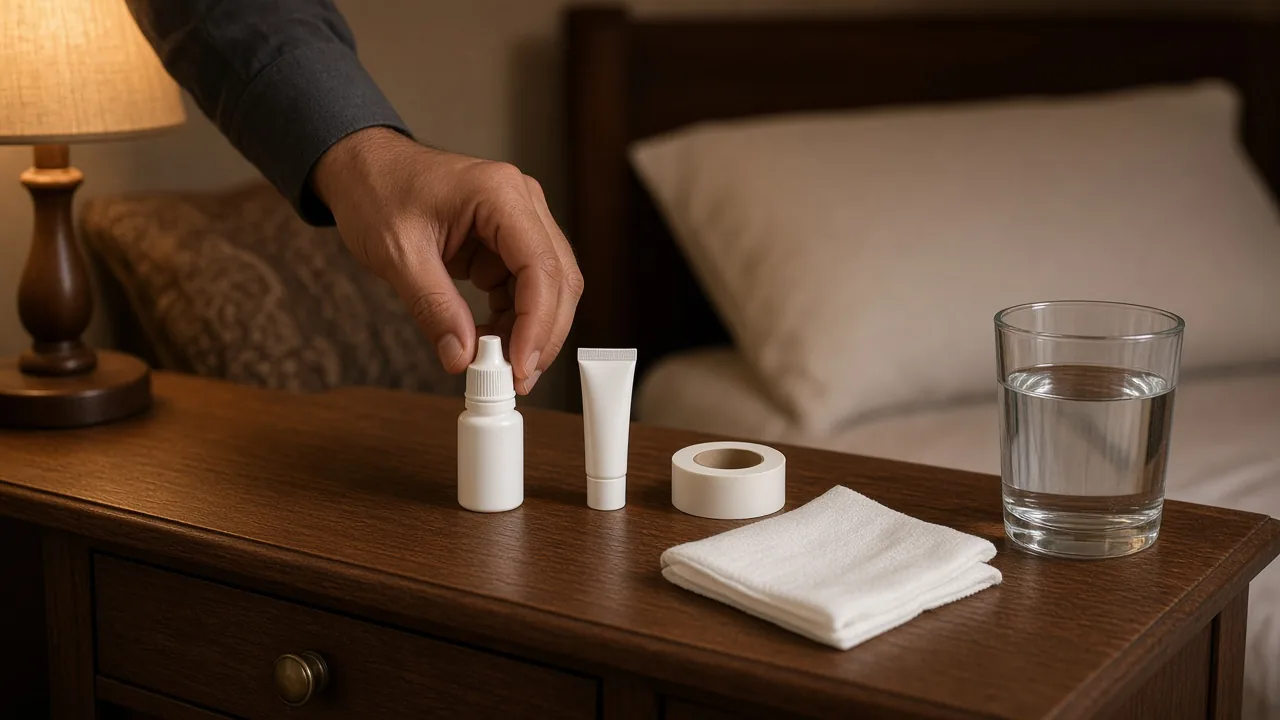
If the eyelid cannot close fully, the eye dries out and is easily scratched. Lubricating drops by day, ointment and taping the eye closed at night protect it until the blink returns.
The NHS lists eye drops and ointment to stop the eye drying out, and surgical tape to keep the eye closed at bedtime, as part of Bell’s palsy treatment. It adds that if the person cannot close the eye at all, they may need treatment to prevent damage to their vision. Ask the doctor which drops and ointment to use, how often, and how to tape the lid safely, and keep doing it until the eye closes properly on its own.
Practical habits help at home. Keep drops by the bed and in a pocket so they are not forgotten. Wash hands before touching the eye, and avoid rubbing it. Ceiling fans, air conditioning and the dust that blows through Islamabad and Rawalpindi on windy days can all dry the eye further, so some people find glasses or wraparound sunglasses outdoors more comfortable. Ask the doctor whether that suits you.
Go back to the doctor promptly if the eye becomes painful or red, if vision changes, or if there is a discharge. A long-term watering eye can also happen after Bell’s palsy, and that too is worth raising.
When do facial exercises help, and when should you wait?
Gentle, tailored facial exercises may help some people, mainly those with moderate or long-lasting weakness, but the evidence is limited and mostly low quality. They are not a substitute for early medical treatment.
A Cochrane review of physical treatments for Bell’s palsy looked at 12 studies with 872 people, most at high risk of bias. Two trials found no difference in incomplete recovery at six months between people who did exercises and those who did not. One small study of moderate quality found that exercises helped people with long-standing facial palsy. One low-quality study in people with recent Bell’s palsy found fewer cases of synkinesis and a shorter time to recovery, mainly in more severe cases, after three months of exercise. The authors concluded that tailored facial exercises can help improve facial function, mainly in moderate and chronic cases, and that early exercise may shorten recovery, but that this evidence is of poor quality.
In practice, that means a few things for families thinking about facial exercises for Bell’s palsy:
- Medical treatment and eye care come first. Exercises are an add-on, not an alternative to seeing a doctor in the first 72 hours.
- Gentle beats forceful. Slow, controlled movements in front of a mirror are the usual approach. Hard grimacing, and chewing gum to “work the face”, are not recommended. Chewing uses different muscles and may increase synkinesis, according to Pakistani rehabilitation doctors.
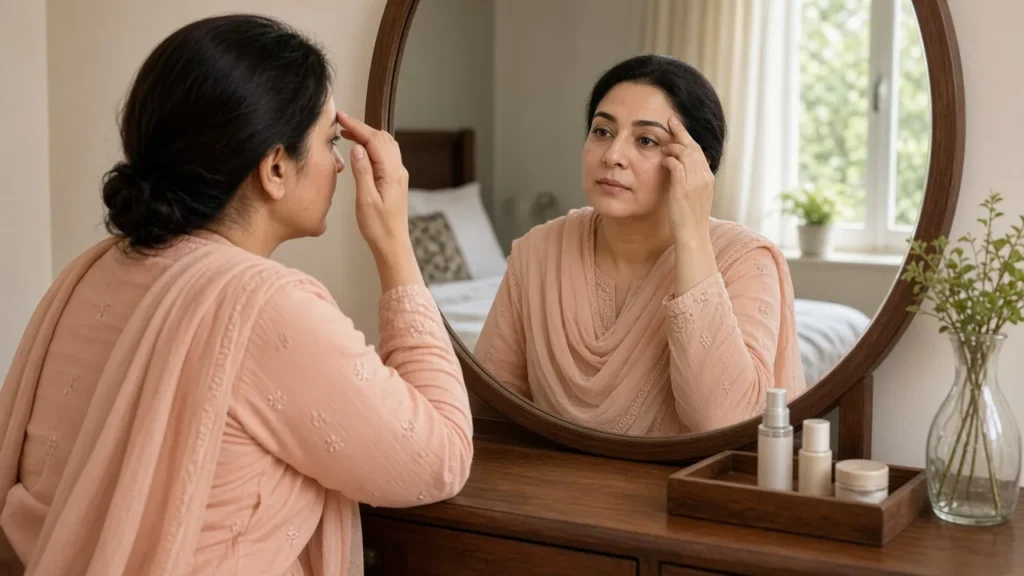
- Use the mirror. Some families cover mirrors after lakwa. There is no basis for this, and a mirror is useful for practising controlled movement.
- Do not expect exercise to force the nerve to heal faster. Recovery depends mostly on the nerve itself. Exercise aims to help the face move as evenly as possible as the nerve recovers, and to reduce unwanted linked movements.
Electrical stimulation, often offered as “current” therapy, has weaker support. The same Cochrane review found no benefit over placebo for incomplete recovery at six months, and not enough evidence to say whether it works.
What does a physiotherapist do for Bell’s palsy at home?
A physiotherapist assesses facial movement, explains what to expect, and teaches a short, gentle routine that fits the stage of recovery, with the family shown how to help.
Our physiotherapy service includes neurological rehabilitation for people whose movement is affected by a condition of the brain, spinal cord or nerves. Treatment starts with an assessment at home, covering history, movement and the person’s goals, and the physiotherapist explains the plan afterwards. Family members learn how to help between sessions. A female physiotherapist is available if you prefer, which some women find more comfortable when the face and appearance are involved.
A first session usually looks at how much each part of the face moves, whether the eye closes, how eating and drinking are going, and what the doctor has already prescribed. The routine that follows is short and simple, so it can be done daily in front of a mirror. If you want a therapist with particular experience of facial palsy, ask about that when you book. Online video sessions are also available, which can suit follow-up checks of a home routine.
Physiotherapy is most useful alongside medical care, not instead of it. If recovery stalls, the therapist may suggest going back to the doctor or asking for a specialist review.
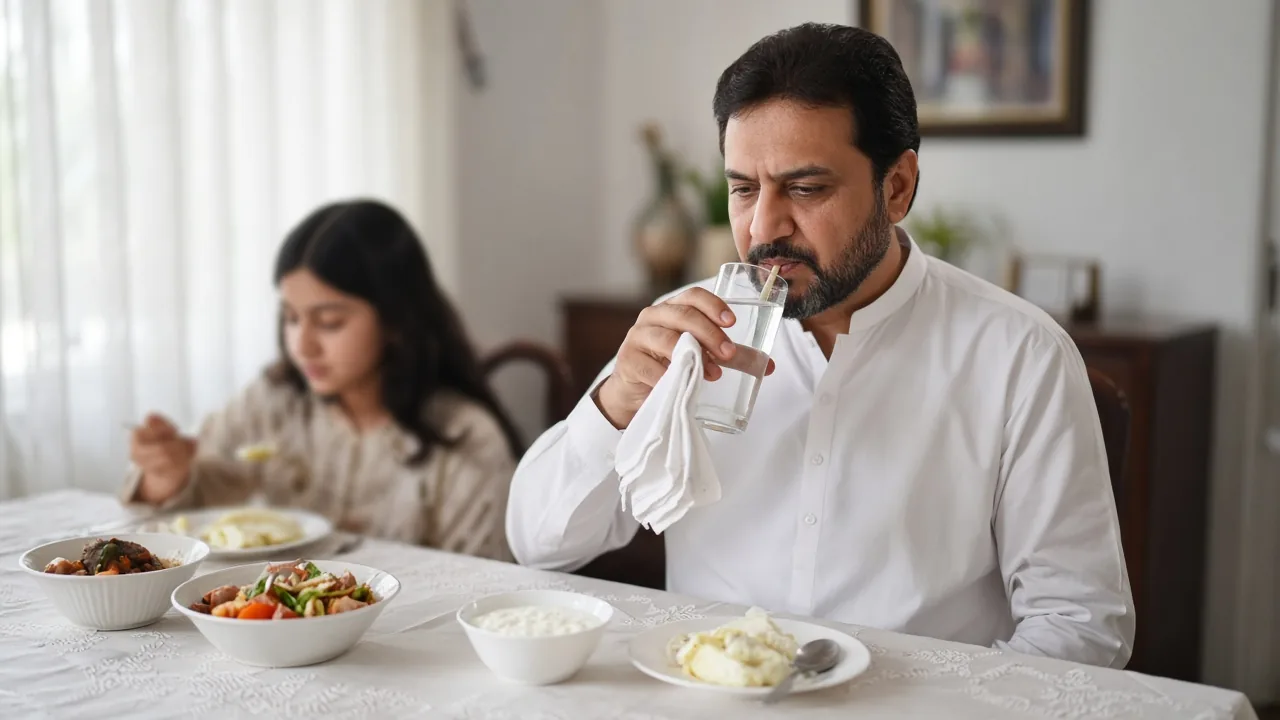
How does Bell’s palsy affect eating, drinking and speaking?
Weak lips and cheek can make drinks spill, food collect inside the cheek and some sounds unclear. Small changes at meals help, and a speech therapist can help if problems persist.
The NHS lists drooling, a dry mouth and loss of taste among the symptoms of Bell’s palsy, and difficulty eating and drinking among the possible long-term problems. During recovery, many people find it easier to take small sips, use a straw or a cup with a narrow rim, take smaller bites, chew on the stronger side and check the weak cheek for trapped food after meals. Brushing and rinsing after eating keeps the mouth clean when food tends to collect.
Speech is usually affected less than eating, but sounds made with the lips, such as “p”, “b” and “m”, can be harder. If drooling, eating or unclear speech continue, our speech therapy team works with drooling, swallowing difficulties and unclear speech caused by weak speech muscles.
Which lakwa myths and desi remedies should you avoid?
Cold air, fans and washing the face do not cause Bell’s palsy, and remedies such as hot turmeric packs or pigeon meat have no evidence behind them. The real risk is that they delay treatment.
Two Pakistani rehabilitation doctors documented common beliefs about facial palsy from more than a decade of practice. They described patients covering the face with warm cloth in hot summers, applying hot turmeric paste, avoiding baths, face washing, tooth brushing and shaving, refusing to sit near a fan or air conditioner, covering every mirror in the house and eating the meat of wild pigeons. Their conclusions were clear: cold exposure is not a documented risk factor, Bell’s palsy is a nerve problem rather than a blood-flow problem, and there is no documented role for any special diet. They also noted that systematic reviews do not support treatments such as cupping, herbal decoctions or homeopathy, because the trials are poor quality.
Many searches for “lakwa ka ilaj” lead to remedies like these. These customs usually come from care and from what elders have seen before, and many are harmless in themselves. The concern is time. A family that spends the first three days on home remedies may miss the window when steroid treatment helps most. Keep washing, brushing and shaving as normal, protect the eye, and see a doctor first. If you want to try any remedy, check with the doctor that it will not interfere with treatment.
When should you go back to the doctor?
Go back if there is no improvement after three weeks, if the eye becomes painful or red, or if new symptoms appear. Weakness spreading beyond the face is an emergency.
- New weakness or numbness in an arm or leg, confusion or slurred speech: call emergency services (1122) or go to the nearest emergency department.
- No sign of improvement three weeks after the weakness began.
- A painful, red or sticky eye, or any change in vision.
- Weakness on both sides of the face, which is rare.
- Weakness that keeps getting worse after the first week, or new symptoms such as severe ear pain or hearing changes.
- Weakness, tightness or unwanted linked movements still present at six months: ask for a specialist review.
- Low mood or anxiety. The NHS notes that living with Bell’s palsy can make people feel depressed, stressed or anxious, and a doctor can help.
Most people only get Bell’s palsy once, although the NHS says it can rarely come back, sometimes years later.

Where can you get physiotherapy for Bell’s palsy at home in Islamabad and Rawalpindi?
IRHC’s physiotherapists visit homes in almost all areas of Islamabad and Rawalpindi, Monday to Sunday, 9 am to 9 pm. Online video sessions and partner clinic appointments are also available.
See our home physiotherapy service for neurological rehabilitation, and our speech therapy service if drooling, eating or speech remain a problem. Each starts with an assessment, and the therapist explains the plan afterwards. If a home visit does not suit you, partner clinic appointments are available at G-8 Markaz, Islamabad and Saddar, Rawalpindi, by booking ahead. Please see a doctor first for diagnosis and treatment, and keep their notes and prescription ready for the first therapy session.
Recovering from Bell’s palsy?
Once a doctor has made the diagnosis, book a home physiotherapy assessment in Islamabad or Rawalpindi. An IRHC physiotherapist will look at how your face is moving, talk you through realistic Bell’s palsy recovery time, and teach a gentle routine you can do in front of a mirror. Every booking is confirmed on WhatsApp. For fees, timings and payment, see our FAQs.
Book an appointment | WhatsApp 0300-6844361 | Call 051-8776556
Frequently Asked Questions
Quick answers to what people ask most about Bell’s palsy recovery. For fees, timings and payment, see our FAQs page.
Can Bell’s palsy go away on its own?
Often, yes. Bell’s palsy gets completely better without treatment in most people, but not all. Because steroid treatment started early lowers the chance of being left with facial weakness, a doctor should still see the person quickly rather than waiting to see if it settles.
Lakwa kitne din mein theek hota hai? How many days does facial lakwa take to get better?
There is no fixed number of days. Many people start to improve within about three weeks, and the NHS says most get better within six months, though it can take longer. Recovery is usually quicker when the weakness was partial. If there is no improvement after three weeks, go back to the doctor.
Does everyone with Bell’s palsy recover completely?
No. In the largest untreated series summarised in a BMJ Clinical Evidence review, 71% recovered complete facial movement. About 85% showed clear improvement within three weeks, and the rest started to improve within three to five months. Early steroid treatment, when a doctor advises it, can improve the odds further. Recovery is usually faster and more complete when the weakness was partial rather than complete.
Is Bell’s palsy the same as a stroke?
No. Bell’s palsy affects the facial nerve, while a stroke affects the brain. But a drooping face can be a sign of either, and families cannot safely tell them apart at home. If the face droops together with arm or leg weakness or trouble speaking, treat it as an emergency.
Should we start steroid tablets ourselves?
No. Steroids, sometimes with an antiviral medicine, are prescribed by a doctor after an examination, ideally within 72 hours of the weakness starting. The doctor will check whether they are safe for the person, for example with diabetes or pregnancy. Do not buy steroids over the counter or stop a prescribed course early.
When should facial exercises start after Bell’s palsy?
Ask the doctor or physiotherapist. In the early days, eye protection and medical treatment come first. Gentle, guided exercises in front of a mirror may then help some people, and the evidence is best for long-standing weakness. Avoid forceful grimacing and chewing gum, which may encourage unwanted linked movements.
How should I protect the eye in Bell’s palsy?
If the eye does not close fully, it can dry out and become damaged. Use lubricating drops in the day and ointment at night if your doctor advises it, and consider taping the eye closed for sleep. Sunglasses can help in dust and wind. Get medical help promptly if the eye is painful, red, or the vision changes. Eye care matters even if facial movement is already starting to return.
Does cold air, a fan or washing the face cause lakwa?
Exposure to cold has not been shown to cause Bell’s palsy. A Pakistani rehabilitation team described patients avoiding fans, showers, face washing, brushing and shaving for this reason. You can wash, brush your teeth and shave as normal. Just keep the affected eye protected.
Does electrical stimulation (current) help Bell’s palsy?
The evidence does not show that it helps. A Cochrane review found no benefit from electrical stimulation over placebo for recovery at six months, and not enough evidence to decide whether it works. Ask your doctor or physiotherapist before paying for a course of it.
How much does home physiotherapy cost in Islamabad or Rawalpindi?
At IRHC, a first or single home visit for physiotherapy or speech therapy is Rs 3,000, and a session lasts 45 minutes. Packages are discounted: 10% off 5 sessions and 15% off 10 sessions. Payment is made in advance, once the booking is confirmed, by Easy Paisa, JazzCash, U Paisa, Raast ID, bank transfer or cash.
How do I book a home physiotherapy assessment?
Call 051-8776556 (9 am to 6 pm), WhatsApp 0300-6844361 (answered 24/7), or use the online appointment form. Our physiotherapists visit almost all areas of Islamabad and Rawalpindi, Monday to Sunday, 9 am to 9 pm, and every booking is confirmed on WhatsApp. Keep the doctor’s notes and prescription ready for the first visit.
Medical disclaimer: This article is for general information only. It does not replace an examination by a doctor or an assessment by a physiotherapist. Sudden facial weakness needs urgent medical review, and facial droop with arm or leg weakness or speech trouble is an emergency.