Short answer: Hearing loss after meningitis is the most common after-effect of bacterial meningitis, so every child who has had it needs a proper hearing test, even if they seem to hear normally. UK guidance (NICE) says to offer an audiological assessment within 4 weeks of the child being well enough for testing, preferably before leaving hospital. Ask for age-appropriate tests: tympanometry and OAE, then ABR (BERA) or ASSR for babies and young children, or pure tone audiometry for older children. If severe or profound loss is found, an urgent cochlear implant assessment matters, because the inner ear can scar over time. Families in Islamabad and Rawalpindi can book these hearing tests at home with IRHC.
This guide is general information. It is not medical advice and does not replace an assessment by your child’s doctor or a qualified audiologist.
Meningitis is a medical emergency. If a child has symptoms such as fever with a severe headache, a stiff neck, unusual sleepiness or floppiness, a rash that does not fade when pressed, or a seizure, take them to hospital immediately or call 1122. This guide is about hearing after treatment. It is not about managing meningitis at home.
Listen to a short overview
58 seconds · a spoken summary of this guide. It does not replace advice from your child’s doctor or audiologist.
Key takeaways
- Hearing loss is the most common after-effect of bacterial meningitis. NDCS puts it at around 1 in 10 children. Viral meningitis does not usually cause it.
- Test within 4 weeks of your child being well enough, ideally before discharge, even if they seem to hear you.
- An absent OAE is a warning sign, not a final diagnosis. It needs prompt follow-up with ABR (BERA) and ASSR.
- Severe or profound loss needs an urgent cochlear implant assessment, because scarring inside the inner ear can make implants harder later.
- IRHC offers tympanometry, OAE, BERA, ASSR and audiometry at home in Islamabad and Rawalpindi. See hearing services.
In this guide
- Can meningitis cause hearing loss in children?
- Why testing is urgent
- Which tests to ask for (table)
- When to test, and for how long
- What did a Pakistani study find about hearing loss after meningitis?
- Is it permanent?
- Fever and other infections
- If hearing loss is found
- Signs to watch for at home
- Hearing tests in Islamabad and Rawalpindi
- FAQs
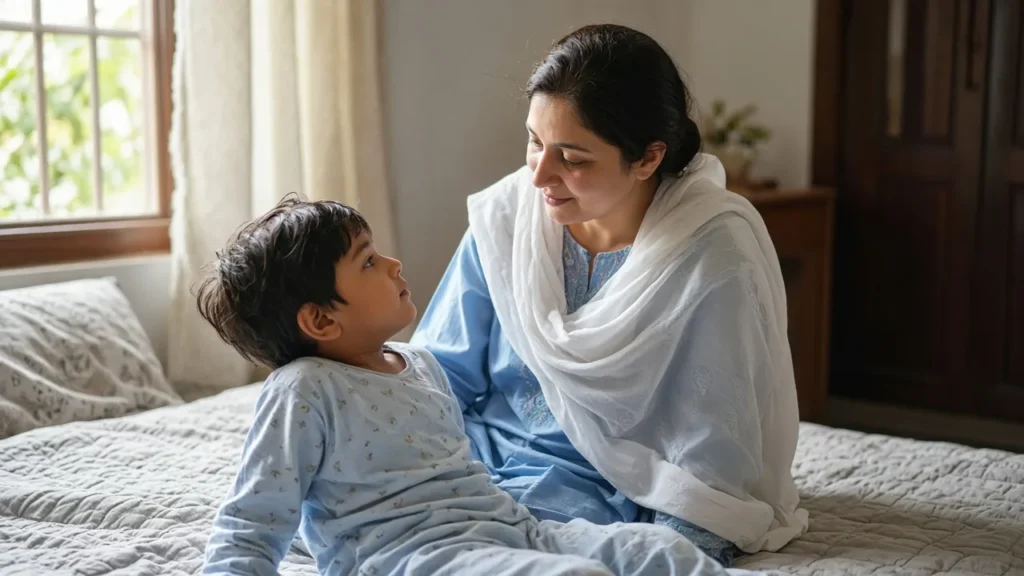
When a child comes home after meningitis, families are usually just relieved. The fever has gone, the drips are out and the focus is on eating, sleeping and getting back to normal. Hearing is rarely the first thing anyone thinks about, and if the child answers when called, it can seem fine. But hearing loss is the most common after-effect of bacterial meningitis, mild loss is easy to miss, and the timing of testing really matters. This guide explains which hearing tests parents should ask for, when to ask, and how to get them done in Islamabad or Rawalpindi.
Can meningitis cause hearing loss in children?
Yes. Bacterial meningitis can damage the inner ear or the hearing nerve, and hearing loss is its most common after-effect. The UK charity NDCS says around 1 in 10 children who have bacterial meningitis become deaf as a result. Viral meningitis does not usually cause hearing loss.
Meningitis is inflammation of the membranes that protect the brain and spinal cord, usually caused by a bacterial or viral infection. According to the National Deaf Children’s Society (NDCS), the most common way bacterial meningitis causes deafness is by the infection spreading into the cochlea, the snail-shaped hearing organ in the inner ear, and damaging its hair cells. Inflammation of the hearing nerve is another possible cause. The loss can range from mild to profound and can affect one or both ears. Some children also develop balance problems or tinnitus.
Babies, toddlers and children under 5 are the group most at risk of meningitis, which is also the age when children are learning to talk. That is why the link between meningitis and hearing loss in children deserves the same attention as any other follow-up check. WHO lists meningitis and other infections among the main causes of hearing loss in childhood.
Why is a hearing test urgent after bacterial meningitis?
Hearing loss usually happens early in the illness, mild or one-sided loss is easy to miss at home, and in some children the inner ear starts to scar and harden. That scarring can make a cochlear implant harder to fit later, so early testing protects every option.
NICE’s 2024 guideline on bacterial meningitis, NG240, recommends offering an audiological assessment within 4 weeks of the person being well enough for testing, and preferably before discharge. It also recommends offering children with severe or profound deafness an urgent assessment for cochlear implants, and a review with a paediatrician 4 to 6 weeks after discharge that covers the hearing results.
NDCS adds a practical point for parents. Severe or profound deafness may be obvious, but mild or moderate loss often is not. A child who turns when you call from close by may still be missing a lot of speech, especially in one ear or in a noisy room.
Cochlear ossification: why implant timing matters
After bacterial meningitis, inflammation inside the cochlea can be followed by scarring (fibrosis) and then new bone forming inside it (ossification). A 2022 review and clinical protocol in the Indian Journal of Otolaryngology and Head and Neck Surgery notes that fibrosis can begin as early as 3 days after the infection starts and ossification can continue for up to a year. As the space inside the cochlea fills, placing a cochlear implant can become more difficult within a few weeks. Not every child develops this, and evidence on timing is limited, but it is the main reason specialists treat severe or profound loss after meningitis as urgent.
Which hearing tests should parents ask for after meningitis?
Ask for a full, age-appropriate audiological assessment, not just a quick screen. For most children that starts with tympanometry and OAE, followed by ABR (BERA) and often ASSR for babies and young children, or pure tone and speech audiometry for children old enough to respond.
Each test answers a different question. You do not need to choose them yourself, but knowing the names helps you ask the right questions and understand the report.
- Tympanometry checks how the eardrum moves. It shows middle ear fluid, which can affect other results.
- OAE (otoacoustic emissions) records the faint echo a healthy cochlea gives back to sound. It is quick and needs no response, so it is a useful first check.
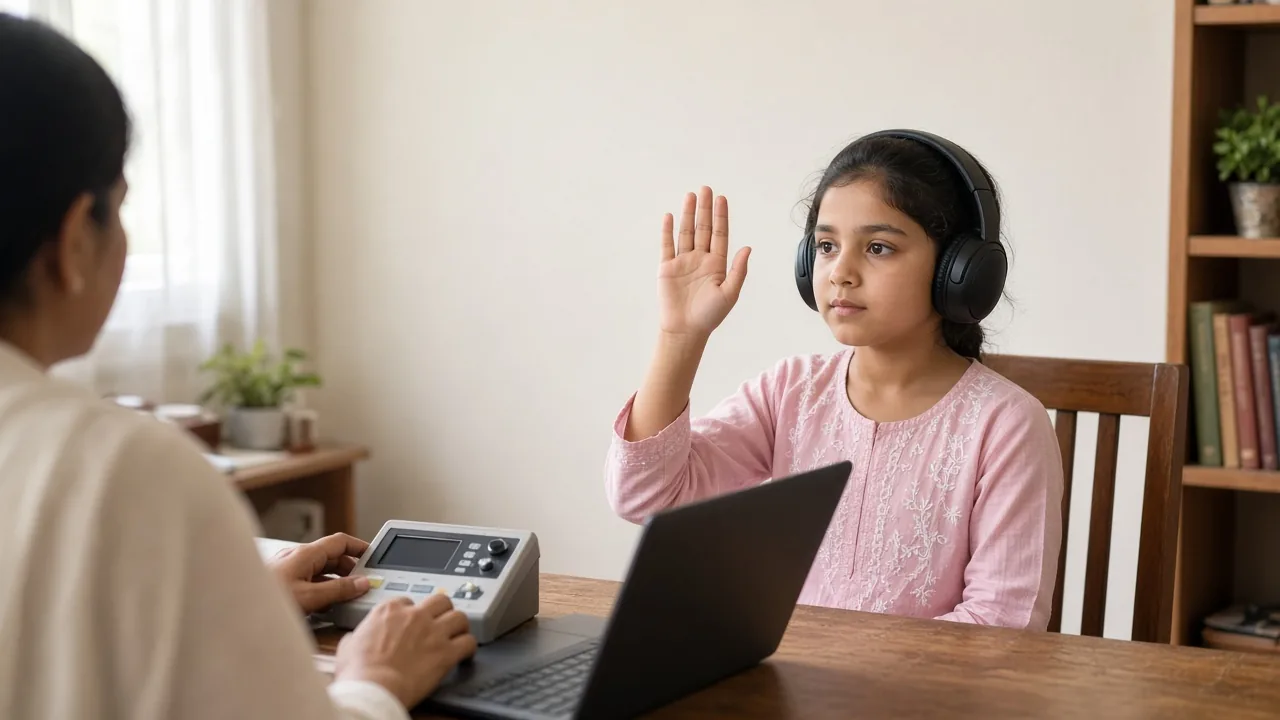
- ABR or BERA (auditory brainstem response) uses small sensors on the head to measure how the hearing nerve responds. It can estimate hearing levels in babies and young children who cannot respond to beeps.
- ASSR (auditory steady state response) works like ABR but estimates hearing at specific pitches. It is often done alongside ABR.
- Pure tone and speech audiometry measure the softest sounds and words a child can hear, for children old enough to respond reliably.
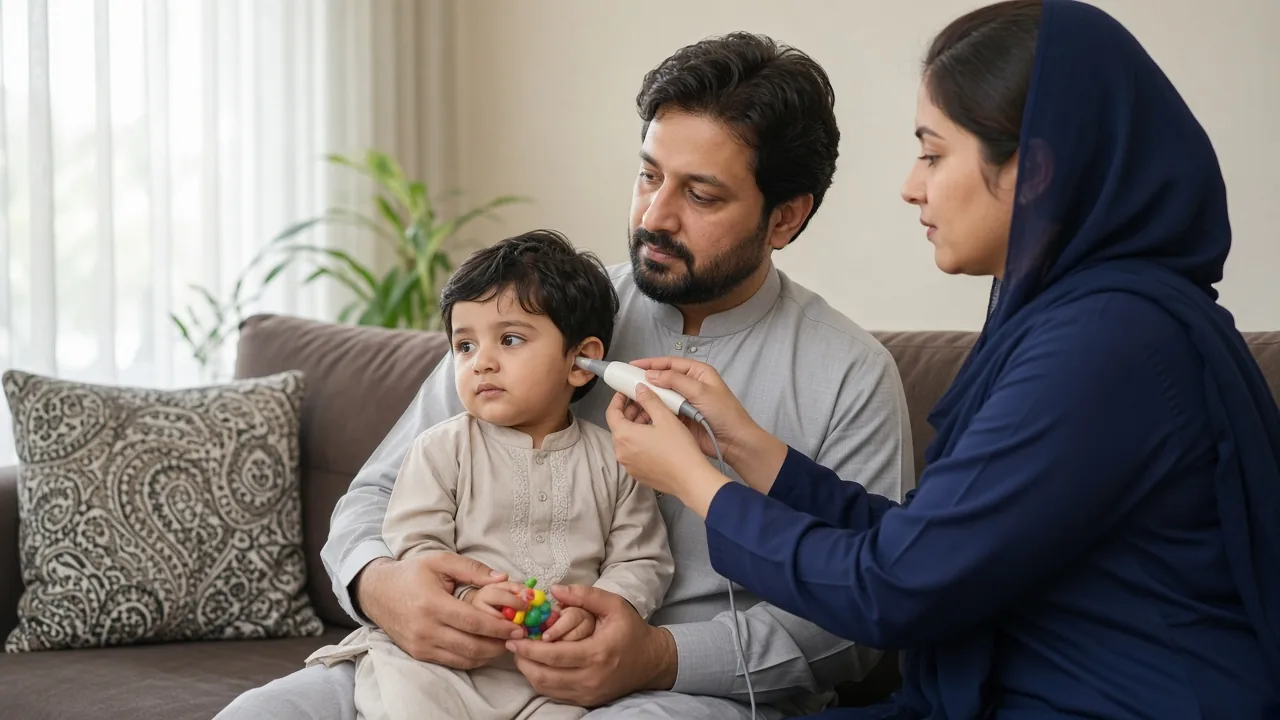
The 2022 protocol suggests an OAE test while the child is still in hospital, with urgent referral for further testing if OAEs are absent. It is important to read OAE results carefully. OAE is a screening test: it can be affected by middle ear problems, and it cannot measure how much hearing is lost or check the hearing nerve. An absent OAE is a reason to test further quickly, not a diagnosis. For a fuller description of each test, see our guide to which hearing tests can be done at home.
| Situation | Hearing tests to ask about | When, according to guidance |
|---|---|---|
| Still in hospital after bacterial meningitis | Ask whether a hearing check can be done before discharge. An early OAE test, with tympanometry to check the middle ear, is a common first step. | NICE: preferably before discharge |
| Home after bacterial meningitis, not yet tested | A full audiological assessment suited to age: tympanometry and OAE for all ages; ABR (BERA), often with ASSR, for babies and young children; pure tone and speech audiometry for older children. | NICE: within 4 weeks of being well enough for testing |
| OAE absent, or any hearing loss found | Further testing with ABR (BERA) and ASSR to measure the hearing level in each ear, plus an ENT review. Doctors may also arrange imaging. | As soon as possible; do not wait for the next routine visit |
| Severe or profound hearing loss found | Urgent referral for a cochlear implant assessment at a specialist implant centre. | NICE: urgent; the 2022 protocol stresses early action because the inner ear can scar |
| First test normal | Ask your paediatrician whether and when to repeat the test. Retest at any time if you notice a change. | Schedules differ between guidelines and doctors |
| Viral meningitis | Not routinely needed. Ask for a referral if you notice any change in hearing. | If concerns arise (NDCS) |
| Other serious infection, or parents worried | An age-appropriate hearing test. The audiologist chooses which tests to use. | Whenever you are concerned |
When should hearing be tested after meningitis, and for how long?
Test as soon as your child is well enough, ideally before discharge and within 4 weeks at most. After that, how often to retest depends on the first result and on your doctors, because guidelines differ. Any change you notice is a reason to test again.
NDCS notes that a child’s hearing may change in the early days after the illness and normally settles during the first few months. That is one reason specialists may repeat tests even when hearing loss has already been found.
Follow-up schedules vary. The 2022 protocol reviews several. One older study suggested a recheck 6 months later if the first test was normal and 3-monthly tests until the hearing level was stable if loss was found. A French group suggested testing every 4 months for 2 years. The Dutch cochlear implant group recommends follow-up at 1, 2, 6 and 12 months when the first test is normal. The protocol’s authors suggest following every child for at least 2 years. Other guidelines are less intensive, so ask your child’s paediatrician what plan suits your child. Whatever the plan, keep every report together and bring it to each visit.
What did a Pakistani study find about hearing loss after meningitis?
In a study of 175 children admitted with meningitis at a children’s hospital in Lahore, OAEs were absent in 22% when tested two weeks after admission. Longer hospital stays, low consciousness on arrival and complications were linked with hearing problems. The authors recommend hearing screening after meningitis.
The study, published in 2018 in the Pakistan Journal of Medical Sciences, included children aged 1 month to 13 years admitted between January 2014 and July 2016. Children with a normal tympanogram had an OAE test two weeks after admission; those with an abnormal tympanogram were sent to ENT. Hearing problems were linked with a hospital stay of more than 10 days, a low Glasgow Coma Scale score at presentation, and meningitis with complications.
The authors are open about the limits. OAE is a screening test, so they could not grade how severe the hearing loss was, and they could not perform ABR testing. They describe the 22% as children identified as at risk of deafness, not children with confirmed permanent loss. It is also one hospital’s experience. Even so, it is a clear local signal that hearing problems after meningitis are not rare in Pakistani children, and that testing should be routine.
Is hearing loss from meningitis permanent?
Often, yes. Bacterial meningitis usually causes sensorineural hearing loss, which is permanent. Hearing can still change in the first weeks and usually settles within a few months. Hearing aids or cochlear implants can help children hear and develop language.
NDCS explains that sensorineural loss comes from damage to the inner ear or hearing nerve, and that it is permanent. Not every hearing problem found after an illness is of this kind, though. Fluid in the middle ear can cause temporary loss, which is one reason tympanometry is part of the assessment. In an older study described in the 2022 protocol, most of the 64 children followed after post-meningitis hearing loss (86%) had stable hearing levels over time, while a small number improved, worsened or fluctuated. Your audiologist can tell you which picture fits your child as tests are repeated.
Can a high fever or another serious infection cause hearing loss?
Fever is a sign of infection rather than a cause of hearing loss in itself. The sources we checked list infections such as meningitis and chronic ear infections as causes of childhood hearing loss. If your child has had a serious illness and you have any doubt about their hearing, ask for a test.
Many families in Pakistan believe that a high fever can “take away” a child’s hearing. The concern behind it is reasonable: some of the illnesses that cause high fevers, such as meningitis, can damage hearing. WHO’s list of childhood causes includes chronic ear infections, fluid in the middle ear, and meningitis and other infections. The practical message is the same whatever the illness: if your child seems to hear less, speak less clearly, or react less to sound after being unwell, get their hearing checked rather than waiting for it to settle.
If your baby had meningitis or another serious infection in the first weeks of life, a newborn screening result from before the illness no longer tells you about their hearing now. Our guide to newborn hearing screening in Pakistan explains baby hearing tests and the 1-3-6 timeline.
What happens if hearing loss is found after meningitis?
The next steps depend on the type and degree of loss. Mild to moderately severe loss is usually managed with hearing aids, while severe or profound loss needs an urgent cochlear implant assessment at a specialist centre. Speech and language support helps in both cases.
The 2022 protocol recommends hearing aids for permanent, non-progressive loss from minimal to moderately severe, and early cochlear implantation when profound loss is found. NICE recommends an urgent cochlear implant assessment for severe or profound deafness. Doctors may also arrange an MRI or CT scan, which can show early scarring or bone formation in the cochlea and help plan an implant. An ENT specialist and an implant team make these decisions with the family.
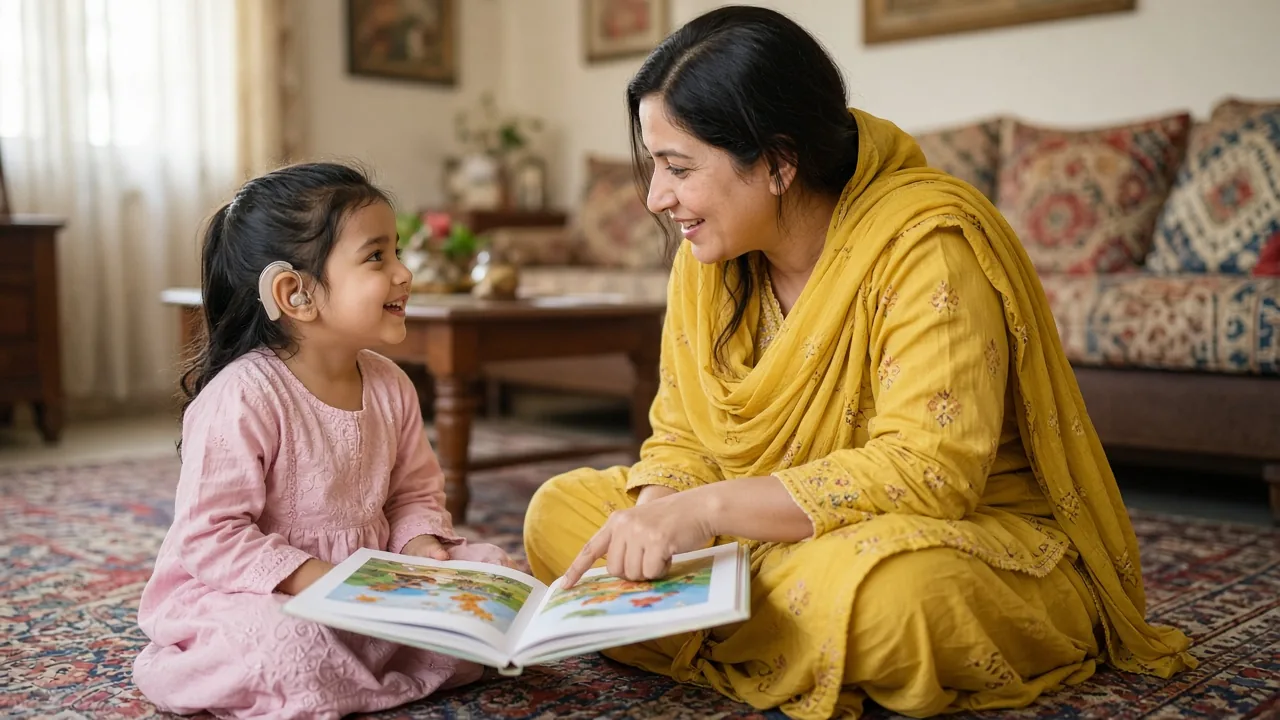
Alongside hearing technology, children benefit from speech and language support, especially if the loss happened before or while they were learning to talk. IRHC offers speech therapy at home and by online video, and supplies hearing aids with fitting, adjustment and follow-up through a partner setup. Cochlear implant assessment and surgery are done at specialist implant centres.
What signs of hearing loss should parents watch for at home?
Watch for a child who does not respond when called, turns the TV up, speaks less or less clearly, seems unsteady, or complains of ringing. Any of these after meningitis is a reason to test again, even if an earlier test was normal.
- not turning or responding when called from another room or from behind;
- asking “what?” more often, or watching faces closely to follow speech;
- wanting the TV or phone louder than before;
- new delays in speech, fewer words, or speech that has become less clear;
- favouring one ear, or struggling in noisy places;
- clumsiness or poor balance, or a child who says their ears are ringing or buzzing.
Home tests such as clapping behind a child are not reliable, because children can react to movement, vibration or other cues. A proper hearing test is the only way to know. If speech is your main worry, our guide on whether a child is a late talker or needs speech therapy explains what is typical at each age.
How can you get a hearing test after meningitis in Islamabad and Rawalpindi?
Before discharge, ask the treating team whether a hearing test can be done or booked. If it was not, ask your paediatrician for a referral or book an audiologist directly. IRHC offers the main hearing tests for children at home in almost all areas of both cities.
Questions worth asking at discharge or at the follow-up visit:
- Was my child’s hearing tested in hospital, and what was the result for each ear?
- Which tests should be done next, and by what date?
- If the result is abnormal, where will my child be referred for ABR (BERA) and a cochlear implant assessment?
- How long should hearing be followed up, and who will arrange it?
IRHC’s hearing services page states that every hearing test offered at the clinic can also be done at home, including OAE, tympanometry, BERA, ASSR and pure tone audiometry. The audiologist chooses tests to suit the child’s age, explains the results at the end of the visit, and advises seeing an ENT specialist when results point to a medical cause. Home testing can help a child who is still tired after hospital, and young children often settle better for BERA in familiar surroundings. Visits run Monday to Sunday, and families can also book at partner clinics in G-8 Markaz, Islamabad and Saddar, Rawalpindi, or arrange an online video consultation.
When you book, share your child’s age, when they had meningitis, the discharge summary, any earlier hearing results, and your area.
Need a hearing test for your child after meningitis?
IRHC’s audiologist can test your child at home in Islamabad and Rawalpindi, Monday to Sunday, and every booking is confirmed on WhatsApp. For fees, timings and payment methods, see our FAQs, or read more about our hearing services.
Book an appointment | WhatsApp 0300-6844361 | Call 051-8776556
Frequently Asked Questions
Quick answers to what parents ask about hearing loss after meningitis and hearing tests for children. For fees, timings and payment, see our FAQs page.
How soon should my child have a hearing test after meningitis?
After bacterial meningitis, UK guidance from NICE says to offer an audiological assessment within 4 weeks of your child being well enough to be tested, and preferably before they leave hospital. If that did not happen, arrange the test now.
Does my child need a hearing test after meningitis if they seem to hear fine?
Yes. Mild or one-sided loss is easy to miss at home. Hearing loss is the most common after-effect of bacterial meningitis, and NDCS says around 1 in 10 children who have it become deaf as a result. NICE recommends an audiological assessment within 4 weeks of the child being well enough for testing, preferably before discharge, even if they seem to hear normally.
Which hearing tests should parents ask for after meningitis?
Ask for a full, age-appropriate audiological assessment, not just a quick screen. For most children that starts with tympanometry and OAE, followed by ABR (BERA) and often ASSR for babies and young children, or pure tone and speech audiometry for children old enough to respond. An absent OAE is a reason to go on to a full assessment, not a diagnosis of deafness on its own.
Is hearing loss from meningitis permanent?
Often, yes. NDCS explains that bacterial meningitis causes sensorineural hearing loss, which is permanent. In the early weeks the hearing level can change, and it usually settles during the first few months. Hearing aids or a cochlear implant can help, depending on the degree of loss.
Can viral meningitis cause hearing loss?
Viral meningitis does not usually cause deafness, and children who have had it are not routinely sent for hearing tests. If you notice any change in your child’s hearing afterwards, ask your doctor for a referral to an audiologist.
Can a high fever cause hearing loss in a child?
Fever is a sign of infection. The sources we checked list infections such as meningitis and chronic ear infections, not fever itself, as causes of childhood hearing loss. If your child has had a serious illness with fever and you are worried about their hearing, ask for a hearing test.
My child’s OAE test was absent after meningitis. Does that mean deafness?
Not necessarily. OAE is a screening test. It can be affected by middle ear problems and cannot show how much hearing loss there is. An absent OAE should lead quickly to further tests, usually ABR (BERA) and ASSR, and an ENT review.
Why is timing important for cochlear implants after meningitis?
In some children, the inner ear can begin to scar and harden after bacterial meningitis. A 2022 clinical protocol notes that scarring can start within days and hardening can continue for up to a year, which can make an implant harder to place. That is why severe or profound loss needs an urgent implant assessment.
Can my child’s hearing be tested at home in Islamabad or Rawalpindi?
Yes. IRHC’s audiologist can carry out hearing tests at home, including tympanometry, OAE, BERA, ASSR and pure tone audiometry, in almost all areas of Islamabad and Rawalpindi, Monday to Sunday. If tests suggest a medical cause, we advise seeing an ENT specialist.
How much does a hearing test cost at IRHC?
Fees for hearing services depend on distance and time, so there is no fixed price. Call 051-8776556 or WhatsApp 0300-6844361 with your area and the tests you need for a quote. Payment is made in advance by Easy Paisa, JazzCash, U Paisa, Raast ID, bank transfer or cash.
How do I book a hearing test for my child?
Call 051-8776556 (9 am to 6 pm), WhatsApp 0300-6844361 (answered 24/7), or use the online appointment form. Share your child’s age, when they had meningitis, any discharge summary or earlier hearing reports, and your area. Every booking is confirmed on WhatsApp.
Medical disclaimer: This article is for general information only and does not replace an assessment by your child’s doctor, ENT specialist or a qualified audiologist. Meningitis is a medical emergency: if you suspect it, take your child to hospital immediately or call 1122.