Short answer: Newborn hearing screening in Pakistan is not yet a national, routine programme, so many parents have to ask for it or arrange it themselves. A “refer” result on an OAE or AABR screen does not mean your baby has hearing loss. It means the screen did not record a clear response and needs a follow-up. Ask for a second screen of both ears. If your baby does not pass again, book a full diagnostic assessment with an audiologist by 3 months of age, so that any support can start by 6 months. Families in Islamabad and Rawalpindi can also book newborn hearing screening and baby hearing tests at home with IRHC.
This guide is general information. It is not medical advice and does not replace an assessment by your baby’s doctor or a qualified audiologist.
Listen to a short overview
57 seconds · a spoken summary of this guide. It does not replace advice from your baby’s doctor or audiologist.
Key takeaways
- “Refer” means “needs another look”, not “deaf”. Temporary things such as fluid in the ear or a noisy room often cause it.
- The usual path is: first screen, second screen of both ears, then a full diagnostic assessment only if the baby does not pass again.
- Aim for the 1-3-6 timeline: screened by 1 month, diagnosed by 3 months, support by 6 months.
- Passing the screen does not rule out hearing loss later. Keep an eye on hearing and speech milestones.
- IRHC offers newborn hearing screening, OAE, BERA and ASSR at home across Islamabad and Rawalpindi. See hearing services.
In this guide
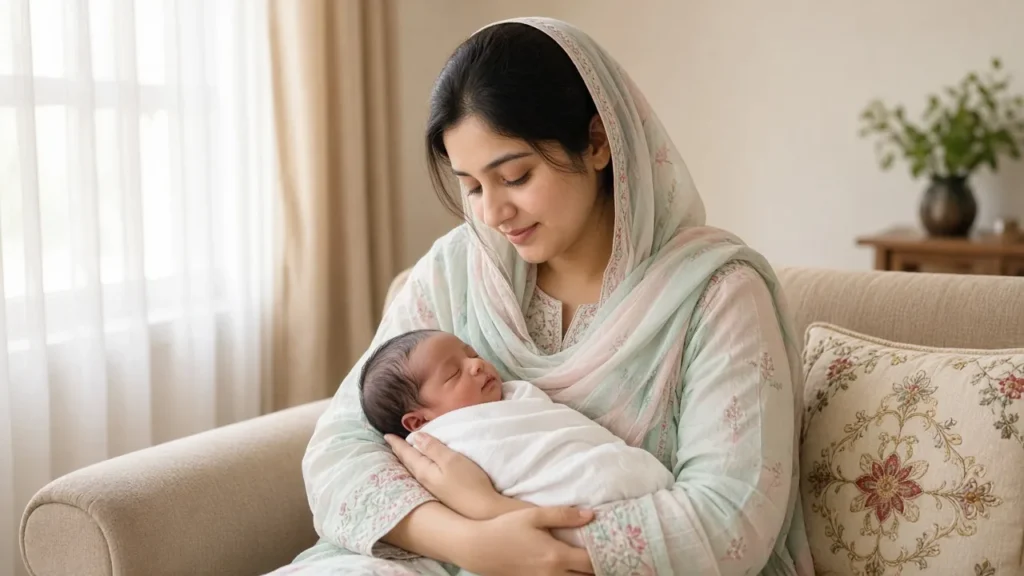
It usually happens in the last hour before you leave the hospital. Someone places a small probe in your baby’s ear, looks at a screen and says, “Refer.” Maybe nobody explains what that means, or what to do about it. By the time you are home, you have a sleeping newborn, a printed slip and a lot of questions, and perhaps a search for “newborn hearing screening Pakistan” open on your phone. This guide answers those questions: what a refer result really means, why it happens so often, what the international timelines say, and how to get the follow-up done in Islamabad or Rawalpindi without losing precious weeks.
Is newborn hearing screening routine in Pakistan?
Not yet. Published studies describe Pakistan as having no national newborn hearing screening programme, so whether your baby is screened often depends on the hospital and on whether you ask. WHO recommends that every baby is screened.
In many countries every newborn is offered a hearing screen before going home. In Pakistan it is patchy. A 2024 survey of 79 paediatricians in Rawalpindi and Islamabad, run at Riphah International University, found that 59.5% reported no universal newborn hearing screening programme in their hospitals, while expressing positive views about screening. The survey used convenience sampling, so it is a snapshot of those who responded, not a nationwide count. An earlier 2020 qualitative study, based on interviews with the heads of three public hospitals in Islamabad, listed the reasons: low awareness among the public and professionals, stretched hospitals, a lack of trained staff and equipment, home births, weak referral links and poor follow-up.
Newborn hearing screening Pakistan: what the guidance says should happen
WHO’s 2021 guide, Hearing screening: considerations for implementation, says newborn screening should be universal. It also notes that screening only babies who seem “at risk” is likely to miss around half of those with hearing loss, because many have no obvious cause. In practice, that means a healthy, full-term baby with no family history can still need a hearing test. For parents here, the message is simple: do not assume it was done. Ask before discharge, and keep the written result.
What does a ‘refer’ result on a newborn hearing test mean?
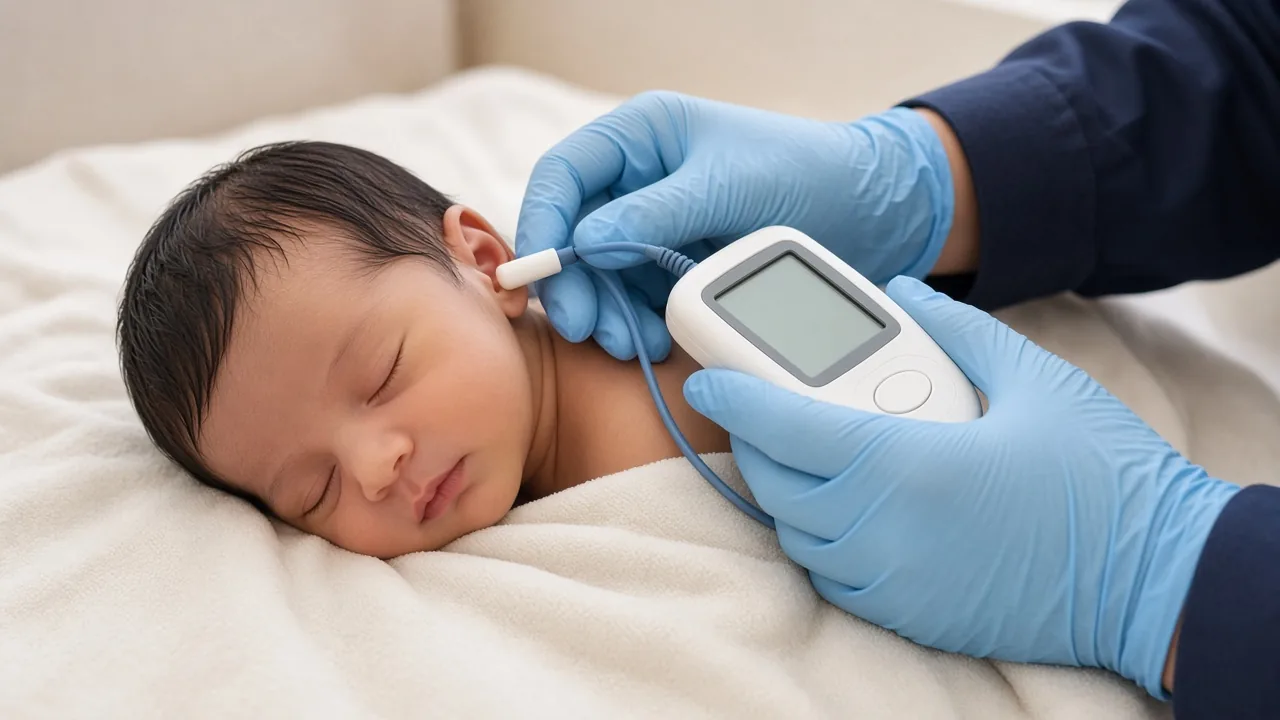
A refer result means the screening equipment could not record a clear response from one or both ears. It is not a diagnosis of hearing loss. Temporary causes are common, so many babies with a first refer go on to pass, but every refer result needs a follow-up.
Newborn screens are quick and automatic. They give a pass or refer result, not a hearing level. Some reports say “did not pass”, “fail”, “no clear response” or, for OAE, “absent”. These all mean the same thing in practice: a second check is needed. The American Speech-Language-Hearing Association (ASHA) explains that a baby has to pass in both ears in the same session for the result to count as a pass.
Why so many babies get a refer result
Both screening methods depend on sound travelling cleanly through the outer and middle ear. In the first days of life that is often not the case. ASHA lists the common reasons a screen does not pass when hearing is actually fine:
- Debris or vernix in the ear canal. The waxy coating newborns are born with can block the probe.
- Fluid in the middle ear. This is common soon after birth and often clears by itself.
- Background noise. Busy wards, fans and conversations interfere, especially with OAE.
- A baby who is awake, hungry or moving. Muscle movement disrupts the recording.
OAE and AABR results, briefly
Most screens use one of two tests. OAE (otoacoustic emissions) records the faint echo a healthy inner ear sends back. AABR (automated auditory brainstem response) uses small sensors on the head to check how the hearing nerve responds. ASHA notes that OAE is more easily affected by debris and middle ear fluid, so it tends to give more refer results. WHO adds that OAE alone cannot detect auditory neuropathy, a problem with the hearing nerve that is more common in babies who needed intensive care. For a fuller description of each test, see our guide to which hearing tests can be done at home.
What should you do after a refer result?
Arrange a second screen of both ears, ideally a few hours later in hospital or as soon as possible after discharge. If your baby still does not pass, book a full diagnostic hearing assessment with an audiologist so it is completed by 3 months of age.
WHO recommends a two-stage screening process because a single screen produces too many false alarms. The second screen should not be done straight after the first. WHO suggests a gap of at least several hours in hospital, so that temporary newborn conditions have time to settle, or a repeat as soon as possible after going home. ASHA adds that both ears should be rescreened even if only one did not pass.
- Get the result in writing. Ask which test was used, which ear or ears did not pass, and the date.
- Book the second screen before you leave, if you can. If the hospital cannot do it, ask your paediatrician who can.
- Prepare your baby. A fed, sleeping baby gives the clearest result. Plan the appointment around a nap or a feed.
- If the second screen is also refer, move on to diagnosis. Do not keep repeating screens for months. A screen can only say “check further”; it cannot tell you how well your baby hears.
Babies who spent time in a neonatal intensive care unit (NICU) follow a slightly different path. WHO and the Joint Committee on Infant Hearing (JCIH) recommend AABR screening for these babies, and ASHA’s summary of JCIH guidance says that a NICU baby who does not pass AABR should go directly to an audiologist rather than to another routine screen.
| Screening result | What it usually means | What to do next | Suggested timing |
|---|---|---|---|
| Pass in both ears | The screen recorded a clear response from each ear. Hearing loss is unlikely at this point. | No further screening is needed now. Keep watching hearing and speech milestones, and ask for a check if you are worried at any age. | Ongoing, especially if your baby has a risk factor such as a NICU stay |
| Refer in one or both ears (first screen) | No clear response was recorded. Often temporary: fluid or debris in the ear, background noise or a restless baby. It is not a diagnosis. | Ask for a second screen of both ears, not just the ear that did not pass. | Several hours later in hospital, or as soon as possible after discharge |
| Refer again on the second screen | The chance of a real hearing problem is higher, but it is still not confirmed. | Book a full diagnostic hearing assessment with an audiologist experienced in testing babies. | Completed by 3 months of age |
| Refer on AABR after a NICU stay | AABR also checks the hearing nerve, which matters more for babies who needed intensive care. | Go straight to an audiologist for rescreening and, if needed, a full assessment rather than another basic screen. | As soon as your baby is medically stable |
| Never screened, or result unclear | Your baby’s hearing status is unknown, not normal. | Arrange a screen now. Keep the written result. | Ideally by 1 month; WHO says no later than 6 weeks where screening at birth is not possible |
| Hearing loss confirmed | The type and degree of hearing loss in each ear have been measured. | Discuss options with the audiologist, ENT doctor and family: hearing technology, speech and language support, sign language or a mix. | Support started by 6 months of age |
What is the 1-3-6 timeline for newborn hearing screening?
The 1-3-6 timeline means screening by 1 month of age, a diagnostic assessment by 3 months if the baby does not pass, and support starting by 6 months if hearing loss is confirmed. WHO recommends it, and the JCIH 2019 statement encourages services that already meet it to aim for 1-2-3.
The first months of life are when babies start building the foundations of language, and they do that through hearing. The point of the timeline is to make sure a baby who cannot hear well gets help during that window, rather than being identified when speech has not appeared at age two or three.
- 1 month: first screen, and a second screen if needed. WHO says that when screening at birth is not possible, for example after a home birth, it should happen no later than 6 weeks.
- 3 months: a full diagnostic assessment for any baby who did not pass both screens.
- 6 months: support under way, such as hearing aids and early language therapy, if hearing loss is confirmed.
The JCIH, a US committee whose guidance is used widely, published an updated position statement in 2019. ASHA summarises it: services already meeting 1-3-6 should work towards screening by 1 month, diagnosis by 2 months and early intervention by 3 months. WHO also recognises that some health systems are not yet able to meet 1-3-6 and suggests they start with a flexible goal of beginning management by 1 year, while working towards the shorter timeline. For an individual family, the shorter the delay, the better. If your baby is already past these ages, the right time to act is now.
What happens at a full diagnostic hearing assessment for a baby?
A diagnostic assessment measures how well each ear hears, rather than giving a pass or refer. It usually includes ABR (BERA), often with ASSR, plus tympanometry and OAE, and a medical review to look for a cause. It works best while the baby sleeps.
WHO lists the core tests. ABR, also called BERA, is the standard way to measure the type and degree of hearing loss in each ear. ASSR can be added to estimate hearing at specific pitches. Tympanometry and acoustic reflex tests check the middle ear, which can show whether fluid is the problem. OAE, combined with ABR, helps tell a nerve problem apart from an inner ear problem. A medical evaluation looks at why any hearing loss happened. WHO stresses that the person testing should have experience testing infants and the right equipment.
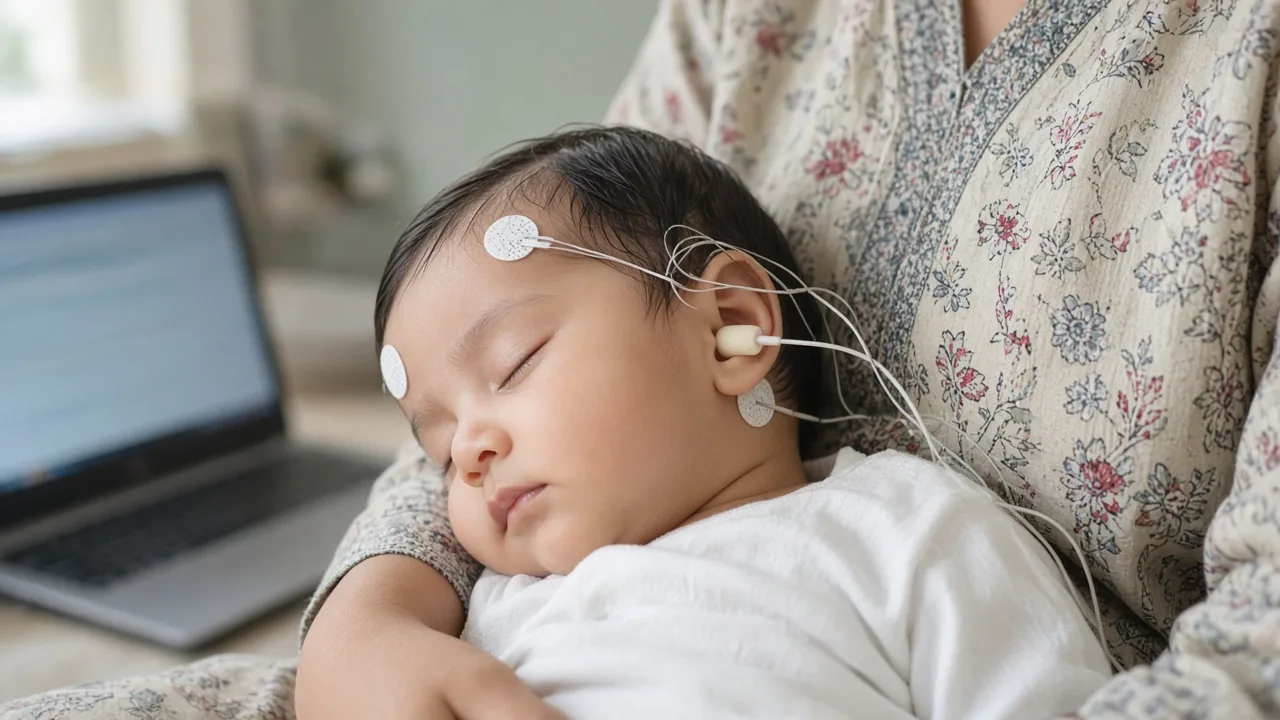
The NHS describes this follow-up appointment in the UK as taking about one to two hours, including time to settle the baby, with the parent staying throughout. Three small sensors are placed on the forehead, the back of the neck and the shoulder, and soft headphones play gentle clicks. Practical tips that help:
- Keep your baby a little awake beforehand, then feed just before the test so they sleep.
- Bring the screening slip, discharge summary and any NICU notes.
- Bring a blanket and whatever usually helps your baby settle.
- Write down your questions: which ear, what type of loss, how much, and what happens next.
See a doctor promptly if your baby has discharge from the ear, seems to be in ear pain, or seems unwell. Medical problems should be checked first, and a hearing test can follow once a doctor has looked at the ear.
What if your baby passed the screen, or was never screened?
A pass is reassuring but not a lifetime guarantee, because some hearing loss develops later or is too mild for a screen to catch. If your baby was never screened, their hearing status is unknown, so arrange a screen now, whatever their age.
The NHS notes that the newborn test does not pick up all types of hearing loss, and that children can develop hearing loss later. ASHA adds that both OAE and AABR screens can miss mild loss and loss that starts later. WHO advises that every child should have a hearing check whenever milestones are not met or hearing loss is suspected, no matter what the earlier result was.
Babies with risk factors need closer monitoring even after a pass. ASHA and WHO mention a NICU stay and conditions linked to later hearing loss, and JCIH-based programmes also list things such as certain infections in pregnancy or after birth. Your paediatrician can tell you whether any apply to your baby.
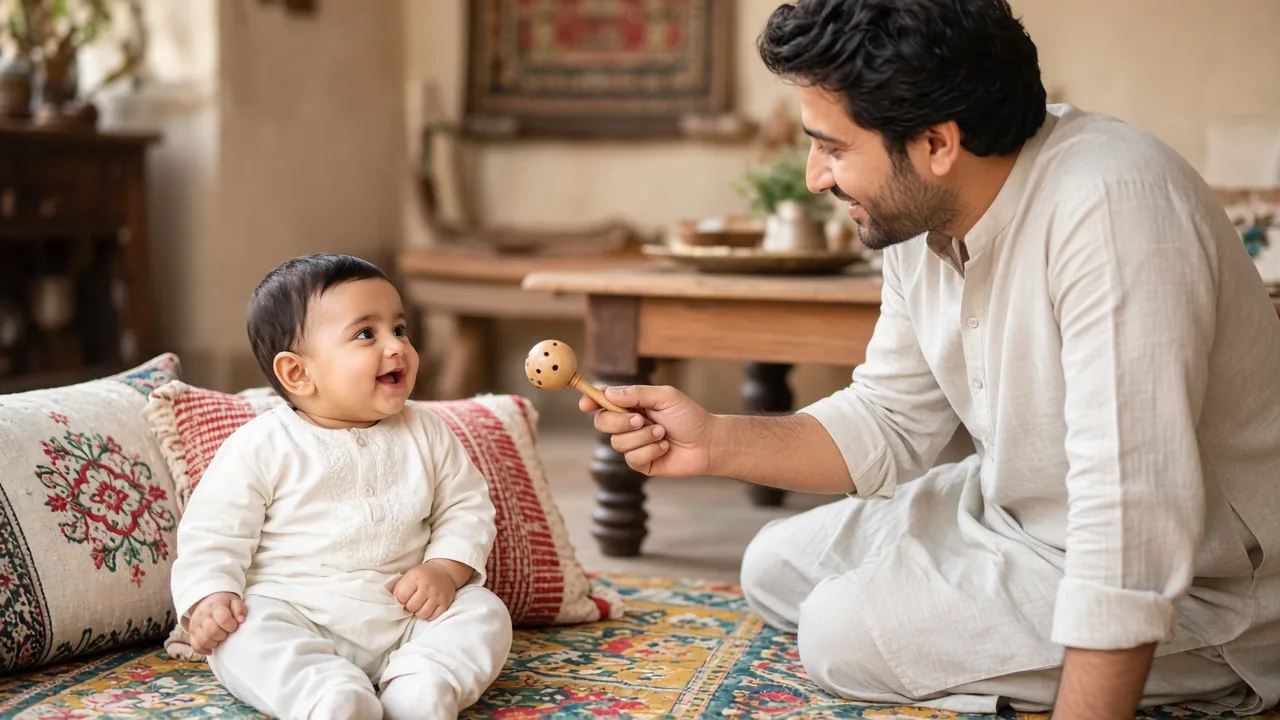
Signs that should prompt a hearing check include:
- a young baby who does not startle at sudden loud sounds;
- an older baby who does not turn towards voices or sounds, or stops babbling;
- a toddler who does not respond to their name or is not saying words when expected;
- a feeling in the family that something is not right.
A hand clap or a pot banged behind a baby’s head is not a reliable test, because a baby may be reacting to movement or vibration rather than the sound. If speech is your main concern, our guide on whether a child is a late talker or needs speech therapy explains what is typical at each age.
What happens if hearing loss is confirmed?
The audiologist and doctors explain the type and degree of hearing loss in each ear, then you decide on support together. WHO lists options including hearing aids or cochlear implants, therapy to build language, sign language, or a combination, alongside early education.
Hearing a diagnosis is hard, and it is normal to feel overwhelmed. Some hearing loss is temporary, such as loss caused by fluid that can be treated, so the first step is to understand exactly what has been found. For permanent hearing loss, WHO stresses that decisions should be made with the family and should reflect the family’s goals for their child. It recommends starting support as soon as possible after diagnosis.
In practical terms, a care plan may include fitting hearing aids, regular hearing reviews as your child grows, referral to an ENT specialist, and support for language at home. Many families also work with a speech and language therapist. IRHC offers speech therapy at home and by online video, and supplies hearing aids with fitting and adjustment through a partner setup.
What mistakes should parents avoid after a refer result?
The biggest mistake is waiting. Common ones include hoping the baby will “show us” by talking, accepting a pass in one ear as good enough, and repeating screens for months instead of moving on to a diagnostic test.
- “Let’s see if he starts talking.” Speech delay shows up late. By then the early months for language are gone.
- Treating a one-ear refer as fine. Hearing loss in one ear still matters, and the second screen should cover both ears.
- Relying on home sound tests. A baby who turns to a clap may be reacting to something else.
- Endless rescreens. WHO notes that extra screening stages can delay diagnosis. After two refers, go to diagnosis.
- Losing the paperwork. Keep every result, with the date and the test used, in one folder.
How can you get newborn hearing screening in Islamabad and Rawalpindi?
Start by asking your hospital before discharge, then your paediatrician. If screening was missed or you need a follow-up, an audiologist can screen or test your baby. IRHC offers newborn hearing screening, OAE, BERA and ASSR at home in almost all areas of both cities.
Services vary between hospitals and change over time, so it is worth asking directly. Useful questions to ask any provider:
- Which test do you use for screening: OAE, AABR or both?
- Will both ears be tested, and will I get a written result?
- If my baby does not pass, can you do the diagnostic ABR (BERA) and ASSR, or where do you refer?
- Does the person testing have experience with newborns?
IRHC’s hearing services page states that every hearing test offered at the clinic can also be done at home, including newborn hearing screening, OAE, BERA and ASSR. The audiologist brings the equipment, chooses tests to suit the baby’s age and explains the results at the end of the visit. Home testing can make it easier to test a baby while they are asleep in familiar surroundings. Visits run Monday to Sunday, and families can also book at partner clinics in G-8 Markaz, Islamabad and Saddar, Rawalpindi, or arrange an online video consultation.
When you get in touch, it helps to share:
- your baby’s age and whether they were born early or spent time in the NICU;
- the screening result, which ear or ears, and the test used, if you know;
- any reports or discharge summaries;
- your area and the days that suit you.
Need a newborn hearing screen or a follow-up test?
IRHC’s audiologist can test your baby at home in Islamabad and Rawalpindi, Monday to Sunday, and every booking is confirmed on WhatsApp. For fees, timings and payment methods, see our FAQs, or read more about our hearing services.
Book an appointment | WhatsApp 0300-6844361 | Call 051-8776556
Frequently Asked Questions
Quick answers to what parents ask about newborn hearing screening in Pakistan and refer results. For fees, timings and payment, see our FAQs page.
Does a refer result mean my baby is deaf?
No. A refer result means the screen could not record a clear response from one or both ears. It is not a diagnosis. Fluid or debris in the ear canal, background noise or an unsettled baby can all cause it. It should always be followed up with a second screen and, if needed, a full assessment.
Should both ears be rescreened if only one ear referred?
Yes. ASHA advises that both ears should be rescreened even if only one did not pass, and that a pass counts only when both ears pass in the same session. Ask for a written result that states which ears were tested and what each showed.
My baby failed the newborn hearing test twice. What should I do?
Book a full diagnostic hearing assessment with an audiologist who tests babies. WHO guidance says babies who do not pass two screens should have this assessment by 3 months of age. It usually includes ABR (BERA), often with ASSR, tympanometry and OAE, plus a medical review.
Is newborn hearing screening mandatory in Pakistan?
Published studies describe Pakistan as having no national newborn hearing screening programme. In a 2024 convenience survey of 79 paediatricians in Rawalpindi and Islamabad, 59.5% said their hospitals had no universal programme. Some hospitals and private audiologists offer it, so ask before your baby is discharged.
When should a newborn hearing test be done?
International guidance says by 1 month of age, ideally before you leave the hospital. Where screening at birth is not possible, for example after a home birth, WHO says it should be done no later than 6 weeks. If that time has passed, arrange it now rather than waiting.
What is the 1-3-6 timeline for newborn hearing screening?
It means screening by 1 month of age, a diagnostic assessment by 3 months if the baby does not pass, and support starting by 6 months if hearing loss is confirmed. WHO recommends this timeline. The JCIH 2019 statement, as summarised by ASHA, encourages services that already meet it to aim for 1-2-3. If your baby is already past these ages, the right time to act is now.
Does newborn hearing screening hurt my baby?
No. The NHS says the test is not uncomfortable and has no known risks. A small soft earpiece or a few sticker sensors are used while your baby is settled or asleep, and the screen itself takes a few minutes.
My baby passed the screen. Can hearing loss still develop later?
Yes. Screening does not pick up every type of hearing loss, and hearing loss can develop or get worse after birth. Watch your child’s hearing and speech milestones and ask for a hearing test at any age if you are concerned.
Can my baby’s hearing be tested at home in Islamabad or Rawalpindi?
Yes. IRHC offers newborn hearing screening, OAE, BERA and ASSR at home in almost all areas of Islamabad and Rawalpindi, Monday to Sunday. Please mention your baby’s age when you book, as some tests work best while the baby is calm or asleep.
How much does a newborn hearing test cost at IRHC?
Fees for hearing services depend on distance and time, so there is no fixed price. Call 051-8776556 or WhatsApp 0300-6844361 with your area and the test you need for a quote. Payment is made in advance by Easy Paisa, JazzCash, U Paisa, Raast ID, bank transfer or cash.
How do I book a hearing test for my baby?
Call 051-8776556 (9 am to 6 pm), WhatsApp 0300-6844361 (answered 24/7), or use the online appointment form. Share your baby’s age, the screening result and any reports, and your area. Every booking is confirmed on WhatsApp.
Medical disclaimer: This article is for general information only and does not replace an assessment by your baby’s doctor or a qualified audiologist. A screening result is not a diagnosis. If your baby is unwell, has a high fever, is not feeding or has difficulty breathing, get medical help immediately, or call 1122 in an emergency.