Short answer: Does hearing aid prevent dementia? The research does not show that. Hearing loss is linked with a higher risk of dementia, and the 2024 Lancet Commission estimated that about 7% of dementia cases worldwide are linked to it. But in the largest trial so far, hearing aids did not slow thinking and memory decline overall, although they seemed to help a smaller group of older adults at higher risk. Hearing aids do not cure or reverse dementia. Because poor hearing can look like confusion, an older relative with memory worries should have their hearing tested too.
This guide is general information for families. It is not medical advice, and it does not replace an assessment by a doctor or audiologist. Memory changes should always be checked by a doctor.
Listen to a short overview
46 seconds · a spoken summary of this guide. It does not replace advice from a doctor or audiologist.
Key takeaways
- Hearing loss is one of 14 potentially modifiable risk factors for dementia in the 2024 Lancet Commission, linked to about 7% of cases worldwide.
- An association is not proof of cause. The estimate assumes a causal link, and it describes populations, not your parent.
- In the ACHIEVE trial, hearing aids did not slow cognitive decline over three years overall. A benefit was seen only in a smaller, higher-risk group.
- Hearing aids help people hear. They do not cure or reverse dementia.
- Hearing loss can make an older person seem confused, so test hearing when memory is a worry. IRHC offers hearing tests at home in Islamabad and Rawalpindi.
In this guide
- Is hearing loss linked to dementia?
- How common is hearing loss in older adults?
- Does hearing loss cause dementia?
- Does hearing aid prevent dementia? What the ACHIEVE trial found
- What other studies suggest
- Headlines versus evidence (table)
- Can hearing aids reverse dementia?
- Hearing loss or memory loss?
- Signs of hearing loss in older adults
- When to see a doctor
- How families can help
- Hearing tests at home in Islamabad and Rawalpindi
- FAQs
Abbu has started nodding along at the dinner table without really answering. Ammi asks the same question twice, and the TV is louder every month. Somewhere in the family WhatsApp group, someone shares a headline saying hearing aids prevent dementia, and someone else says it is all nonsense. Both are partly wrong. If you have typed “does hearing aid prevent dementia” into Google, this guide explains what the research really shows, what it does not, and what a sensible next step looks like for an older parent in Pakistan.
Is hearing loss linked to dementia?
Yes. Older adults with hearing loss have a higher risk of developing dementia than those with normal hearing, and the risk rises as hearing gets worse.
The US National Institute on Aging (NIA) states that older adults with hearing loss have a greater risk of developing dementia, and that memory and concentration decline faster in older adults with hearing loss than in those with normal hearing.
The most detailed recent summary is the 2024 report of the Lancet standing Commission on dementia, written by an international panel of experts. It lists 14 potentially modifiable risk factors for dementia, from less education in early life to hearing loss, high LDL cholesterol, high blood pressure and smoking in midlife, and social isolation and air pollution in later life. Together, the Commission estimates, these 14 factors account for about 45% of dementia cases worldwide. Hearing loss and high LDL cholesterol are the two largest, each linked to about 7% of cases.
In its own analysis of high-quality studies, the Commission found that people with hearing loss had about a 37% higher risk of dementia than people with normal hearing. The uncertainty in that analysis ranged from no increase to an 87% higher risk. Every study that looked at severity found that dementia risk rose as hearing got worse, by between 4% and 24% for every 10 decibels of hearing lost.
How common is hearing loss in older adults?
Very common. The World Health Organization estimates that more than a quarter of people over 60 have disabling hearing loss, and most people with it live in low- and middle-income countries.
According to the World Health Organization, more than 25% of people older than 60 are affected by disabling hearing loss, and nearly 80% of people with disabling hearing loss live in low- and middle-income countries such as Pakistan. WHO also lists an increased risk of dementia and faster cognitive decline among the effects of hearing loss that is not addressed. The Lancet Commission adds that hearing loss is often untreated.
Age-related hearing loss usually comes on slowly and affects both ears, so people often do not notice it themselves, as the NIA points out. In many families, an elderly parent may also feel that hearing loss is simply part of getting old, or worry that a hearing aid will make them look frail. That is a general observation rather than a research finding, but it is one reason hearing loss in older relatives can go unchecked for years.
Does hearing loss cause dementia?
That has not been proven. Families often ask whether hearing loss can cause dementia. It is linked with a higher risk, but a link is not the same as a cause, and researchers are still working out why the two go together.
The Lancet Commission is careful on this point. Its estimate of how many cases could be prevented assumes that the risk factors cause dementia, and it notes that some associations may be only partly causal. It also says that reducing risk factors affects populations but does not guarantee that any individual will avoid dementia.
The Commission describes several possible explanations, none yet proven. Hearing loss may lead to loneliness, low mood and social isolation. It may reduce the stimulation the brain gets from conversation and sound. Straining to listen may use up mental effort that would otherwise support memory and thinking. Another possibility is that the same underlying problem, such as damage to blood vessels, affects both hearing and the brain. If that were the main reason, treating hearing would not lower dementia risk much at all.
So when you read that hearing loss “causes” dementia, or that the answer to “does hearing aid prevent dementia” is a simple yes, the honest version is this: hearing loss is one of the strongest known risk factors, and treating it is a reasonable step for many reasons, but research has not shown that hearing loss causes dementia in a given person.
Does hearing aid prevent dementia? What did the ACHIEVE trial find?
In the largest trial so far, hearing aids did not slow thinking and memory decline over three years for the group as a whole. A benefit was seen only in a smaller group of older adults at higher risk.
The ACHIEVE trial, published in The Lancet in 2023, is the first large randomised trial to test this question. It enrolled 977 adults in the USA aged 70 to 84 who had untreated hearing loss but no substantial memory or thinking problems. Half received a hearing intervention (hearing aids plus counselling from an audiologist). The other half received health education sessions on preventing chronic disease. Everyone had detailed thinking and memory tests over three years.
Here is what it found:
- Overall: no difference. Across all 977 participants, thinking and memory scores declined by almost exactly the same amount in both groups over three years. This was the trial’s main result.
- Higher-risk group: slower decline. Participants came from two sources. 238 were recruited from a long-running heart health study (ARIC) and were older, had more risk factors for cognitive decline and had lower starting scores. The other 739 were healthy volunteers. A prespecified analysis showed the hearing intervention worked differently in the two groups. The 2024 Lancet Commission describes the effect in the higher-risk ARIC group as a 48% reduction in cognitive decline over three years.
- No serious harms from either approach were reported.
The trial authors concluded that a hearing intervention might reduce cognitive decline over three years in older adults at increased risk, but not in those at lower risk. That is a cautious conclusion for good reasons. The benefit came from a subgroup, not the whole trial. The trial measured decline in test scores, not new diagnoses of dementia. Three years is a short time for a condition that develops over many years. And about 88% of participants were White Americans, so the results may not apply in the same way to older adults in Pakistan.
What do other studies say about hearing aids and dementia?
Long-term observational studies find lower rates of cognitive decline and dementia in people who use hearing aids, but they cannot prove the hearing aids caused the difference.
So do hearing aids reduce dementia risk in everyday life, outside a trial? The Lancet Commission cites a review of eight cohort studies with nearly 127,000 participants. People with hearing loss who used hearing aids had a 19% lower risk of cognitive decline and, in the four studies that measured it, a 17% lower risk of dementia than people with untreated hearing loss. The Commission describes this observational evidence as consistent and supportive, and considers the evidence that treating hearing loss lowers dementia risk to be stronger than before.
Observational studies have a well-known weakness, though. They compare people who chose to use hearing aids with people who did not, and those groups may differ in income, general health, education or social contact. Researchers adjust for these differences, but they cannot rule them out completely. That is why randomised trials such as ACHIEVE matter, and why their mixed result is important.
What does the evidence show, and what does it not show?
The research supports a real link between hearing loss and dementia, and some possible benefit from hearing aids in higher-risk people. It does not support claims that hearing aids prevent, cure or reverse dementia.
The table sets common claims against what the studies above actually found.
| What you may have read | What the research actually shows | What it does not show | Where this comes from |
|---|---|---|---|
| “Hearing loss causes dementia.” | People with hearing loss have a higher risk of dementia than people with normal hearing, and the risk rises as hearing gets worse. | That hearing loss directly causes dementia in any one person. The link is an association, and the reasons for it are still being studied. | 2024 Lancet Commission; NIA |
| “Hearing loss is behind a big share of dementia.” | The Lancet Commission estimated that about 7% of dementia cases worldwide are linked to hearing loss, one of the two largest of 14 potentially modifiable risk factors. | That 7% of cases would definitely disappear if everyone’s hearing were treated. The estimate assumes the link is causal, and it applies to populations, not individuals. | 2024 Lancet Commission |
| “Hearing aids prevent dementia.” | In the ACHIEVE trial, hearing aids did not slow thinking and memory decline over 3 years in the group as a whole. In a smaller higher-risk group, decline was slower. | That hearing aids prevent dementia. ACHIEVE measured cognitive decline over 3 years, not new dementia diagnoses, and the overall result was null. | ACHIEVE trial, The Lancet 2023 |
| “People who wear hearing aids get dementia less often.” | Observational studies find lower rates of cognitive decline and dementia in hearing aid users than in people with untreated hearing loss. | Proof that the hearing aids caused the difference. People who choose to wear hearing aids may differ in other ways from those who do not. | Meta-analysis cited by the 2024 Lancet Commission |
| “A hearing aid can bring memory back.” | Hearing aids help a person hear. Better hearing can make conversation and daily life easier. | That hearing aids cure or reverse dementia. ACHIEVE enrolled people without substantial cognitive impairment, and no trial has shown reversal. | ACHIEVE trial; NIA |
This table summarises research for general understanding. It is not a diagnosis. Memory changes and hearing changes should both be checked by a qualified professional.

Can hearing aids reverse or cure dementia?
No. Hearing aids are not a treatment for dementia, and no trial has shown that they reverse it. Their job is to help a person hear.
ACHIEVE deliberately enrolled people without substantial cognitive impairment, so it says nothing about whether hearing aids change the course of dementia once it has started. Be wary of any advert or social media post that promises a hearing aid will “bring memory back”. There is also no evidence that hearing aids cause dementia.
That does not mean hearing aids are pointless for someone with memory problems. If a person has hearing loss, a hearing aid fitted and adjusted properly can make conversation, phone calls and family time easier, whatever is happening with their memory. The decision should be based on their hearing test results and what they and the family find helpful, not on a promise about dementia.
Could it be hearing loss rather than memory loss?
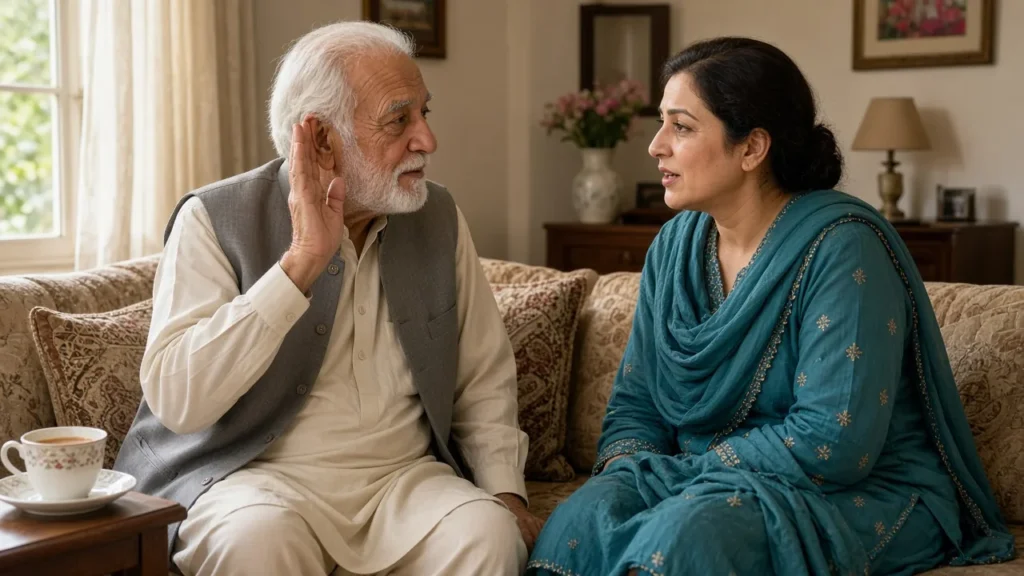
Sometimes. An older person who cannot hear well may seem confused or forgetful simply because they missed what was said. Testing hearing is a sensible part of looking into memory worries.
The NIA notes that older people who cannot hear well are sometimes mistakenly thought to be confused, unresponsive or uncooperative, and that they may become withdrawn or depressed because they feel frustrated or embarrassed about not understanding. Picture a grandmother who answers the wrong question, does not respond when called from the next room, or repeats a question because she did not catch the answer. To the family, it can look like memory loss. Sometimes it is a hearing problem, and sometimes it is both.
Some causes of poor hearing are treatable. The NHS lists earwax build-up and ear infections among the common causes, and advises seeing a GP if hearing is gradually getting worse. So if an older relative has memory or confusion worries, a practical approach is to do two things: see a doctor about the memory changes, and have their hearing tested. A hearing test does not diagnose or rule out dementia, but it can remove one possible reason for the confusion and help the doctor see the full picture.
What are the signs of hearing loss in older adults?
Asking people to repeat themselves, turning the TV up loud, trouble following group conversations or phone calls, and feeling that others mumble.
The NIA suggests seeing a doctor if a person:
- has trouble understanding what people say on the telephone
- finds it hard to follow conversations when two or more people are talking
- often asks people to repeat what they are saying
- turns the TV up so loud that others complain
- struggles to understand speech when there is background noise
- thinks that others seem to mumble
- cannot understand children or people with higher-pitched voices
The NHS adds feeling tired or stressed from having to concentrate while listening, and notes that someone else may notice the problem before the person does. In a busy Pakistani household, with several conversations, a TV and a ceiling fan going at once, these signs are easy to dismiss as “Abbu is just not paying attention”.
When should hearing loss be checked by a doctor urgently?
Sudden hearing loss is a medical emergency. Hearing that worsens over days or weeks, ear pain, discharge, dizziness or hearing loss after a head injury also needs a doctor promptly.
The NIA says sudden hearing loss, whether all at once or over a few days, should be treated as a medical emergency. The NHS advises an urgent appointment for sudden hearing loss in one or both ears, hearing that has been getting worse over the last few days or weeks, or hearing loss with earache or discharge. Our hearing solutions page gives the same advice, adding hearing loss after a head injury and dizziness with hearing changes. A hearing test can follow once a doctor has checked the ear.
Memory changes also deserve a doctor’s attention in their own right, especially if they are new, getting worse or affecting daily life.
How can families help an older parent with hearing loss?
Face them when you speak, talk clearly without shouting, cut background noise, rephrase rather than repeat, and encourage a proper hearing test.
The NIA’s advice for people with hearing loss translates into simple habits for the family:
- Face the person so they can see your face, lips and gestures.
- Speak a little louder and more clearly, but do not shout.
- Reword what you said if they did not catch it, instead of repeating the same words.
- Reduce noise. Turn the TV down or move to a quieter spot before an important conversation.
- Tell others. Let relatives and visitors know about the hearing problem so the person is not left out.
If your parent resists a hearing test, it can help to frame it as a routine check rather than a test of whether they are “getting old”, and to keep the dementia worry out of the conversation if it upsets them. These are general suggestions, not research findings. If they already have a hearing aid that sits in a drawer, it may need adjusting or repairing rather than replacing.
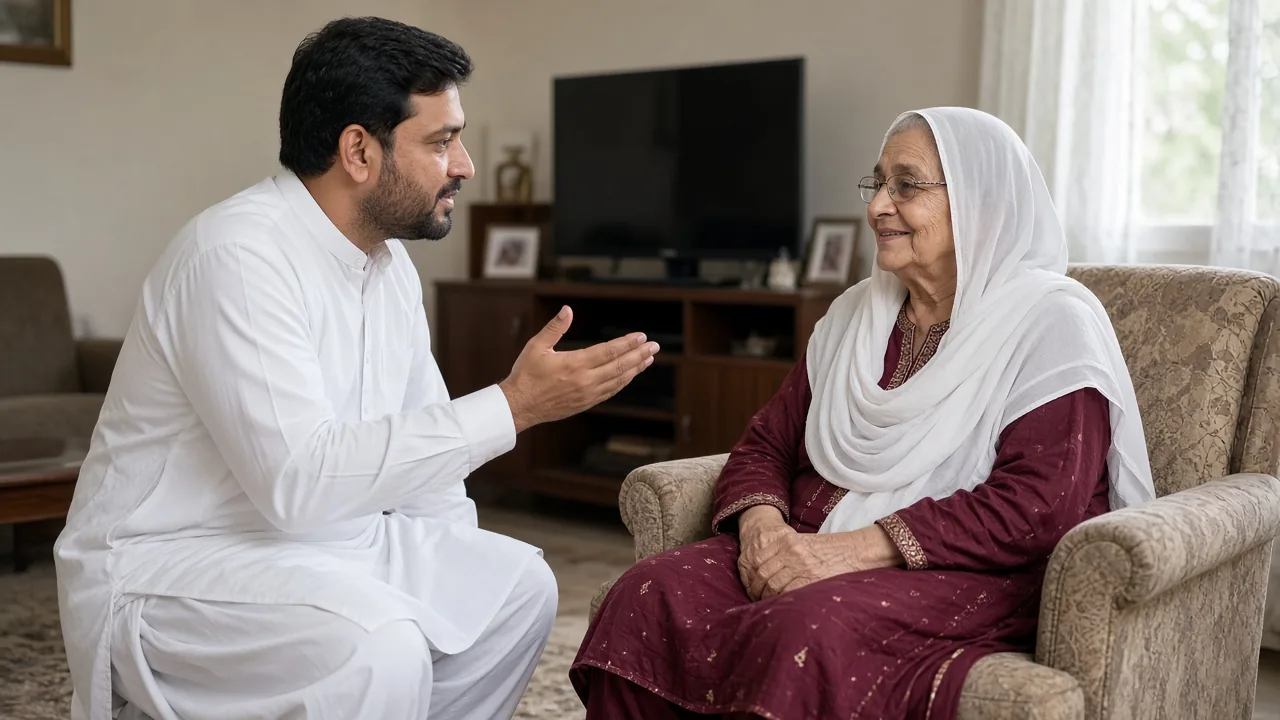
Where can older adults get a hearing test at home in Islamabad and Rawalpindi?
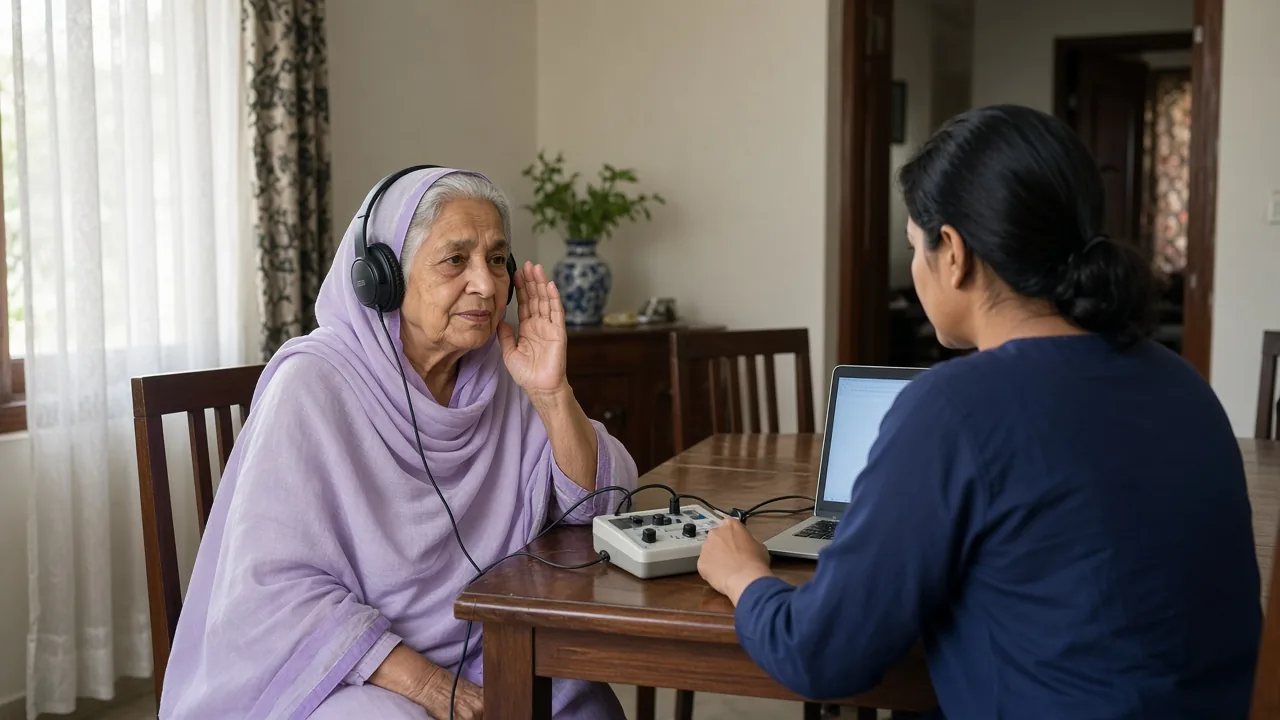
IRHC’s audiologist carries out hearing tests at home in almost all areas of Islamabad and Rawalpindi, Monday to Sunday. Hearing aids are available through our partner setup, with fitting, adjustment and repairs.
Many families search for a “hearing test for elderly at home” because getting an older parent to a clinic is hard work. Our hearing solutions service is built for people who find travel difficult, including older adults who are finding conversation, the TV or the phone harder to follow. The audiologist brings the testing equipment to your home and asks about the hearing concern, ringing in the ears, ear infections, noise exposure and other medical conditions. Tests for adults usually include pure tone audiometry and speech audiometry. At the end of the visit, the audiologist explains the type and degree of any hearing loss and the next steps. That may be a hearing aid with fitting through our partner (collaboration) setup, adjusting an existing aid, a follow-up test, or advice to see an ENT doctor when the results point to a medical cause. Our guide to hearing tests that can be done at home explains each test in more detail.
A quiet room helps, so we may ask for the TV or fans to be switched off during the test. Partner clinic visits are available at G-8 Markaz, Islamabad and Saddar, Rawalpindi by booking ahead, and a hearing consultation is also available by online video. We do not diagnose dementia; memory concerns should be assessed by a doctor. If a younger family member listens to loud music for hours, our article on earbuds and noise-induced hearing loss may also be useful.
Worried about an older parent’s hearing?
Book a hearing test at home with IRHC in Islamabad or Rawalpindi. Our audiologist will test your parent’s hearing in their own home, explain the results in plain language and discuss next steps, including hearing aids through our partner setup if they would help. It will not answer the question “does hearing aid prevent dementia”, but it will tell you how well your parent hears. Every booking is confirmed on WhatsApp. For fees, timings and payment, see our FAQs.
Book an appointment | WhatsApp 0300-6844361 | Call 051-8776556
Frequently Asked Questions
Quick answers to what families ask about hearing loss, memory and hearing aids. For fees, timings and payment, see our FAQs page.
Does a hearing aid prevent dementia?
Not proven. In the largest trial so far (ACHIEVE, published in The Lancet in 2023), hearing aids did not slow thinking and memory decline over three years in the group as a whole. In a smaller group of older adults at higher risk of decline, the hearing intervention was linked with slower decline. Hearing aids help hearing, and research on their effect on dementia is still developing.
Can not wearing hearing aids cause dementia?
There is no proof that not wearing hearing aids causes dementia. Untreated hearing loss is linked with a higher risk of dementia, and the 2024 Lancet Commission lists hearing loss as a potentially modifiable risk factor. But a link is not the same as a cause, and many people with hearing loss never develop dementia.
Can hearing loss cause dementia?
That has not been proven. Hearing loss is linked with a higher risk of dementia, and the 2024 Lancet Commission lists it as a potentially modifiable risk factor. But a link is not the same as a cause, and many people with hearing loss never develop dementia. Researchers are still working out why the two go together.
How much of dementia is linked to hearing loss?
The 2024 Lancet Commission estimated that about 7% of dementia cases worldwide are linked to hearing loss. Together, the 14 risk factors it lists account for about 45% of cases. These are population estimates that assume the links are causal, and they cannot predict what will happen to one person.
What did the ACHIEVE trial find about hearing aids and memory?
ACHIEVE gave 977 US adults aged 70 to 84 with untreated hearing loss either hearing aids with audiology support or health education, and followed them for three years. Overall, thinking and memory scores declined by the same amount in both groups. In a prespecified analysis, the effect differed in the 238 participants from an older, higher-risk study group, where decline was slower with the hearing intervention.
Can hearing aids reverse or cure dementia?
No. Hearing aids are not a treatment for dementia and have not been shown to reverse it. They can make it easier for a person to hear and follow conversation. ACHIEVE studied people without substantial memory problems, so its results do not apply to people who already have dementia.
Do hearing aids help if someone already has dementia?
They can help the person hear, which may make conversation and daily life easier, but they have not been shown to reverse or slow dementia once it has started. ACHIEVE studied people without substantial memory problems, so its results do not apply to people who already have dementia. The decision should be based on a hearing test and what the person and family find helpful, not on a promise about memory.
Could my parent’s confusion actually be hearing loss?
Sometimes. The US National Institute on Aging notes that older people who cannot hear well are sometimes mistakenly thought to be confused, unresponsive or uncooperative. If an older relative has memory or confusion worries, it makes sense to have their hearing tested as well as seeing a doctor about the memory changes.
When is hearing loss urgent?
See a doctor promptly for sudden hearing loss in one or both ears, hearing that gets worse over a few days or weeks, ear pain or discharge, hearing loss after a head injury, or dizziness with hearing changes. Sudden hearing loss should be treated as a medical emergency.
How much does a hearing test at home cost in Islamabad or Rawalpindi?
At IRHC, fees for hearing services depend on distance and time, so there is no fixed price. Call 051-8776556 or WhatsApp 0300-6844361 with your area and what you need, and we will give you a quote. Hearing aid prices are also quoted on request. Payment is made in advance by Easy Paisa, JazzCash, U Paisa, Raast ID, bank transfer or cash.
How do I book a home hearing test with IRHC?
Call 051-8776556 (9 am to 6 pm), WhatsApp 0300-6844361, or use the online appointment form. Our audiologist visits almost all areas of Islamabad and Rawalpindi, Monday to Sunday, and every booking is confirmed on WhatsApp. Please keep any earlier hearing reports, doctor’s notes and the hearing aid (if one is used) ready for the visit.
Medical disclaimer: This article is for general information only. It does not replace an assessment by a doctor or audiologist. Hearing aids are not a treatment for dementia. New or worsening memory problems, and sudden hearing loss, should be checked by a doctor promptly.