

Short answer: Parkinson’s speech therapy at home can help a person with a soft voice speak louder and more clearly, and can make swallowing and drooling easier to manage. Physiotherapy at home works on slow, shuffling walking, balance, freezing and getting up from a chair. Neither therapy cures Parkinson’s, but both are recommended in the UK’s national guideline, and regular practice at home, timed for when medicines are working, is what keeps the gains going.
This guide is general information for families. It is not medical advice, and it does not replace an assessment by a speech therapist, a physiotherapist or the patient’s neurologist.
Listen to a short overview
51 seconds · a spoken summary of this guide. It does not replace an assessment by a therapist or doctor.
Key takeaways
- A quiet voice, small steps and slow swallowing often come together in Parkinson’s, and the person may not notice them as much as the family does.
- A speech therapist works on loudness, clarity, swallowing and saliva. A physiotherapist works on walking, balance, freezing and getting up.
- LSVT LOUD and LSVT BIG are specific four-week programmes given by certified clinicians. Ordinary therapy can still help if they are not available.
- Plan practice and therapy for the hours when medicine is working well, and keep a simple diary of good and bad times.
- IRHC speech therapists and physiotherapists visit homes in almost all areas of Islamabad and Rawalpindi.
In this guide
- Why the voice gets soft
- What does Parkinson’s speech therapy at home involve?
- Voice practice between sessions
- Swallowing, tablets and drooling
- Slow, shuffling walking and physiotherapy
- Freezing and falls at home
- LSVT LOUD and LSVT BIG explained
- Timing therapy around medicines
- Which therapist helps with what (table)
- What therapy can and cannot do
- When to call the doctor
- Home therapy in Islamabad and Rawalpindi
- FAQs
It usually starts with small things. Abbu answers the phone and the caller keeps saying “hello? hello?” Ammi asks him to speak up at the dinner table, and he insists he is already talking loudly. His walk to the mosque takes longer, his steps get shorter, and he stops at the doorway as if his feet have stuck. At meals he coughs more than before. Each change seems minor, and many families put them down to age. Together, they are a common pattern in Parkinson’s disease, and most of them can be worked on at home with the right therapy. This guide explains what Parkinson’s speech therapy at home and home physiotherapy actually involve, what families can practise between visits, and where honest expectations lie.
Why does Parkinson’s make the voice so soft?
Parkinson’s makes movements smaller and slower, and that includes the breathing and voice muscles. The voice becomes quieter and flatter, and the person often does not realise, because their own voice still sounds normal to them.
Doctors call a weak, quiet voice hypophonia. Families describe it differently: the voice fades at the end of a sentence, sounds breathy or hoarse, or loses its ups and downs so everything comes out in one tone. Speech can also become fast, rushed or mumbled, with words running together. The face may show less expression, which makes it harder to read emotion from someone who is talking quietly. Speech changes like these are common. The NHS notes that many people with Parkinson’s have problems with their speech and with swallowing.
The puzzling part for families is that the person usually disagrees. LSVT Global, the organisation behind the LSVT LOUD programme, explains that sensory changes in Parkinson’s can stop the brain from registering how softly the person is actually speaking. So when you ask your father to speak up, a normal voice may feel to him like shouting. This is not stubbornness. It is one reason why therapy for a soft voice focuses on recalibrating what “normal loudness” feels like, and why simply telling someone to talk louder rarely lasts.
This speech pattern is different from the speech problems after a stroke, which can affect language itself. If your family member has had a stroke, our guide to speech therapy after a stroke at home covers aphasia and stroke-related dysarthria.
What does Parkinson’s speech therapy at home involve?
A speech therapist assesses voice, clarity, swallowing and saliva control, then sets exercises and strategies that fit daily life. At home, the therapist can also teach the family how to support practice and safer meals.
The UK’s NICE guideline on Parkinson’s disease recommends considering an early referral to a speech and language therapist with experience of Parkinson’s, for assessment, education and advice, even before problems are severe. It recommends offering speech and language therapy to anyone with problems with communication, swallowing or saliva. That therapy should include strategies to make swallowing safer and more efficient, and strategies to improve speech and communication, such as attention-to-effort therapies, which train the person to put deliberate effort into speaking loudly and clearly.
A first home session usually starts with questions about when the changes began, the medicines and their timing, and what the person most wants to manage, such as talking on the phone, being understood at family gatherings, or eating without coughing. The therapist listens to the voice, checks how clearly the person speaks, and may watch a drink or a snack to look at swallowing. Then comes a plan, usually built around short daily exercises.
At IRHC, our speech therapy team works with dysarthria (unclear or slurred speech linked to a neurological condition), voice disorders, swallowing disorders and drooling. Therapy uses exercises and speaking strategies, voice and breathing work, exercises for the swallowing muscles and safer ways to eat and drink. Home has a practical advantage too. The therapist hears the person in the rooms where they actually talk, with the ceiling fan, the TV and the grandchildren in the background.
What voice practice can families do at home between sessions?
Short, regular practice set by the therapist, plus small changes to how the family talks with the person. Daily effort matters more than long sessions, and the exercises should come from the therapist rather than from a video.
Exercises differ from person to person, so ask the therapist for a written or recorded routine. Alongside it, these habits make everyday conversation easier for most families:
- Cut background noise. Switch off the TV or move away from the fan before a real conversation. A quiet voice has no chance against a news channel.
- Face each other. Seeing the lips and face helps the listener, and it reminds the speaker that someone is listening.
- Breathe, then speak. A breath before a sentence gives the voice more power. Shorter sentences help when breath runs out.
- Use an agreed cue. Agree on a short, kind prompt such as “louder, please” or a hand signal. Avoid guessing or finishing sentences, because it removes the practice.
- Talk when the medicine is working. Plan phone calls and visits for the person’s better hours.
- Keep talking. Daily conversation, reading a few lines aloud, or reciting something familiar keeps the voice in use. People who stop speaking because it is hard tend to lose confidence quickly.
Some families record a short clip on a phone once a week, reading the same few lines. Listening back helps the person hear the difference between their “normal” and a stronger voice, and gives the therapist something useful to review. Agree on this with the person first, since not everyone likes hearing their own recording.

How does Parkinson’s affect swallowing and drooling?
Parkinson’s swallowing problems happen because the muscles of the mouth and throat slow down too, so meals take longer, food or drink can go the wrong way, and saliva collects and spills. A speech therapist assesses the swallow and sets safer ways to eat and drink.
Signs to watch for include coughing or throat clearing during or after meals, a wet or gurgly voice after drinking, food left in the cheeks, meals that take much longer than before, weight loss and repeated chest infections. Some people also find tablets hard to swallow. Do not crush tablets or open capsules without asking the doctor or pharmacist first, because some medicines should not be altered.
The NHS says excessive drooling can be improved with swallowing exercises, with medicine or surgery considered in severe cases. NICE lists speech and language therapy among the non-drug options for drooling, and it names expiratory muscle strength training (EMST), a breathing exercise with a small hand-held device, as one strategy to make swallowing safer. Whether EMST suits a particular person is for the therapist to decide.
At meals, sit fully upright in a chair rather than leaning back in bed, take small sips and small bites, finish one mouthful before the next, and avoid talking with food in the mouth. If the therapist recommends softer textures, our separate guide to soft food for swallowing problems shows how to prepare daal, khichdi and other Pakistani home food at each texture level. This article does not repeat that detail.

Why does walking become slow and shuffling, and how does physiotherapy help?
Parkinson’s shrinks and slows movement, so steps get shorter, arms stop swinging and posture stoops. Physiotherapy retrains bigger, safer movement and works on balance, walking, turning and getting up.
Families often notice the walk before anything else: short steps, feet barely leaving the floor, one arm hanging still, the body bent forward, and a hurried shuffle that is hard to stop. Getting up from a low sofa can take several tries. Turning round in the kitchen becomes a slow, multi-step job. These changes raise the risk of falls, which can then make the person afraid to walk at all.
NICE recommends offering Parkinson’s-specific physiotherapy to people who have balance or motor problems, and considering an early referral to a physiotherapist experienced in Parkinson’s for assessment, education and advice on physical activity. The NHS describes the physiotherapist’s aim as relieving stiffness, making movement easier, and improving walking, flexibility and fitness.
Our physiotherapy service lists Parkinson’s disease under neurological rehabilitation. Therapy works on movement, balance, walking and everyday activities, and family members learn how to help between sessions. Treatment starts with an assessment at home of history, movement, strength and pain, and the goals are agreed with the patient and family. Parkinson physiotherapy exercises at home usually focus on things that matter in daily life: getting out of bed, standing from a chair, walking to the bathroom and managing stairs, in the place where they happen. A female physiotherapist is available if the family prefers.
Exercise matters between visits too. A short daily walk, practice with big steps and arm swings, and the specific exercises the physiotherapist sets are more useful than an occasional long session. If the person is unsteady, someone should stay close during practice.
What helps with freezing and falls at home?
Freezing is a sudden, brief inability to move, as if the feet were glued down. Cues such as counting, rhythm or a line to step over can help restart walking. Never pull or push someone who has frozen.
The Parkinson’s Foundation reports that about 38 percent of people living with Parkinson’s fall each year, and that falls happen mostly when turning or changing direction, often linked to a freezing episode. It lists the common triggers: moving from standing to walking, walking through a doorway, turning a corner or turning around, stepping onto a different floor surface, stress and trying to do two things at once. Freezing can also happen when a medicine dose is wearing off.
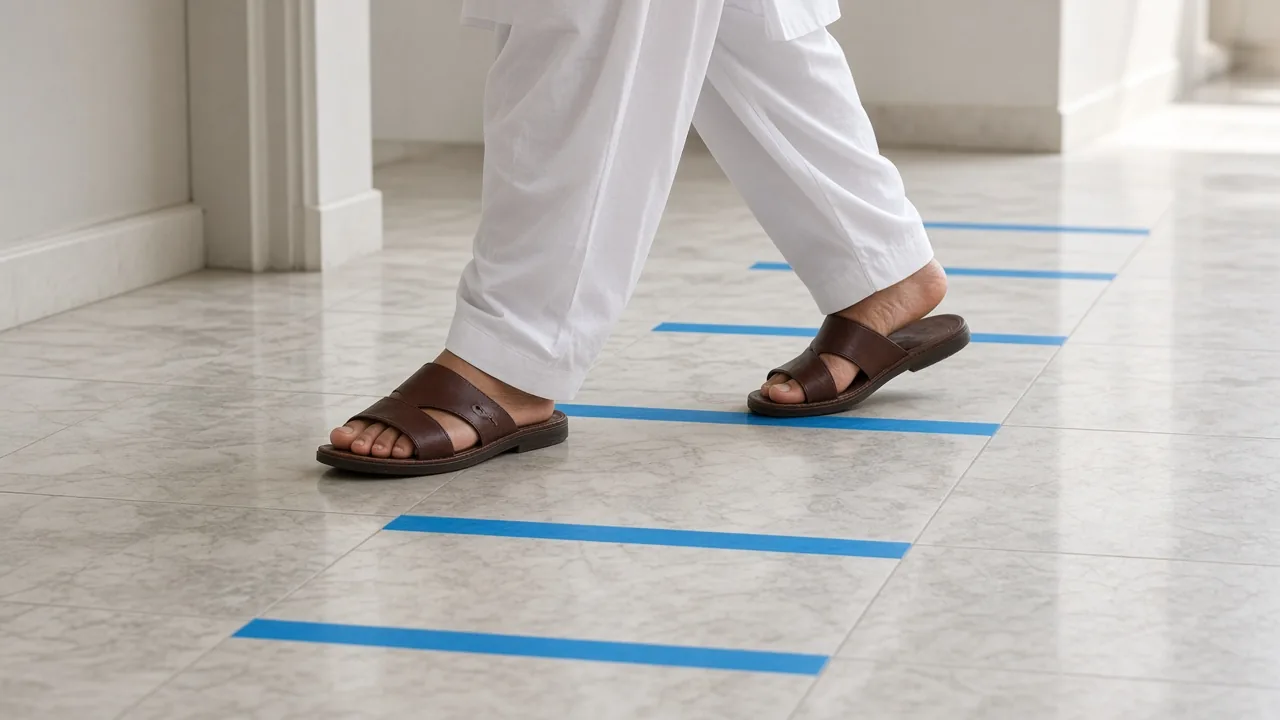
Strategies the Foundation describes include marching with high steps, shifting weight from one leg to the other before stepping, stepping in time with music, humming or counting, aiming for a line or a target on the floor, and turning in a wide half-circle instead of pivoting on the spot. It also suggests a simple sequence to remember: stop, sigh (take an audible breath), shift your weight, then take one big step.
For family members, the advice is to stay calm and wait a few seconds, not to rush or pull the person, and to offer a cue such as counting or placing a foot across their path for them to step over. Around the house, keep corridors and the route to the bathroom clear, remove loose rugs and floor clutter, add a night light, and arrange furniture so the person does not need tight turns. A physiotherapist can help you find the cues that work for your family member, because what helps one person may not help another.
What are LSVT LOUD and LSVT BIG, and do they work?
They are two structured, intensive programmes for Parkinson’s: LSVT LOUD for the voice and LSVT BIG for movement. Each runs for one month with four one-hour sessions a week and daily homework, and each is given by a clinician certified in that method.
LSVT LOUD, named after Mrs Lee Silverman, trains people with Parkinson’s to use a voice at normal loudness in daily life. According to LSVT Global, it is delivered one-to-one, four times a week for four weeks, with a short daily homework routine of about 10 to 15 minutes that continues after the month ends. It is built around recalibration: learning that the louder voice, which feels too loud to the person, actually sounds normal to others.
A 2021 meta-analysis of 10 randomised controlled trials found that LSVT increased voice loudness and improved functional communication and speech scores. The size of the loudness gain varied a lot between those trials. Gains were largest straight after treatment and smaller at six to twelve months, which is why ongoing practice matters. Most participants had mild to moderate Parkinson’s, and the authors called for more trials in people with severe disease.
LSVT BIG applies the same principles to movement. It trains people to make bigger movements, such as longer steps, wider arm swings and fuller turns, for walking, dressing and getting up from a chair. LSVT Global says it can only be given by a certified physical or occupational therapist, and that research on BIG is newer and less extensive than on LOUD.
What this means for families in Pakistan: these programmes are named, branded methods, and not every speech therapist or physiotherapist is trained in them. If you specifically want LSVT LOUD or BIG, ask any provider, including us, whether the therapist holds current LSVT certification. If that is not available, ordinary speech therapy and physiotherapy can still use effort-based voice work, big-movement practice and cueing. NICE refers to attention-to-effort approaches generally, rather than requiring one branded programme.
Why does timing therapy around Parkinson’s medicine matter?
Parkinson’s medicines can wear off between doses, and the person’s voice, walking and swallowing may all be worse in those “off” times. Practising and scheduling therapy in “on” times usually gets better results.
The NHS explains that long-term levodopa use is linked to “on-off” effects, where the person switches between moving well and being unable to move. Many families learn the pattern quickly: Abbu walks well an hour after his tablet and struggles just before the next one. The Parkinson’s Foundation notes that freezing can happen when the next dose is due, and often eases after the medicine is taken.
Keep a simple diary for a week, writing down medicine times and the times when walking, speech or eating are better or worse. Share it with the therapist and the neurologist. Book home sessions for good hours where possible, and plan meals and practice for those times as well. Do not change doses or timings yourself. That is a decision for the doctor, but your notes help them make it.
Which therapist helps with which Parkinson’s problem?
Speech therapists handle voice, speech, swallowing and drooling. Physiotherapists handle walking, freezing, balance and getting up. The neurologist manages medicines and should hear about any fall, choking episode or sudden change.
Many families need both therapists at different times, and the problems overlap. Freezing can affect speech as well as walking, and a fall can follow a bad night of coughing and poor sleep.
| Problem | What families usually notice | Who usually helps | What may help at home, once the therapist agrees |
|---|---|---|---|
| Soft, quiet voice | People keep asking him to repeat himself. His voice fades at the end of sentences, and he says everyone else has gone deaf. | Speech therapist | Daily voice exercises set by the therapist. Turn the TV off for conversations, face him, and say “louder, please” instead of guessing. |
| Unclear or fast speech | Words run together or sound mumbled, especially when he is tired or excited. The face may look less expressive. | Speech therapist | Short sentences, a breath before speaking, and one conversation at a time. Give him time to finish. |
| Swallowing problems | Coughing or clearing the throat at meals, a wet voice after drinking, slow meals, tablets that are hard to get down. | Speech therapist (swallowing assessment), with the doctor | Sit fully upright, take small sips and bites, and avoid talking with food in the mouth. Follow the texture advice you are given. |
| Drooling | Wet chin or pillow, a handkerchief always in hand, embarrassment when eating with others. | Speech therapist, with the doctor if it is severe | Reminders to swallow, upright posture and the exercises the therapist sets. Medicines or other treatment are a doctor’s decision. |
| Slow, small, shuffling steps | Short steps, feet close to the floor, less arm swing, a stooped posture, taking much longer to cross a room. | Physiotherapist | Practise big steps and arm swings, and walk a short route each day. Keep floors clear and well lit. |
| Freezing | Feet seem stuck to the floor when starting to walk, turning, or going through a doorway. | Physiotherapist, with the doctor about medicine timing | Rhythm cues such as counting or a song, lines to step over, and wide turns instead of tight pivots. Never pull or push. |
| Balance problems and falls | Near-falls when turning or standing up, holding on to furniture, fear of walking alone. | Physiotherapist, and the doctor after any fall | Balance exercises from the physiotherapist, a clear path to the bathroom, a night light, and a stable chair with arms. |
| Getting up from a chair or bed | Several attempts to stand, sliding forward in the chair, needing help to roll over or sit up in bed. | Physiotherapist | Practise the step-by-step method the physiotherapist teaches, at the time of day when medicines are working well. |
This table is a general guide for families, not a treatment plan. Parkinson’s affects each person differently, and the right exercises depend on an assessment. Ask the therapist before starting any new exercise, and tell the doctor about any fall or choking episode.
Can therapy cure Parkinson’s, and what about desi ilaj?
No. There is currently no cure for Parkinson’s disease. Medicines, therapy and, for some people, surgery help manage symptoms. No desi or herbal remedy has clinical evidence that it controls Parkinson’s symptoms.
Searches for “Parkinson ka ilaj”, “permanent ilaj” and “desi ilaj” are common, and it is natural to look for something that will make the illness go away. The honest answer protects your family member. The NHS states that there is currently no cure, that there is no clinical evidence complementary therapies are effective at controlling symptoms, and that some herbal remedies can interact unpredictably with Parkinson’s medicines. Check with the doctor before trying any remedy, and never use one in place of prescribed medicine.
What therapy can do is real, even if it is not a cure. It can help a person be heard on the phone, take part in family conversations, eat with fewer coughing episodes, walk with more confidence and stay independent in daily tasks for longer. Parkinson’s changes over time, so goals change too. A block of therapy, regular home practice and a review when things get harder is a realistic pattern for many families.
When should you call the doctor instead of waiting for therapy?
Choking that does not clear or difficulty breathing is an emergency. A fall with a possible broken bone or head injury, sudden weakness or numbness, and fever or a new cough after meals need medical care first.
- Choking that does not clear, or difficulty breathing: get emergency help.
- A fall with a head injury, severe pain or a possible fracture: get emergency medical care before any therapy.
- Sudden weakness, numbness, drooping face or new slurred speech: these can be stroke signs and need urgent care.
- Fever, fast breathing or a new cough after eating or drinking: see a doctor the same day, as food or drink may have gone into the lungs.
- Rapid weight loss, not drinking enough, or meals that have become a struggle: tell the doctor and ask for a swallowing assessment.
- New hallucinations, sudden confusion, unusual sleepiness or out-of-character behaviour: tell the neurologist, as the NHS lists these among possible medicine side effects.
Where can you get Parkinson’s speech therapy and physiotherapy at home in Islamabad and Rawalpindi?
IRHC’s speech therapists and physiotherapists visit homes in almost all areas of Islamabad and Rawalpindi, Monday to Sunday, 9 am to 9 pm. Online video sessions are also available.
For voice, speech, swallowing and drooling, see our home speech therapy service. For walking, balance, freezing and daily movement, see our home physiotherapy service, which lists Parkinson’s disease under neurological rehabilitation. Each starts with an assessment at home, and the therapist explains the plan afterwards. Family members are shown how to help between visits. If a home visit does not suit you, partner clinic appointments are available at G-8 Markaz, Islamabad and Saddar, Rawalpindi, by booking ahead.
Before the first visit, keep the neurologist’s notes, a list of current medicines with their timings, and your symptom diary ready. If possible, book the visit for a time when the medicine is working well.
Want help with a soft voice, swallowing or walking?
Book Parkinson’s speech therapy at home or a home physiotherapy assessment in Islamabad or Rawalpindi. An IRHC therapist will assess your family member at home, agree goals with you and show the family how to support practice between sessions. Every booking is confirmed on WhatsApp. For fees, timings and payment, see our FAQs.
Book an appointment | WhatsApp 0300-6844361 | Call 051-8776556
Frequently Asked Questions
Quick answers to what families ask most about Parkinson’s speech therapy and physiotherapy at home. For fees, timings and payment, see our FAQs page.
Can speech therapy help someone with Parkinson’s disease?
Yes, for many people. Speech therapy can work on a quiet voice, unclear speech, swallowing and drooling. The UK’s NICE guideline recommends offering speech and language therapy to people with Parkinson’s who have problems with communication, swallowing or saliva. Therapy does not stop the disease, but it can help the person be heard and eat more safely.
Can Parkinson’s speech therapy be done at home?
Yes. A therapist can assess voice, speech and swallowing at home, and home is where the person actually talks to family and eats meals. The home visit also lets the therapist show family members how to support daily practice. Online video sessions are another option for practice between visits.
Why does his voice sound normal to him but too quiet to us?
Many people with Parkinson’s do not hear their own voice the way others do. LSVT Global, which developed the LSVT LOUD programme, describes this as a change in how the brain registers loudness, so a normal voice can feel like shouting to the person. Part of speech therapy is learning what a normal loudness feels like again.
What is the difference between LSVT LOUD and ordinary speech therapy?
LSVT LOUD is a specific, branded programme: 16 one-hour sessions over four weeks plus daily homework, delivered by a clinician certified in the method. It focuses on loudness. Ordinary speech therapy is planned around the person’s own problems and may cover voice, clarity, swallowing and saliva. If you want LSVT LOUD itself, ask the therapist whether they hold current LSVT certification.
Is there a permanent cure or desi ilaj for Parkinson’s?
No. There is currently no cure for Parkinson’s disease, and the NHS says there is no clinical evidence that complementary therapies control its symptoms. Some herbal remedies can interact with Parkinson’s medicines. Speak to the neurologist before trying any remedy, and do not stop prescribed medicine.
What exercises help Parkinson’s walking at home?
A physiotherapist will choose exercises after assessing the person, but they usually include practice with big steps and arm swings, balance work, standing up from a chair and turning safely. Doing them regularly, at a time when the medicine is working, matters more than doing many at once.
What should I do when someone with Parkinson’s freezes?
Stay calm and wait a few seconds. Do not rush, pull or push the person. Offer a cue such as counting, humming, or placing a foot across their path for them to step over. The Parkinson’s Foundation also describes a simple sequence: stop, sigh (take an audible breath), shift your weight, then take one big step. A physiotherapist can help you find the cues that work for your family member.
Should therapy and practice be timed around Parkinson’s medicines?
Yes, when you can. Plan therapy visits and home practice for the hours when medicines are working well, sometimes called “on” time, because movement and voice are usually easier then. A simple diary of good and bad times helps the therapist choose a slot. Do not change doses or timings yourself; that is a decision for the doctor.
How many sessions of therapy will be needed?
It depends on the person’s symptoms, goals and how they respond. Intensive programmes such as LSVT LOUD and BIG run for four weeks, but Parkinson’s changes over time, so many people need a block of therapy, then home practice and a review when things change. The therapist explains the plan after the first assessment.
How much does home speech therapy or physiotherapy cost in Islamabad or Rawalpindi?
At IRHC, a first or single home visit for speech therapy or physiotherapy is Rs 3,000, and a session lasts 45 minutes. Packages are discounted: 10% off 5 sessions and 15% off 10 sessions. Payment is made in advance, once the booking is confirmed, by Easy Paisa, JazzCash, U Paisa, Raast ID, bank transfer or cash.
How do I book a home visit for Parkinson’s?
Call 051-8776556 (9 am to 6 pm), WhatsApp 0300-6844361 (answered 24/7), or use the online appointment form. Our speech therapists and physiotherapists visit almost all areas of Islamabad and Rawalpindi, Monday to Sunday, 9 am to 9 pm, and every booking is confirmed on WhatsApp. Keep the neurologist’s notes and a list of current medicines ready.
Medical disclaimer: This article is for general information only. It does not replace an assessment by a speech therapist or physiotherapist, or the advice of the patient’s neurologist. Do not change Parkinson’s medicines without medical advice.