
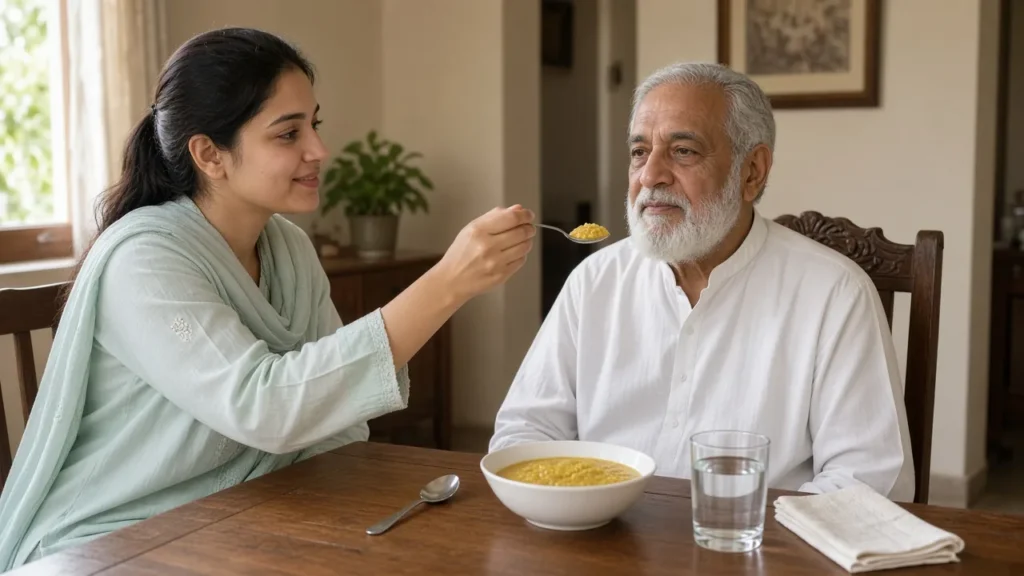
Short answer: The safest soft food for swallowing problems is food made at the exact texture level a speech therapist sets after a swallowing assessment. Pakistani home food can work well. Daal and khichdi can be blended smooth, mashed, or served as soft pieces in thick gravy. Yakhni and chai count as thin liquids, soup with pieces in it is a mixed texture, and regular roti usually suits only people cleared for everyday food. Coughing at meals, a wet voice after swallowing or repeated chest infections need a professional check.
This guide is general information for families. It is not medical advice, and it does not replace a swallowing assessment by a speech-language pathologist or the advice of the patient’s doctor.
Listen to a short overview
53 seconds · a spoken summary of this guide. It does not replace a swallowing assessment.
Key takeaways
- Soft is not the same as safe. What matters is the texture level, from smooth puree to soft bite-sized pieces, and the thickness of drinks.
- The international IDDSI framework numbers food levels 3 to 7 and drink levels 0 to 4. Ask the hospital or therapist which number applies.
- Daal, khichdi, dalia, keema, dahi and mashed aloo can be adapted to several levels. Plain rice, roti, bones, whole spices and soup with pieces are the usual trouble spots.
- Simple fork and spoon checks help you keep each meal at the right texture.
- IRHC speech therapists assess swallowing at home in almost all areas of Islamabad and Rawalpindi.
In this guide
- Is soft food for swallowing problems always safe?
- Why texture matters
- Who needs texture-modified food
- The IDDSI levels in plain words
- Pakistani foods by texture level (table)
- Daal, khichdi, roti and other home foods
- Checking texture at home
- Water, chai, lassi and thick drinks
- How to serve a meal safely
- Common mistakes
- Keeping up food and fluids
- When to get professional help
- Swallowing therapy in Islamabad and Rawalpindi
- FAQs
The discharge slip says “soft diet.” At home, that turns into a bowl of daal, a plate of khichdi, maybe a roti torn into small pieces. Then your mother coughs halfway through dinner, or your father’s voice sounds wet and bubbly after a sip of chai, and you start to wonder whether you are doing it right. That worry is reasonable. When swallowing is weak, soft food for swallowing problems has to be the right kind of soft, and much of the advice that ranks online is written for Western kitchens: mashed potato, applesauce, scrambled eggs. This guide translates the international texture levels into the food Pakistani families actually cook, and explains where the common risks hide.
Is soft food for swallowing problems always safe?
No. Soft describes how food feels, not whether a particular person can swallow it safely. Safety depends on matching the food’s texture, and the thickness of drinks, to the level a speech therapist recommends.
Daal is a good example. Cooked briefly with plenty of water, it can be a thin liquid with whole lentils floating in it. Cooked long and blended, it becomes a smooth, thick puree. Both are “soft,” yet they behave very differently in a weak swallow. A person who cannot control thin liquid may cope well with the thick puree and struggle with the runny version.
That is why hospitals and therapists around the world now use the International Dysphagia Diet Standardisation Initiative (IDDSI) framework. It gives every texture a number and a simple test, so “soft” means the same thing to the doctor, the cook and the carer. IDDSI is clear that the clinician chooses the level after a full assessment. The family’s job is to cook to that level, meal after meal.
Why does food texture matter so much when swallowing is weak?
A safe swallow needs the mouth to gather food into one soft ball and the throat to move it past the airway at the right moment. When the muscles or timing are weak, the wrong texture can slip into the airway or get stuck.
A public guide from the American Speech-Language-Hearing Association (ASHA), published through its consumer site, describes swallowing in three phases: the mouth chews and moves food back, the throat starts the swallow and closes off the airway, and the food pipe carries food down to the stomach. A problem in any phase is called dysphagia. Food or drink that goes into the airway is called aspiration, and ASHA lists pneumonia and other lung infections, dehydration and poor nutrition among the possible results.
Texture changes the job the mouth and throat have to do. Thin liquids move fast and give a slow swallow less time to react. Dry, crumbly or grainy food scatters and is hard to gather. Sticky food clings and leaves residue in the throat. Smooth, moist, cohesive food, at the right thickness, gives the person the best chance of a clean swallow. ASHA also notes that some people feel embarrassed by swallowing problems and want to eat alone, so getting the texture right is about dignity as well as safety.
Who needs soft or texture-modified food?
People whose swallowing has been affected by a stroke, Parkinson’s disease, dementia, multiple sclerosis, head and neck cancer or its treatment, a long illness or general frailty. Missing teeth, loose dentures and a painful mouth can also make chewing hard.
The NHS lists conditions that affect the brain and nerves, such as stroke, dementia, cerebral palsy and multiple sclerosis, along with some cancers, acid reflux and certain medicines, among the causes.
Watch for these signs at meals:
- Coughing or choking while eating or drinking, or just after.
- A wet, gurgly voice after swallowing.
- Food left in the cheeks, or food or drink leaking from the mouth.
- Needing much longer, or extra effort, to chew and swallow.
- A feeling of food stuck in the throat or chest.
- Weight loss, dehydration or repeated chest infections.
If your family member has had a stroke, our guide to speech therapy after a stroke at home covers swallowing safety, aspiration signs and positioning in that situation. This guide focuses on the next practical question: what to eat with difficulty swallowing, and how to cook it.
What are the IDDSI texture levels, in plain words?
IDDSI has eight levels, numbered 0 to 7. Drinks run from Level 0 (thin) to Level 4 (extremely thick). Foods run from Level 3 (liquidised) to Level 7 (regular). Levels 3 and 4 are shared, because a very thick drink and a smooth puree are the same texture.
These are the dysphagia diet levels most hospitals and therapists now refer to. For drinks, the levels are thin (0), slightly thick (1), mildly thick (2), moderately thick (3) and extremely thick (4). For food, they are liquidised (3), pureed (4), minced and moist (5), soft and bite-sized (6), and regular or easy to chew (7). Higher numbers need more chewing and more control. Lower is not “better”: the aim is the most normal food that is still safe.
In Pakistan these levels are still being put into everyday practice. A 2023 study in The Rehabilitation Journal, by researchers from Riphah International University and Capital Hospital, recruited 16 speech-language pathologists and dietitians in Rawalpindi and Islamabad. It noted that, at the time, clinical practice in the country had no standard diet protocol, which caused confusion about recommended textures. The team tested 29 common local foods and drinks with the IDDSI methods and sorted them into the eight levels, which makes it the most specific dysphagia diet guidance for Pakistan that we found. A 2026 survey of 74 speech-language pathologists in Lahore found that 64.9% used IDDSI guidelines, yet 62.1% had low confidence in modifying traditional Pakistani foods, and only 27% used local food guides. The authors point to roti, rice, lentils and meat curries as staples that are hard to modify safely. If your hospital advice felt vague, that is part of the reason.
Which Pakistani foods fit each texture level?
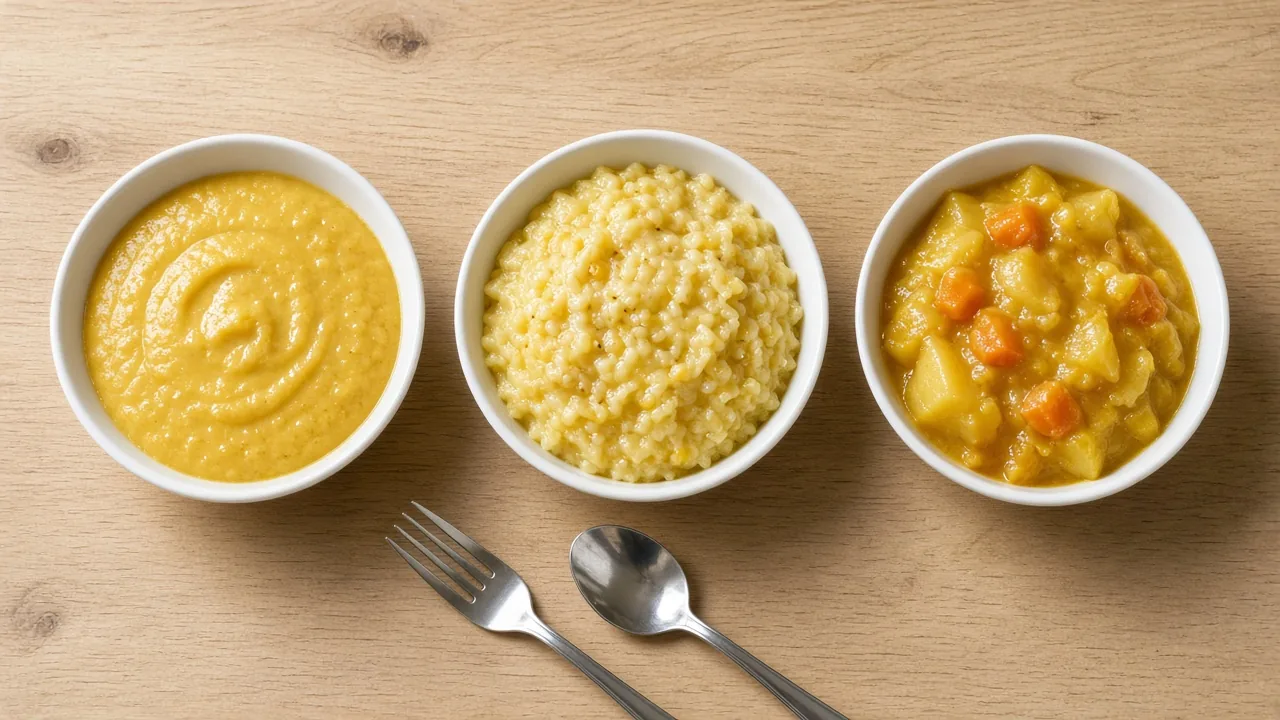
Daal, khichdi, dalia, keema, dahi, custard and mashed aloo or banana can all become soft food for swallowing problems, fitting Levels 3 to 6. Roti, kabab and kheer sit at Level 7. The table shows what each level looks like and the home foods that may fit it.
Use this table to understand the advice you have been given, not to choose a level yourself.
| IDDSI food level | What it looks and feels like | Pakistani home foods that may fit, if prepared this way | Watch out for |
|---|---|---|---|
| Level 3: Liquidised | Smooth, with no bits at all. Pours from a spoon and drips slowly through a fork. Taken with a spoon or from a cup. No chewing. | Karhi without pakoras, blended smooth (the Pakistani study placed karhi here). Daal blended and strained until no husk or grain is left, at the thickness your therapist shows you. | Pakoras, onion, whole spices or husk left in the bowl. If it runs off the spoon like water, it is a thinner level, not Level 3. |
| Level 4: Pureed | Smooth and thick. Holds its shape on a spoon and slides off in one spoonful when you tilt it. No lumps, not sticky, no water separating out. | Plain dahi and custard (both placed here in the study). Daal or khichdi blended and strained to a thick, smooth puree. | Puree that clings to the spoon like paste, or that goes runny as it cools or warms. Test it at the temperature you serve it. |
| Level 5: Minced and moist | Soft and moist, with small lumps no wider than about 4 mm, roughly the gap between fork prongs. The tongue can squash the lumps. No thin liquid pooling. | Thick, well-cooked daal, dalia and finely minced keema in thick gravy (the study placed these here). Mashed potato with no lumps bigger than 4 mm. | Dry keema, loose rice grains, thin shorba pooling around the food. IDDSI says no regular bread or roti at this level. |
| Level 6: Soft and bite-sized | Soft, tender, moist pieces no bigger than 1.5 cm, about the size of a thumbnail. A fork pressed on a piece squashes it. Chewing is still needed. | Very soft khichdi, mashed banana and mashed potato (study). Aloo, lauki or carrot boiled soft and cut small in a thick salan, and fish flaked off the bone (my application of IDDSI’s rules, not in the study). | Plain rice that falls into separate grains, chicken on the bone, stir-fried or crunchy vegetables, dry roti or bread. |
| Level 7: Easy to chew / Regular | Everyday food. Easy to chew means soft and tender food of any size, with nothing hard, chewy, crunchy, stringy or crumbly. Regular has no limits. | Chapati, shami kabab and kheer were placed at Level 7 Regular in the study. Tender salan and soft roti suit people cleared for this level. | Nuts, seeds, papad, tough boti, crumbly cake, dry biscuits dunked in chai, and soup with pieces in it. |
Read this table as a guide, not a prescription. The food examples come from one small 2023 study of 16 speech-language pathologists and dietitians in Rawalpindi and Islamabad, plus the IDDSI descriptions. In that study, speech-language pathologists and dietitians did not always agree on every item, including yakhni, dalia and rice. The same daal can be Level 3, 4 or 5 depending on how long it cooks, how much water goes in and how you blend it. Only the level your speech therapist or doctor sets for your family member is safe for them.
How do you prepare daal, khichdi, roti and other home foods for each level?
Cook everything until very soft, remove anything hard, then blend, mash or cut to the size your level allows. Keep food moist with thick sauce rather than thin liquid, and check the texture before every meal.
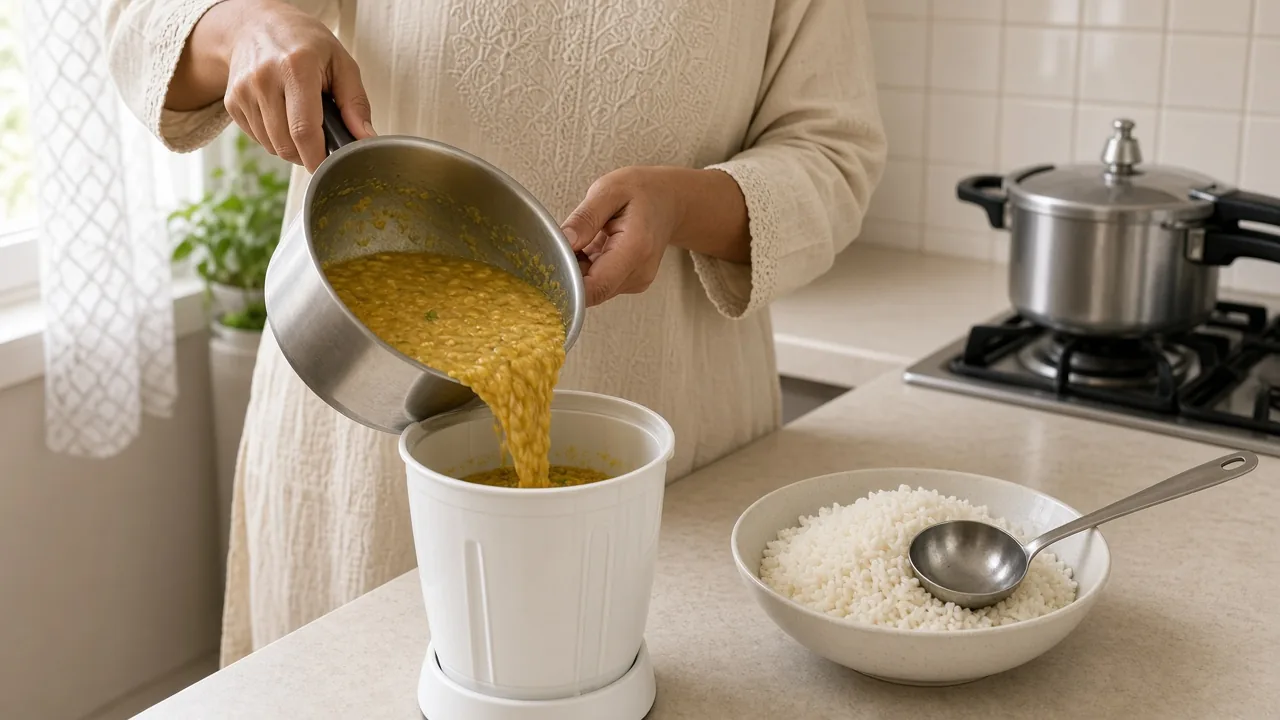
Daal
Split moong and masoor break down more easily than whole chana or mash. Pressure-cook the daal until the grains fall apart. For Levels 3 and 4, blend it until completely smooth, then press it through a fine sieve to catch husks and skins. For Level 5, a thick, well-mashed daal with no whole grains is often closer. Add the tarka before blending, or strain it out, because whole zeera, curry patta, bay leaves, dried chillies and fried onion slices are all small hard bits that the IDDSI descriptions exclude at these levels. Ground spices are fine.
Khichdi and rice
Khichdi is one of the most useful dishes here because rice and lentils cooked long with extra water turn soft and cohesive. Cook it softer than usual, mash it while hot, and stir in a spoon of ghee, butter or milk if it starts to dry out. Plain boiled chawal is a different matter. Grains that separate and roll around the mouth are hard to control, and IDDSI says rice at Levels 5 and 6 should not be grainy, sticky or fall into separate grains. Biryani and pulao, with their whole spices, bones and separate grains, are best kept for people cleared for regular food.
Roti, paratha and bread
Roti is the food families most want to keep, and the hardest to adapt. It needs real chewing, it is chewy and it absorbs saliva and clumps. IDDSI does not allow regular bread at Levels 5 and 6, and the Pakistani study placed chapati at Level 7. Paratha, naan and crisp toast are harder still. Many families try soaking roti in daal or yakhni, but that can leave soggy lumps sitting in thin liquid, which is a mixed texture. If roti matters to your family member, ask the therapist directly whether, and how, it can return.
Meat, keema and fish
Pieces of boti, nalli and chicken on the bone need strong chewing. Keema cooked soft in a thick gravy is a better starting point, and for Level 5 it needs to be minced finely enough that the bits are no wider than about 4 mm. For Level 6, tender meat or flaked fish in pieces no bigger than 1.5 cm can work. Check carefully for bones in fish and chicken.
Vegetables, fruit and sweets
Aloo, lauki, kaddu and carrots boil soft and mash well. Leafy saag can be blended smooth, but stringy or leafy bits are a risk if left whole. Ripe banana and papaya mash easily. Avoid orange and kinnow segments with their membranes, and watermelon, whose juice separates from the flesh in the mouth. Custard can suit the pureed level once checked. Kheer was placed at Level 7 in the study. Ice cream and kulfi melt into thin liquid in the mouth, so give them only if a specialist says they are suitable.
How can you check the texture at home?
IDDSI designed simple tests that need only a fork, a spoon and your fingers. A speech therapist can show you which ones to use for your family member’s level.
- Spoon tilt test (Levels 4 and 5): scoop some food and tilt the spoon. Pureed food should hold its shape and slide off in one spoonful, leaving only a thin film. If it sticks to the spoon, it is too thick or sticky. If it pours, it is too runny.
- Fork drip test (Levels 3 and 4): liquidised food drips slowly through the prongs. Pureed food sits in a mound on top of the fork.
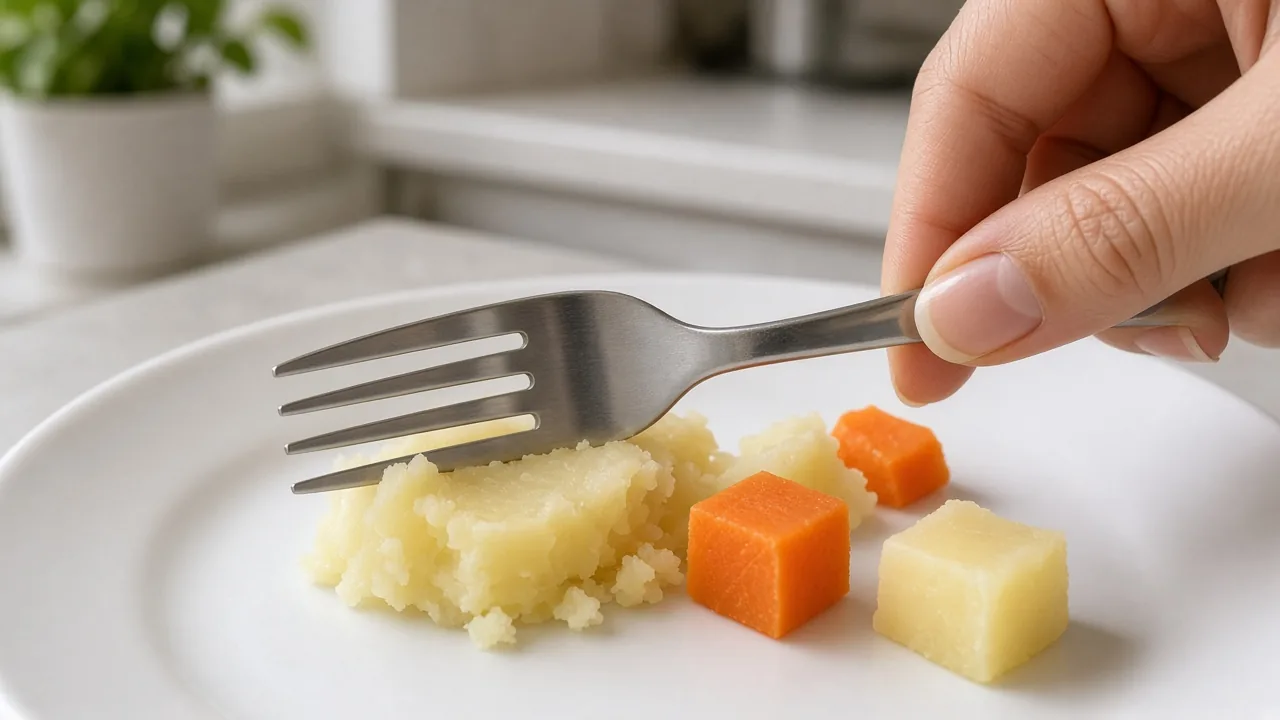
- Fork prong gap (Level 5): the gap between the prongs of a standard fork is about 4 mm, which is the largest lump allowed at this level.
- Fork pressure test (Levels 5 and 6): at Level 6, press a piece with the back of a fork until your thumbnail turns white. The food should squash and not spring back. Level 5 food should mash with much lighter pressure. A thumbnail is also a handy guide to the 1.5 cm size limit at Level 6.
Test the food as you will serve it. IDDSI says testing should be done at the serving temperature, and the Pakistani study notes that starch-based foods such as custard change thickness with temperature. A daal that is right when hot may set firm as it cools.
What about water, chai, lassi and thickened drinks?
Water, chai, juice, sherbet, Rooh Afza and clear yakhni are all thin liquids, IDDSI Level 0. Thin liquids move fast and can be the hardest to control when swallowing is weak. Thicken drinks only if a therapist or doctor has advised it and shown you the target thickness.
The Pakistani study placed water, tea, black coffee, yakhni, sharbat, fruit juice, lemonade, Rooh Afza and lassi at Level 0. Squash and raita came out slightly thick (Level 1), milkshakes and homemade yogurt mildly thick (Level 2). The researchers also note that commercial thickeners are not easy to find in Pakistan, which is one reason they looked at naturally thick foods. Even so, don’t guess. Thickness is measured with a 10 ml syringe flow test, and a drink that is right for one person can be unsafe for another. Your therapist can show you the test and suggest a product or method that is available locally.
Whatever the drinks, keep count of how much your family member drinks through the day, as the ASHA guide suggests, especially in Islamabad and Rawalpindi’s hot months.
How should you serve a meal to someone with swallowing difficulty?
Sit the person fully upright, use a small spoon, go slowly, and wait for each mouthful to be swallowed before the next. Follow any specific positions or techniques the therapist has taught.
- Upright posture: sitting in a chair at the table is best. In bed, raise them as upright as their condition allows and support them with pillows.
- Calm room: turn off the TV and keep conversation to the gaps between mouthfuls. Talking and swallowing at the same time is risky.
- Small amounts: a teaspoon rather than a tablespoon, and small sips if drinks are allowed.
- Time: check that the mouth is empty before the next spoonful. If the person is drowsy or confused, wait.
- One texture at a time: serve the daal and the khichdi separately rather than as a runny mix.
- After the meal: keep them sitting up for a while and clean the mouth, teeth or dentures. Leftover food in the mouth can be breathed in later.
- Medicines: ask the doctor or pharmacist before crushing tablets or opening capsules. Some medicines must not be crushed.
What are the most common mistakes families make?
Treating every soft food as safe, serving soups with pieces, thinning puree with water, leaving whole spices or bones in, and changing the texture level without advice.
- Assuming yakhni is the easiest food. It feels gentle, but it is a thin liquid. For someone who coughs on water, it may be one of the hardest.
- Bits floating in liquid. Chicken soup with pieces, daal with whole grains in thin water, cereal in milk and a biscuit dunked in chai all mix thin liquid with solid pieces. IDDSI lists these mixed textures as a choking risk.
- Thinning a puree with plain water. It can make the food runnier than the level allows and adds no nutrition. Use milk, thick daal or a little ghee and recheck with the spoon tilt test.
- Forgetting the tarka and the bones. Whole spices, seeds, fish bones and small chicken bones are easy to miss.
- Moving up or down a level on your own. Going up too soon raises the risk. Staying on puree longer than needed can mean poorer intake and less enjoyment. Let the therapist decide.
- Feeding when tired. Fatigue makes chewing and swallowing harder. Smaller, more frequent meals at alert times of day can help.
How do you keep up nutrition on a soft diet?
Blending adds water and bulk, so pureed food for elderly parents can carry fewer calories and less protein than the same meal unblended. Enrich the food, offer smaller meals more often, and watch for weight loss.
Add protein and energy without thinning the texture: a spoon of ghee or butter in daal or khichdi, milk instead of water when blending dalia, an egg cooked into khichdi before mashing, thick dahi on the side if allowed at the person’s level. Use the person’s usual ground masala so the food still tastes like home.
The NHS notes that dysphagia can lead to weight loss, dehydration and repeated chest infections over time, and the ASHA guide suggests that carers keep track of how much is eaten and drunk. If clothes are getting loose or meals are coming back half finished, tell the doctor, and ask about a dietitian. Poor intake also affects the skin of a person who spends long hours in bed, which our guide to preventing bedsores at home covers.
When should you get professional help?
Get a swallowing assessment as soon as you notice coughing or choking at meals, a wet voice after swallowing, food sticking, weight loss or repeated chest infections. Choking that does not clear, or difficulty breathing, is an emergency.
The NHS advises getting urgent medical advice for anyone who has difficulty swallowing, coughs or chokes while eating or drinking, has a wet or gurgly voice afterwards, is short of breath after eating or drinking, or keeps getting chest infections. Fever, fast breathing or a new cough after meals also need a doctor the same day.
A speech-language pathologist (speech therapist or SLP) assesses swallowing and sets the texture level. The ASHA guide describes the assessment as a look at the person’s history, how well the mouth muscles move, and how they eat and drink. If more detail is needed, hospital tests such as a modified barium swallow (an X-ray video) or an endoscopic swallowing assessment (FEES) can show exactly where the swallow goes wrong. These are done in hospital, not at home. Therapy may include exercises for the swallowing muscles, safer positions and techniques, and the right food and drink textures.
Where can you get swallowing therapy at home in Islamabad and Rawalpindi?
IRHC’s speech therapists treat swallowing disorders at home in almost all areas of Islamabad and Rawalpindi, Monday to Sunday, 9 am to 9 pm. Online video sessions are also available.
Swallowing disorders are one of the conditions our speech therapy team works with, and therapy includes exercises for the swallowing muscles and safer ways to eat and drink. The first session starts with an assessment, and the therapist explains the plan afterwards. At home, the therapist can also see the food you cook and where meals happen. You can read about our therapists on the team page.
If your family member also needs nursing care, such as NG tube care after a hospital stay, help at mealtimes for a bedbound patient, or regular checks of temperature and blood pressure, our home nursing staff can work alongside the therapist. Partner clinic appointments are available at G-8 Markaz, Islamabad and Saddar, Rawalpindi, by booking ahead. Before the first visit, keep any discharge notes, the hospital’s diet advice and a list of medicines ready.
Worried about what is safe to eat?
Not sure which soft food for swallowing problems suits your family member? Book a home speech therapy assessment in Islamabad or Rawalpindi. An IRHC speech therapist can assess swallowing, advise on a safe texture level and help your family prepare daal, khichdi and other home food to match it. Every booking is confirmed on WhatsApp. For fees, timings and payment, see our FAQs.
Book an appointment | WhatsApp 0300-6844361 | Call 051-8776556
Frequently Asked Questions
Quick answers to what families ask most about soft food and swallowing. For fees, timings and payment, see our FAQs page.
Can a person with swallowing problems eat roti?
Only if their speech therapist has cleared them for everyday food (Level 7). Roti is chewy, needs good chewing, and can stick in the mouth and throat. IDDSI does not allow regular bread or roti at the pureed, minced or soft and bite-sized levels. Soaking roti in daal or yakhni does not make it safe by itself, because it can turn into a mix of soggy pieces and thin liquid.
Can someone with dysphagia eat bread?
Only if their speech therapist has cleared them for everyday food (Level 7). Regular bread, like roti, needs chewing and can clump in the mouth. IDDSI does not allow regular bread at the pureed, minced or soft and bite-sized levels. Soaking bread in daal, yakhni or chai can leave soggy lumps in thin liquid, which is a mixed texture.
Is khichdi or rice safe for someone with dysphagia?
Khichdi cooked very soft can fit several levels, from blended smooth to soft and mashed, depending on how it is prepared. Plain boiled rice is harder. If it falls apart into separate grains, the grains can scatter in the mouth. IDDSI says rice at the minced and soft levels must not be grainy, sticky or separate into grains.
Is yakhni or soup good for swallowing difficulty?
Clear yakhni behaves like water, which is the thinnest level (Level 0), and thin liquids can be the hardest to control when swallowing is weak. Soup with pieces of chicken or vegetables floating in it is a mixed texture, which IDDSI lists as a choking risk. Ask your therapist whether yakhni needs to be thickened or blended for your family member.
Can dysphagia patients eat ice cream?
Not without advice. Ice cream and kulfi melt into a thin liquid in the mouth. IDDSI calls ice cream a transitional food that should only be given if a dysphagia specialist has assessed the person as suitable for it.
What is the difference between a soft diet and a pureed diet?
A pureed diet (IDDSI Level 4) is completely smooth, with no lumps, and needs no chewing. A soft diet usually means soft and bite-sized food (Level 6): tender pieces up to about 1.5 cm that still need chewing. Because the word soft is used loosely, ask the hospital or therapist which IDDSI level number they mean.
Can I thicken water or chai at home?
Only if a speech therapist or doctor has said your family member needs thickened drinks and has shown you the right thickness. Too thin and the drink may not be safe, and too thick can also be harder to swallow. Thickness can change with temperature and standing time, so check it each time.
How long does someone need soft food after a stroke or illness?
There is no fixed time. Some people’s swallowing improves and they can move up a level. Others need modified food for a long time, for example with a progressive condition such as Parkinson’s or dementia. The level should be reviewed by the therapist, not changed by the family on their own.
Does dysphagia get worse over time?
It depends on the cause. After a stroke or a short illness, swallowing can improve with therapy and time. In a progressive condition such as Parkinson’s or dementia, swallowing may become more difficult later. Some people stay much the same. The texture level should be reviewed by a speech therapist, not changed at home on the assumption that it will only get better or only get worse.
How much does a home speech therapy visit cost in Islamabad or Rawalpindi?
At IRHC, a first or single speech therapy home visit is Rs 3,000, and a standard session lasts 45 minutes. Packages are discounted: 10% off 5 sessions and 15% off 10 sessions. Payment is made in advance, once the booking is confirmed, by Easy Paisa, JazzCash, U Paisa, Raast ID, bank transfer or cash.
How do I book a swallowing assessment at home?
Call 051-8776556 (9 am to 6 pm), WhatsApp 0300-6844361 (answered 24/7), or use the online appointment form. Our speech therapists visit almost all areas of Islamabad and Rawalpindi, Monday to Sunday, 9 am to 9 pm, and every booking is confirmed on WhatsApp. Keep any hospital discharge notes and diet advice ready for the first visit.
Medical disclaimer: This article is for general information only. It does not replace an assessment by a speech-language pathologist or the advice of the patient’s doctor. Texture levels must be set for each person, and no food list can guarantee that a swallow will be safe.