
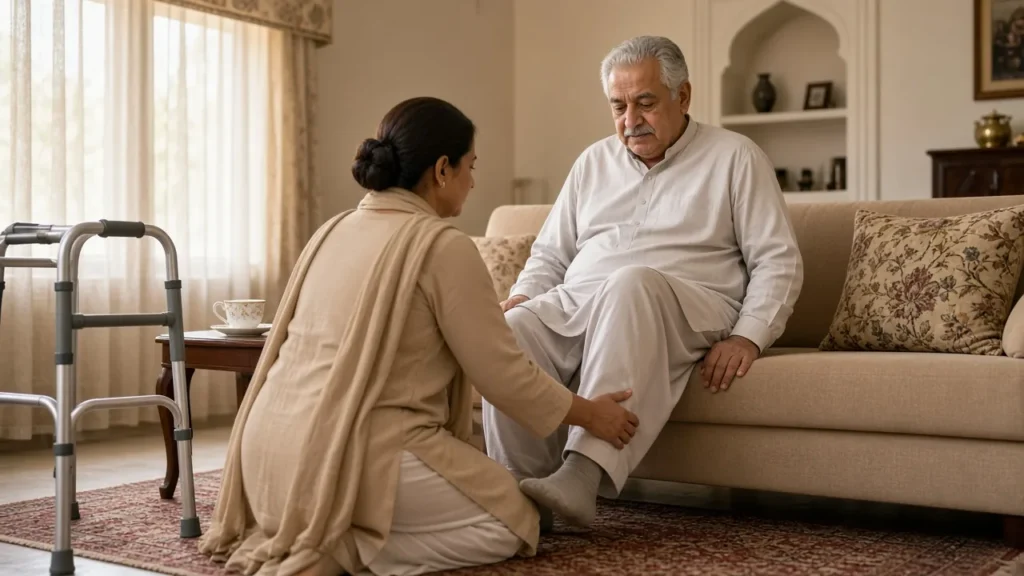
Short answer: Physiotherapy after knee replacement at home starts with gentle exercises, short walks with a frame or crutches, and ice and a raised leg for swelling. Over weeks, the exercises get harder and most people move to a cane or no aid. Recovery takes several months, so follow your surgeon’s protocol, not a generic timetable. Calf pain or swelling, fever, a red or leaking wound, or sudden breathlessness need urgent medical help. Families in Islamabad and Rawalpindi can book a physiotherapist to visit at home with IRHC.
This guide is general information. It is not medical advice and does not replace your surgeon’s instructions or an assessment by a qualified physiotherapist.
Listen to a short overview
48 seconds · a spoken conclusion of this guide. It does not replace your surgeon’s advice.
Key takeaways
- Physiotherapy after knee replacement at home carries on from the hospital exercises, which start within hours of surgery. Regular, gentle practice beats occasional hard sessions.
- Most people use a frame or crutches at first. A cane or no aid usually comes between about 2 and 6 weeks, if the team agrees.
- Pain and swelling are normal for weeks. Calf pain, a hot red wound, fever or chest pain are not.
- Stairs, getting off the floor and low toilets need planning before you come home.
- IRHC sends a physiotherapist to your home in almost all areas of Islamabad and Rawalpindi, Monday to Sunday. See home physiotherapy.
In this guide
- How long is recovery?
- What home physiotherapy involves
- Week-by-week recovery (table)
- Knee replacement exercises at home
- Pain and swelling
- Walking and walking aids
- Stairs, floor sitting and the bathroom
- Warning signs
- Common mistakes
- Home or clinic?
- Knee replacement rehab at home in Islamabad and Rawalpindi
- FAQs
The operation is over, and the hospital sends you home within a few days with a sheet of exercises and a follow-up date. Then the real work starts, and most families are not sure what is safe in week one, what should wait until week six, or when a swollen knee is a problem. This guide covers physiotherapy after knee replacement at home: what to expect, what the exercises look like, and when to call the doctor.
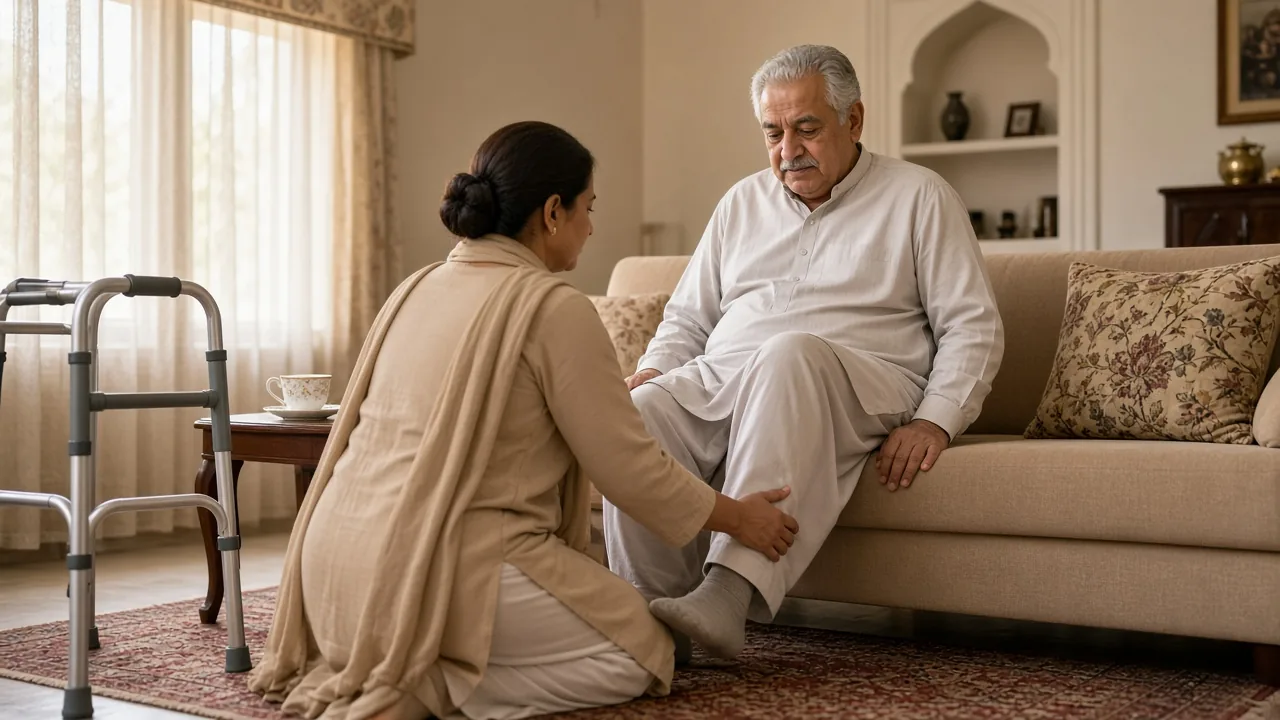
How long does recovery from a knee replacement take?
Plan on several months. Most people are back to daily activities within about 3 to 6 weeks, but full recovery can take longer, and for some people up to a year. Your age, health and the type of surgery all change the pace.
The NHS says it may take several months or longer to recover fully, and that a partial knee replacement should be quicker than a total one. Many people leave hospital 1 to 4 days after the operation, once they can get around safely with crutches or a frame. After that, the biggest gains usually come from doing the exercises regularly. AAOS, the American orthopaedic surgeons’ patient site, says most people can resume most normal activities within 3 to 6 weeks, and that pain with activity and at night is common for several weeks.
What does physiotherapy after knee replacement at home involve?
A physiotherapist visits you at home, checks your knee, strength and walking, and builds a plan on your surgeon’s advice. The plan covers exercises, walking, stairs and daily tasks, and the family learns the exercises to repeat between visits.
Physiotherapy after surgery is about getting movement back safely and preventing stiffness, as we explain in our guide to the benefits of physiotherapy. For a knee replacement, a first home visit at IRHC usually looks like this:
- Questions: the physiotherapist asks about the operation, your medical history, medicines and the surgeon’s instructions. Keep your discharge summary, reports and any X-rays ready.
- Checks: movement, strength, pain, swelling and how you stand and walk.
- Plan: goals agreed with you, and a set of exercises for the days ahead. It can include stretching and hands-on techniques as well as exercises.
- Family training: a family member learns how to help with the exercises and with moving around safely.
Our home physiotherapy service includes post-operative rehabilitation after joint replacement. The physiotherapist follows your surgeon’s advice, not a fixed script. If your surgeon’s instructions differ from anything in this guide, follow your surgeon.
What does knee replacement recovery look like week by week?
Early weeks are about gentle movement, walking with support and controlling swelling. Strength work and fewer walking aids follow between roughly weeks 2 and 6. Longer walks and work come later. The table shows typical stages, but your own timetable can be faster or slower.
For physiotherapy after knee replacement at home, the timings below come from the NHS and AAOS patient guides. Treat them as typical ranges, not targets. If your recovery looks different, ask your surgeon or physiotherapist, and do not compare yourself with a neighbour or a relative.
| When | What the work usually focuses on | Walking and aids | Often asked about |
|---|---|---|---|
| Days 1 to 4 (hospital, then home) | Ankle pumps, tightening the thigh, first gentle knee bends, getting out of bed and standing. | Walking frame or crutches, with the weight allowed by your surgeon. | Going home: many people leave hospital 1 to 4 days after the operation. |
| Week 1 to 2 | Exercises several times a day, ice and a raised leg for swelling, short walks indoors. | Frame or crutches. Short, frequent walks rather than one long one. | Stitches or clips are usually taken out after about 10 days. |
| Week 2 to 3 | Straightening and bending a little further, more thigh strength, practising stairs with a handrail. | Some people can start with one crutch or a cane around 2 to 3 weeks, if the team agrees. | Standing and walking for 10 minutes or more without tiring. |
| Week 4 to 6 | Strength work, possibly light ankle weights and an exercise bike if the physiotherapist approves. | Cane or no aid. NHS says to try walking without an aid after about 6 weeks, if you feel ready. | Driving (4 to 6 weeks is common) and the 6-week check-up with the surgeon. |
| Week 6 to 12 | Longer walks, better balance, building up everyday tasks and, for many people, work. | Mostly without aids, as the surgeon and physiotherapist advise. | Return to work often falls between 6 and 12 weeks. No heavy household lifting for the first 3 months. |
| 3 months to 1 year | Keeping up the strengthening so the knee keeps improving. Swelling settles slowly. | Normal walking is the goal. Stairs and longer distances get easier. | Full recovery can take several months and, for some people, up to a year. |
Progress is rarely a straight line. A good day can be followed by a stiff, sore one, especially after a longer walk or a hard exercise session.
Which knee replacement exercises at home are usually used early on?
The early knee replacement exercises at home are ankle pumps, thigh-tightening, straight leg raises, knee straightening and gentle supported bends. Do only what your surgeon or physiotherapist has approved, and how often they say.
The AAOS exercise guide suggests that your surgeon and physiotherapist may recommend 20 to 30 minutes of exercise once or even 2 to 3 times a day in early recovery, plus walking. These are the usual starting exercises:
- Ankle pumps: move your foot up and down at the ankle. This keeps blood moving in the leg, which matters for preventing clots.
- Thigh sets: tighten the thigh muscle and press the knee gently towards the bed, holding for 5 to 10 seconds.
- Straight leg raises: with the thigh tight and the knee straight, lift the leg a few inches, then lower slowly.
- Knee straightening: with a small rolled towel under the heel, tighten the thigh and try to straighten the knee fully.
- Supported knee bends: sit with the thigh supported and slowly bend the knee as far as is comfortable, using the other foot for support if needed.
This is the core of knee replacement exercises at home. Some discomfort during these is expected. Sharp pain, a sudden increase in swelling or a feeling that something has given way is not. Stop and call your physiotherapist or surgeon. Later, depending on the plan, the physiotherapist may add standing knee bends, sit-to-stand practice, light ankle weights and an exercise bike. This is exactly why a plan built around your knee is better than copying a video.
How do you manage pain and swelling at home?
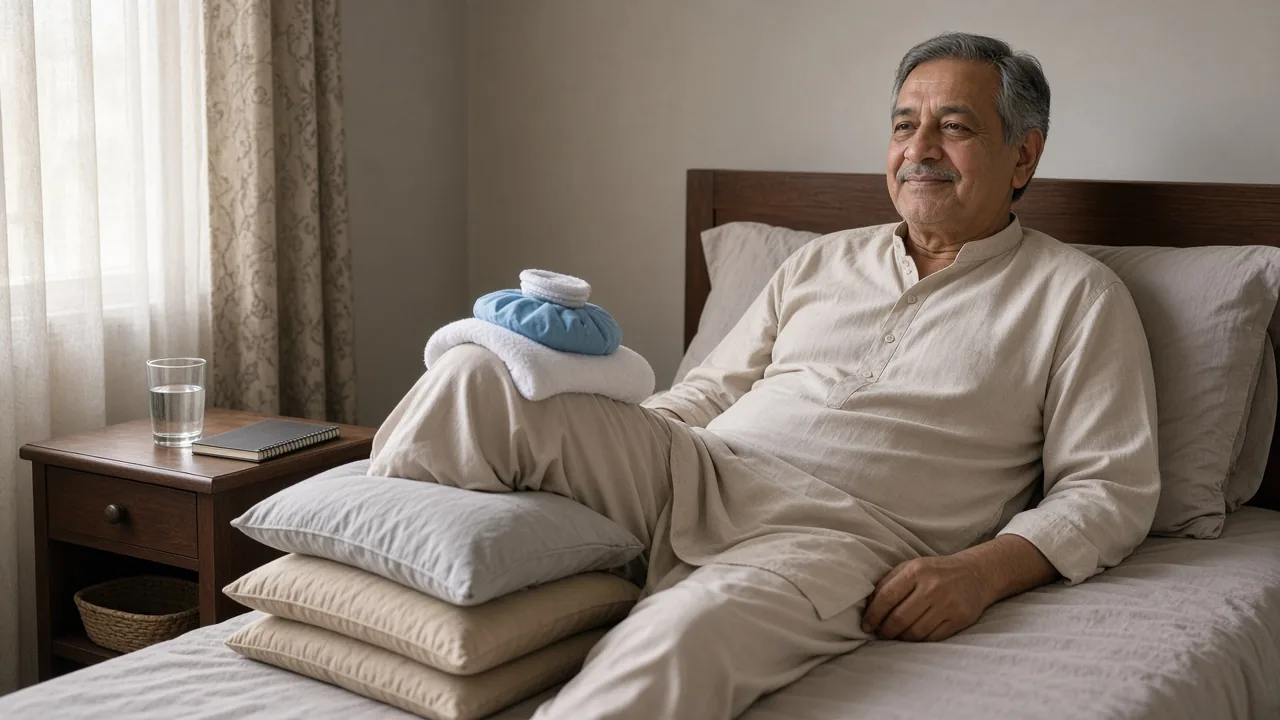
Take pain medicines exactly as prescribed, use ice, and keep the whole leg raised. Some swelling and pain are normal for weeks. New or increasing swelling in the calf, or a hot, red wound, is not normal.
- Medicines: take them as your doctor prescribed. Getting pain under control makes it easier to do your exercises, and AAOS advises using opioid painkillers only as directed and stopping as soon as pain begins to improve.
- Ice: AAOS suggests an ice pack, or ice wrapped in a towel, for 20 minutes, then off for 20 minutes, for up to about 2 hours after exercise if the knee is sore or swollen. Never put ice straight on the skin.
- Raise the leg: the NHS advises keeping the leg raised as much as possible to reduce swelling. Raise the whole leg on pillows under the calf and heel. Do not sleep with a pillow under the knee itself.
- Do not stand for long periods: the NHS warns that this can make the ankle swell.
How do you walk safely at home, and when can you stop using the frame?
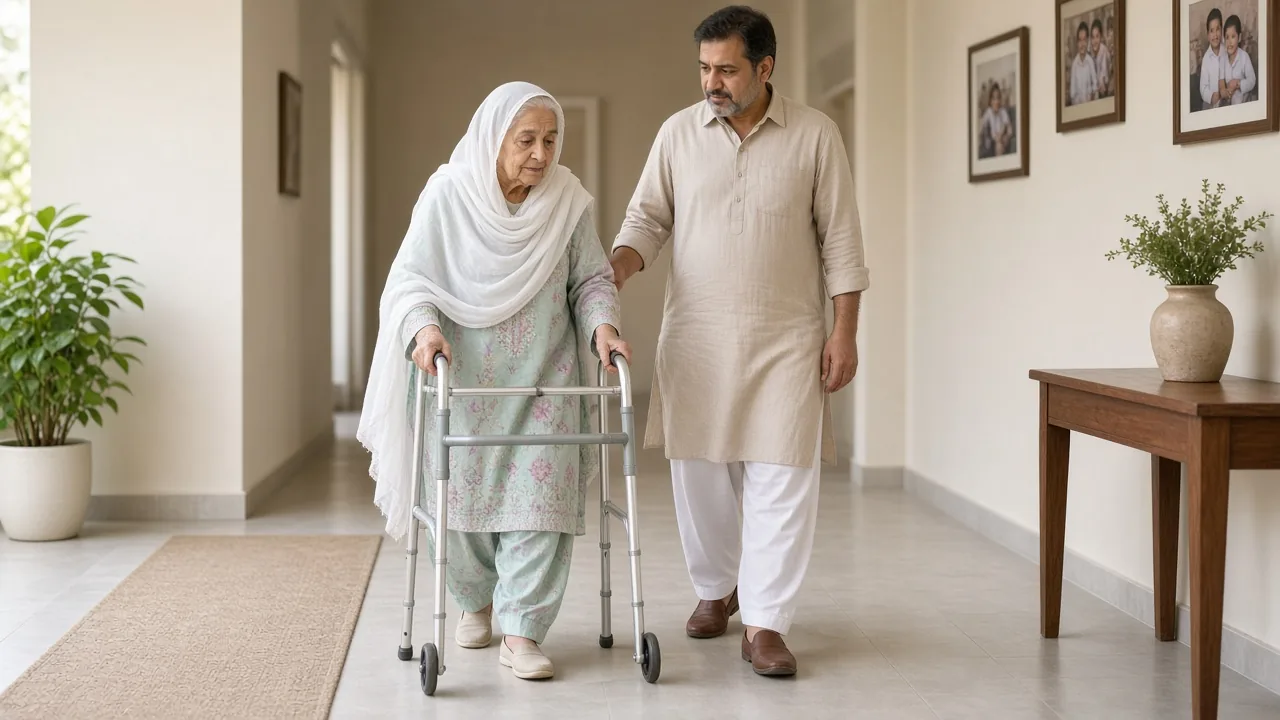
Start with a frame or crutches, walk little and often, and move to a cane only when your team says so. Many people reach a cane around 2 to 3 weeks and walk without an aid near 6 weeks, but only when it feels safe.
AAOS says walking is the best way to help the knee recover. Your surgeon or physiotherapist tells you how much weight to put on the leg. A few practical points:
- Heel first: reach forward so the heel lands first, then the whole foot, then lift the toes. Do not rush. Aim for an even, smooth walk.
- Cane in the opposite hand: if the right knee was operated on, hold the cane in the left hand. You should not limp or lean away from the operated side.
- Clear the path: take up loose rugs, cables and low stools, and keep passages well lit, especially the way to the bathroom at night.
- Falls matter: AAOS warns that a fall in the first few weeks can damage the new knee and may mean further surgery.
The NHS suggests going from two crutches down to one, then to a stick as you gain confidence, and trying walking without an aid after about 6 weeks if you feel ready. Do not give up the aid just because a relative says you should be ready.
How do you manage stairs, sitting on the floor and the bathroom?
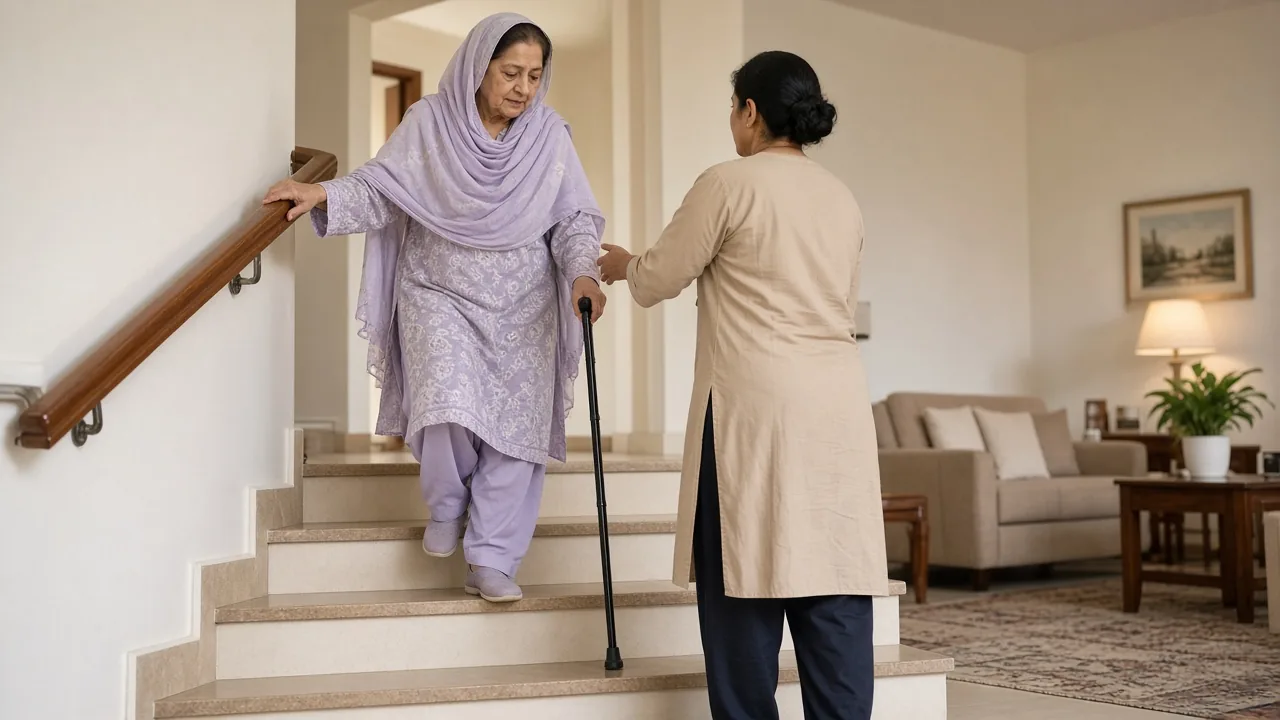
Use the handrail and go one step at a time. Step up with the good leg and down with the operated one. Ask your surgeon before sitting on the floor, squatting or kneeling, and plan a raised toilet seat or chair for the bathroom.
Many homes in Islamabad and Rawalpindi have stairs, floor seating and low toilets, so it is worth thinking about this before you leave hospital.
- Stairs: AAOS says to lead up with the good knee and down with the operated one (“up with the good, down with the bad”), with a handrail, and not to use steps higher than standard. Have someone beside you until your strength and balance return.
- Sitting: the NHS says not to sit with your legs crossed for the first 6 weeks and not to kneel on the new knee until your doctor says you can. Many families set up a firm, higher chair for meals and prayer at first. Ask your surgeon when sitting on the floor is safe.
- Bathroom: a non-slip mat, a shower chair and wall grab bars help. If getting up from a low toilet is hard, ask the physiotherapist about a raised seat or commode chair.
Our guide to home nursing after hospital discharge covers setting up the bedroom and bathroom, and what to do about wound care or medicines if a nurse is also needed.
Which warning signs need urgent care after knee replacement?
Call your surgeon straight away for calf pain or swelling, a red or draining wound, or fever. Sudden breathlessness or chest pain is an emergency: go to the nearest emergency department or call 1122.
Blood clots in the leg veins are one of the most common complications of knee replacement, and they can become life-threatening if they travel to the lungs, according to AAOS. Infection is less common but serious. Contact your doctor immediately if you notice:
- Possible blood clot: increasing pain in the calf, tenderness or redness above or below the knee, or new or increasing swelling in the calf, ankle or foot. The NHS says to get medical help as soon as possible if you think you have a DVT.
- Possible clot in the lung: sudden shortness of breath, sudden chest pain, or chest pain that comes with coughing. Treat it as an emergency.
- Possible infection: persistent fever, chills, increasing redness, tenderness or swelling around the wound, drainage from the wound, or knee pain that gets worse with both activity and rest.
- A fall, especially with new pain, a change in the shape of the knee, or being unable to put weight on the leg.
Do not wait for the next physiotherapy visit if any of these appear. Your physiotherapist can pass on a concern, but diagnosis and treatment come from a doctor.
What mistakes slow down knee replacement recovery?
Whether you do knee replacement rehab at home or at a clinic, the common ones are skipping exercises because of fear, doing too much on a good day, sitting or standing for too long, and ignoring the surgeon’s do-and-don’t list.
- Skipping exercises. The NHS says following the exercises recommended by your physiotherapist helps your recovery and prevents complications.
- Overdoing it. A long walk or heavy session can leave the knee more swollen and stiff the next day. Build up gradually.
- Staying in one position. Long periods sitting with the knee bent make stiffness worse, and long periods standing make the ankle swell.
- Heavy household work too soon. The NHS says to avoid heavy lifting or moving things, such as carrying shopping, for the first 3 months.
- Dropping the walking aid early because you feel better, or keeping it too long out of fear. Ask the physiotherapist to assess your walking.
Is physiotherapy at home better than going to a clinic after knee replacement?
For many people it is easier in the first weeks, because there is no travel, and exercises are practised on your own bed, chair and stairs. A clinic or video session can still suit you later. The right choice depends on how well you can travel safely.
Getting into a car, across a waiting room and home again is hard on a new knee. Physiotherapy after knee replacement at home removes that, and the physiotherapist sees the real obstacles: your stairs, your bathroom, your bed height. Later, when you walk well and travel is no longer a strain, a clinic visit or an online session can make sense. IRHC offers all three: home visits, partner clinics in G-8 Markaz (Islamabad) and Saddar (Rawalpindi), and online video sessions.
Knee replacement rehab at home in Islamabad and Rawalpindi: how IRHC arranges it
IRHC sends a physiotherapist to your home in almost all areas of Islamabad and Rawalpindi, Monday to Sunday, 9 am to 9 pm. A female physiotherapist is available. Every booking is confirmed on WhatsApp.
If you are looking for physiotherapy after knee replacement at home in Islamabad or Rawalpindi, our physiotherapy team follows the surgeon’s advice and works on movement, strength, walking and everyday activities at your home. Knee replacement recovery at home in Islamabad and Rawalpindi usually involves a mix of exercise, walking practice, stairs practice and teaching the family what to do between visits.
To book, call 051-8776556 (9 am to 6 pm), WhatsApp 0300-6844361 (answered 24/7), or use the online appointment form. Tell us:
- Which knee was operated on, whether it was a total or partial replacement, and the date of surgery.
- The surgeon’s instructions, including any limit on weight-bearing, and any blood-thinning medicine.
- Your area, and whether you would prefer a home visit, a clinic visit or a video session.
Not sure we cover your area? Send your location on WhatsApp and we will confirm before booking. For fees and payment methods, see our FAQs. If you are also looking after wounds, injections or personal care, a nurse can visit as well.
Just had a knee replacement, or helping someone who has?
IRHC sends a physiotherapist to your home in Islamabad and Rawalpindi, Monday to Sunday. Our team confirms every booking on WhatsApp. For fees, timings and payment methods, see our FAQs, or read more about our home physiotherapy.
Book an appointment | WhatsApp 0300-6844361 | Call 051-8776556
Frequently Asked Questions
Quick answers to what families ask most about knee replacement physiotherapy at home and recovery afterwards. For fees, timings and payment, see our FAQs page.
How soon after a knee replacement should physiotherapy start?
Very soon. In hospital, most people begin gentle exercises within hours of surgery. At home, physiotherapy carries on from what the hospital team started, following your surgeon’s instructions. At the first IRHC visit, please keep your reports, X-rays and your surgeon’s instructions ready.
How long does recovery from knee replacement take?
Most people manage daily activities within about 3 to 6 weeks and return to work around 6 to 12 weeks, but full recovery can take several months and sometimes up to a year. It depends on your age, health, the type of surgery and how regularly you do the exercises.
How many physiotherapy sessions will I need after knee replacement?
There is no fixed number. It depends on your surgery, your strength and how you respond. After the first assessment, the IRHC physiotherapist explains the plan and reviews progress as the sessions continue. You will also be given exercises to do on your own between visits.
How much does physiotherapy at home cost in Islamabad or Rawalpindi?
At IRHC, a first or single physiotherapy home visit is Rs 3,000. Packages are discounted: 10% off 5 sessions and 15% off 10 sessions. Payment is made in advance, once your appointment is confirmed, by Easy Paisa, JazzCash, U Paisa, Raast ID, bank transfer or cash.
How long is a home physiotherapy session?
A standard physiotherapy session at your home lasts 45 minutes. Visits run Monday to Sunday, 9 am to 9 pm, in almost all areas of Islamabad and Rawalpindi.
Is swelling after knee replacement normal?
Yes, some swelling and pain are normal for several weeks, and the knee can feel tight after exercise. Ice and a raised leg usually help. But new or increasing swelling in the calf, ankle or foot, increasing redness of the wound, drainage or fever need a call to your surgeon straight away.
When can I drive after a knee replacement?
The NHS says to wait at least 6 weeks after a total knee replacement, and AAOS says most people drive again at about 4 to 6 weeks. Your surgeon decides. You should be able to sit comfortably in the car and brake quickly without hesitation.
How do I book knee replacement physiotherapy at home in Islamabad or Rawalpindi?
Call 051-8776556 (9 am to 6 pm), WhatsApp 0300-6844361 (answered 24/7), or use the online appointment form. Tell us which knee, the date of surgery, your area and any instructions from the surgeon. A female physiotherapist is available if you prefer. Every booking is confirmed on WhatsApp.
Medical disclaimer: This article is for general information only and does not replace your surgeon’s instructions or an assessment by a qualified physiotherapist. Recovery times vary, and no result is guaranteed. If you have warning signs such as calf pain or swelling, fever, a red or draining wound, or sudden breathlessness, get medical help immediately.