
Short answer: Stuttering in children means speech interrupted by repeated sounds, stretched sounds or blocks. Many young children go through a bumpy patch and most settle, but nobody can predict which child will. If it has lasted about six months, started after age 3½, is getting worse, comes with struggle, or your child avoids talking, see a speech therapist. You did not cause it. Families in Islamabad and Rawalpindi can arrange speech therapy at home with IRHC.
This guide is general information for parents. It is not medical advice and does not replace an assessment by a qualified speech therapist or your child’s doctor.
Listen to a short overview
48 seconds · a spoken conclusion of this guide. It does not replace your doctor’s advice.
Key takeaways
- Repeated whole words and “um” are common in toddlers. Repeated sounds, stretched sounds, blocks and visible effort are the signs to take seriously.
- Parenting, nervousness and a bilingual home do not cause stuttering.
- See a speech therapist if it lasts around six months, began after 3½, is increasing, or your child struggles or avoids talking. Worried sooner? Ask sooner.
- At home, listen to what your child says, not how. Give time and do not finish their words.
- IRHC offers speech therapy at home in almost all areas of Islamabad and Rawalpindi, Monday to Sunday.
In this guide
- What is stuttering in children?
- Normal phase or stuttering? (table)
- Age and recovery
- When to see a speech therapist
- What causes it
- What parents can do at home
- What to avoid
- What an assessment looks like
- What therapy looks like
- School and teasing
- Urdu, English and stuttering
- Myths
- Speech therapy at home in Islamabad and Rawalpindi
- FAQs
Your four-year-old has been chatting happily for months, and today says “I w-w-want my toy.” Your stomach drops. Is this normal? Should you say something, or wait? This guide covers stammering in children: what is normal, when to get help, what you can do at home, and what therapy involves.
What is stuttering in children?
Stuttering, also called stammering, is when speech is interrupted by repeated sounds or syllables, stretched sounds, or blocks where a word will not come out. The child knows what they want to say, but the words get stuck.
The NHS and NIDCD describe three patterns:
- Repetitions: “mu-mu-mummy.”
- Prolongations: stretching a sound, “mmmmummy.”
- Blocks: a silent pause where the word gets stuck.
Some children also show effort, such as tight lips, eye blinking or head movements. Stuttering varies a lot: a child may stutter heavily on Monday and barely at all on Friday. Singing and reading aloud are often easier, while excitement, tiredness or feeling rushed make it worse (ASHA). This page is about developmental stuttering, which starts as a child learns to talk. A sudden change in speech after a head injury or stroke is different and needs a doctor.
Is it normal disfluency or stuttering?
Repeating whole words, saying “um” or restarting a sentence is typical for young children. Repeated sounds, stretched sounds, blocks, and tension or frustration point more towards stuttering. A speech therapist can tell the two apart.
Everyone is disfluent sometimes, and children more so while language is racing ahead. ASHA calls “cookies cookies and milk” typical. The table is a rough guide only, and a child can show a mix of both.
| What you notice | Usually typical disfluency | More likely stuttering |
|---|---|---|
| What it sounds like | Whole words or phrases repeated (“I want, I want a drink”), fillers like “um”, restarting a sentence. | Parts of words repeated (“b-b-ball”), stretched sounds (“sssso”), or a word that gets stuck with no sound. |
| Effort and tension | Speech flows with ease. | Tight lips or jaw, eye blinks, head nods, visible effort. |
| How the child reacts | Usually unaware or unbothered. | May get frustrated, go quiet, or avoid words and situations. |
| Pattern | Comes and goes, often when tired, excited or learning new words. | Becomes more frequent, or continues even when the child is calm. |
| How long | Usually passes in under six months. | Lasts around six months or more, or keeps returning. |
| What to do | Listen, give time, keep an eye on it. | Ask a speech therapist for an assessment. |
Not sure which column fits? That is a good reason to ask. A short phone video of your child talking naturally helps the therapist.
At what age does stuttering start, and do children outgrow it?
Stuttering most often starts between ages 2 and 6, commonly around 3. Roughly two in three to three in four children who stutter stop, but nobody can predict which ones.
- Onset: usually 2 to 6 years (ASHA), often as children start joining words into sentences. For about one-third of children the start is sudden (Lidcombe Program).
- How common: about 1 in 12 young children go through a stage of stammering (NHS). Boys are 2 to 3 times as likely as girls (NIDCD).
- Recovery: about 2 in 3 (NHS) to 75 percent (NIDCD) become fluent. The rest may continue into adult life.
- More likely to continue: boys, a start at 3½ or later, and relatives who still stutter (ASHA).
The odds are good, but they are not a promise. Because no one can say in advance who will recover alone, many experts prefer early advice to waiting.
When should you take your child to a speech therapist?
See a speech therapist if it has lasted about six months, started after age 3½, is increasing, comes with struggle, or your child avoids talking. If you are worried sooner, ask sooner.
Guidance varies: NIDCD suggests an assessment after 3 to 6 months, ASHA 6 to 12 months, and the Lidcombe Program says as soon as possible. A sensible rule is to ask early and not wait beyond six months. Book if you notice:
- It has lasted around six months or keeps returning.
- It began at 3½ or later, or is getting more frequent.
- Your child tenses up, blinks, nods or struggles to get words out.
- Your child avoids talking, says it is too hard, or swaps words to dodge a stutter.
- A parent, brother, sister or other relative has a long-term stutter.
- There are other speech or language worries too. See our guide on late talkers and speech therapy.
Get urgent medical help if speech changes suddenly together with face drooping, weakness or confusion, or after a head injury. That is not developmental stuttering.
What causes stuttering in children?
There is no single cause. Genes and small differences in how the brain coordinates speech play a part. It is not caused by parenting, anxiety, shyness or having two languages at home.
The NHS says plainly that it is not caused by anything parents have done. Researchers point to a mix of factors: family history (about 2 in 3 people who stammer have a relative who does, and researchers have linked genes to it), small differences in how speech areas of the brain work together, and, some researchers think, speech skills that cannot always keep up with what a child wants to say (NIDCD). Excitement, tiredness or rushing can make a stutter worse on a given day, but they do not cause it. If you have been blaming yourself, please stop.
What can parents do at home when a child stutters?
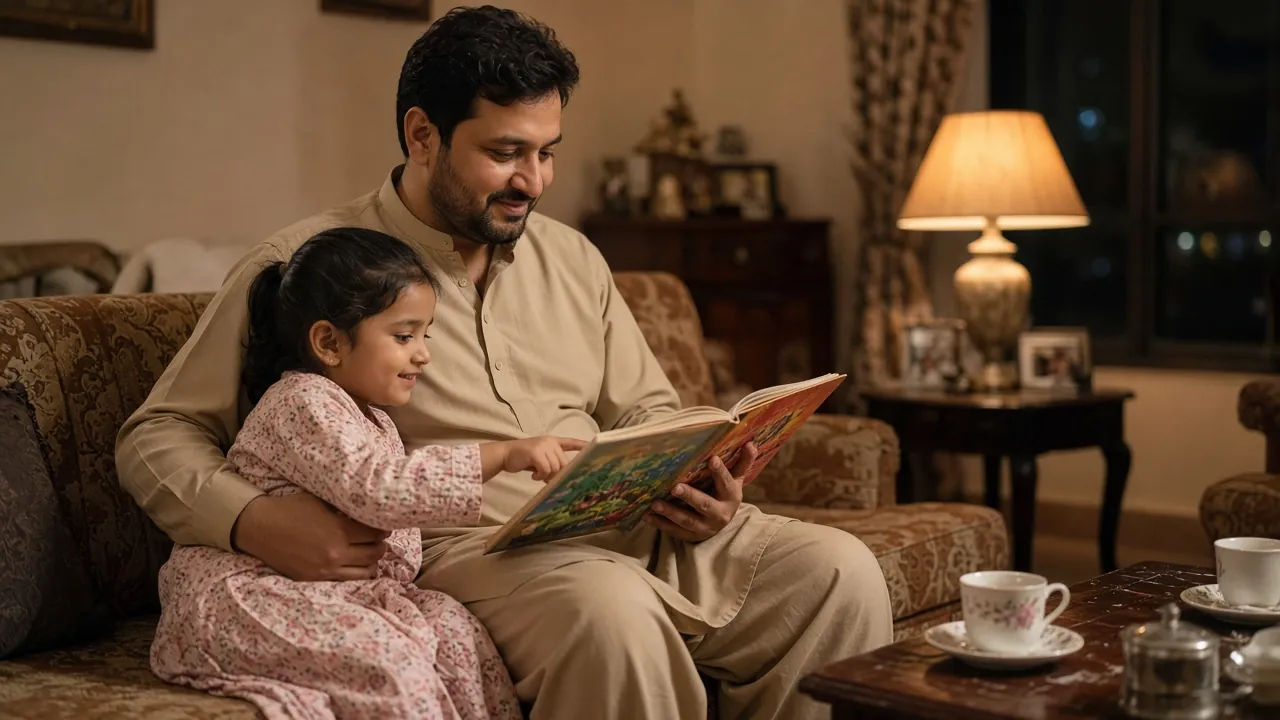
Listen to what your child says, not how they say it. Give time to finish, keep eye contact, pause before you reply, and make time for relaxed one-to-one talk and play. This lowers pressure but does not replace an assessment.
These tips come from the Stuttering Foundation, NIDCD and ASHA:
- Let them finish. Wait patiently with natural eye contact. Do not fill in words.
- Pause before answering. A quiet two seconds takes away the race against the clock.
- Slow your own speech. Talk in a relaxed way with small pauses. Show it, do not tell them to do it.
- Ask fewer questions. Try a comment instead: “I had an apple for snack” rather than “What did you eat?”
- Follow their lead in play, and keep your sentences short and simple.
- Make daily one-to-one time: five or ten phone-free minutes of play or reading.
- Praise the message. Tell your child that stuttering does not bother you and it is okay to stutter. If they mention it, a short calm answer is enough: “Sometimes words get stuck. I’m listening.”
For relaxed talking games, see our speech therapy activities for kids.
What should parents avoid saying or doing?
Avoid finishing your child’s words, saying “slow down” or “take a deep breath,” making them repeat things, rushing them, or letting others tease. These well-meant habits add pressure.
- “Slow down,” “relax,” “think before you speak.” The Stuttering Foundation says this does not help, because stuttering is a different kind of speaking problem.
- Finishing their words. ASHA lists it as a well-meant action that can lead to more stuttering.
- Showing impatience, such as sighing or looking away.
- Asking for a performance, like “say it nicely for Uncle.”
- Pointing out every stutter, or reminding your child to use therapy techniques unless the therapist asks you to.
Otherwise, treat your child as before: the same rules, the same chores, the same turn to talk at dinner.

What happens at a speech therapy assessment?
The therapist asks when the stuttering began and how it changes, listens to your child talk and play, counts and describes the disfluencies, checks speech and language, and then explains whether therapy is needed.
Based on ASHA and NIDCD, expect questions about when it started, whether it began suddenly, and whether relatives stutter. The therapist notes the types and number of disfluencies, how your child reacts, and whether stuttering affects play or school. A plan to review again in a few months is a legitimate outcome. At IRHC, the first visit starts with an assessment and the therapist explains the plan afterwards.
What does speech therapy for stuttering in children look like?
For young children, therapy mostly works through parents: either coaching you in how you talk and play, or teaching you to give gentle feedback on smooth speech. Older children learn easier ways to speak and work on fear and avoidance. No therapy can promise a cure.
The therapist picks an approach to fit your child’s age and how they respond. You may come across three kinds of help.
Parent-led treatment, such as the Lidcombe Program
The Lidcombe Program is designed for children under six and can suit slightly older ones. A parent does the treatment in daily life with regular guidance from a speech therapist, giving gentle feedback, mostly when speech is smooth and only occasionally when it is not. Parents also rate the stuttering from 0 to 10 each day. Stage 1 aims to bring stuttering to a very low level, and Stage 2 protects the progress over about a year. Its team says clinical trials show it reduces stuttering.
Family-based approaches
Approaches such as Palin Parent-Child Interaction therapy are play-based. Parents and therapist look at what you already do that helps smooth talking, and you do a little more of it, while learning to talk openly about stuttering.
Therapy for school-age children
Older children learn ways to speak with less tension and work on feelings such as fear and embarrassment. The NHS lists three parts: a relaxed talking environment, strategies for easier speech, and work on feelings about stammering.
NIDCD says there is currently no cure for stuttering. The aims are easier speech, a confident child and a family that knows how to help. The NHS notes that treatment is often successful in pre-school children, which is why early help matters.
How can you support a child who stutters at school?
Tell the teacher early, agree a plan with your child for reading aloud and talks, deal with teasing quickly, and keep reminding your child that what they say matters more than how smoothly they say it.
- Ask your child what helps. Some prefer to be called on like everyone else, others prefer the teacher to wait for a raised hand on hard days (Stuttering Foundation).
- Plan oral work together: go first or last, practise at home, or present to a small group first.
- Handle teasing early. It happens to many children, not only those who stutter. Listen, tell the school, and remind your child that stuttering says nothing about how clever or kind they are.
- Keep normal rules. If your child interrupts, handle it as you would for any child.
If your child dreads reading aloud or has started avoiding talking at school, book or revisit an assessment.
Does speaking Urdu and English at home cause stuttering?
No. There is no evidence that growing up with two languages causes stuttering. Mixing Urdu and English in a sentence is normal. Tell your speech therapist every language your child uses.
Many Pakistani families switch between Urdu, English and a home language such as Punjabi or Pashto. The Stuttering Foundation says no evidence suggests two languages at home since birth cause stuttering, though mixing words may briefly bring more disfluency, and adding a new language at ages three to five may increase stuttering in some children. Its advice: speak one language at a time to your child, let them mix freely, say the word back in the main language without asking for a repeat, and see a speech therapist if stuttering lasts more than six months. Do not drop a language out of fear. Tell us which languages your child speaks when you book.
What are the common myths about stuttering in children?
The biggest myths are that parents cause it, that nervous children stutter, that “slow down” helps, that two languages cause it, and that every child grows out of it.
- Myth: Parents or a stressful home cause it. Fact: No. Parents are never to blame.
- Myth: Nervous or shy children stutter. Fact: Nerves can make it worse on a bad day, but do not cause it.
- Myth: Two languages cause it. Fact: No evidence supports this.
- Myth: All children grow out of it, so just wait. Fact: Many do, not all, and no one can tell in advance.
Speech therapy at home in Islamabad and Rawalpindi: how IRHC arranges it
IRHC sends a speech therapist to your home in almost all areas of Islamabad and Rawalpindi, Monday to Sunday, 9 am to 9 pm, or holds sessions by video call. The first visit is an assessment. Every booking is confirmed on WhatsApp.
If you are looking for a speech therapist in Islamabad or stuttering therapy in Rawalpindi, our speech therapy service covers children and adults, including stuttering therapy for children, unclear speech and delayed speech.
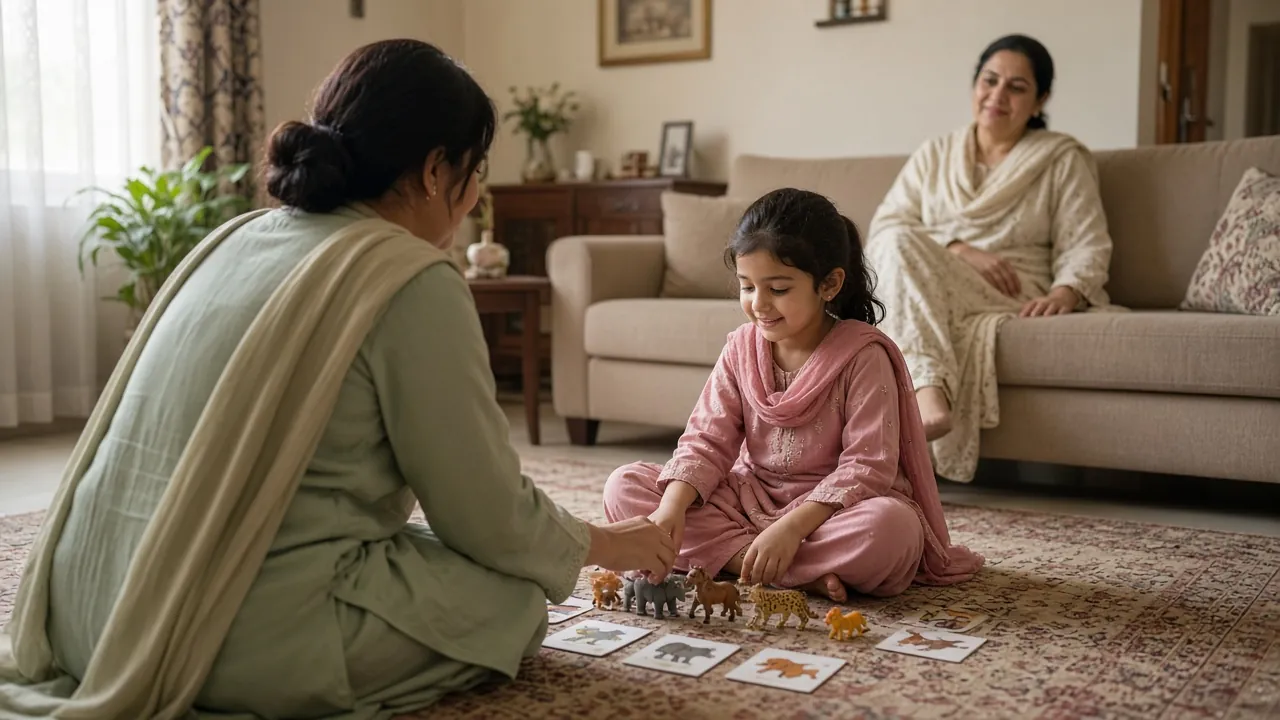
- Familiar surroundings: therapy takes place where your child is comfortable, with familiar toys and routines, and no travel or waiting room.
- Guidance for the family: you are guided on the do’s and don’ts to follow at home, which matters because therapy for young children relies on parents.
- Video option: sessions on WhatsApp, Microsoft Teams, Zoom or another suitable app.
- Clinic option: partner clinics in G-8 Markaz, Islamabad and Saddar, Rawalpindi, by appointment. Please book ahead.
To book, call 051-8776556 (9 am to 6 pm), WhatsApp 0300-6844361 (answered 24/7) or use the online appointment form. Tell us your child’s age, when the stuttering started, the languages your child speaks and your area. Not sure we cover it? Send your location on WhatsApp and we will confirm before booking. For fees and payment, see our FAQs.
Worried about your child’s speech?
IRHC provides speech therapy at home in Islamabad and Rawalpindi, Monday to Sunday. Our team confirms every booking on WhatsApp. For fees, timings and payment methods, see our FAQs, or read more about our speech therapy service.
Book an appointment | WhatsApp 0300-6844361 | Call 051-8776556
Frequently Asked Questions
Quick answers to what parents ask most about stuttering in children. For fees and payment, see our FAQs page.
At what age do children start to stutter?
Most often between ages 2 and 6, commonly around 3, when children begin joining words into sentences. It can start gradually or suddenly. A sudden start is alarming but common. It is still worth having a speech therapist take a look.
Will my child outgrow stuttering?
Many children do. Roughly two in three to three in four stop, but nobody can tell in advance which child will. That is why an early assessment is better than waiting, especially if there is tension, a family history, or a start after age 3½.
Is it normal for a toddler to repeat words?
Yes. Repeating whole words or phrases, saying “um” or restarting a sentence is common while language grows fast. If you hear repeated sounds, stretched sounds, blocks or struggle, or it lasts around six months, ask a speech therapist to check.
Can stress, shyness or a nervous nature cause stuttering?
No. Stuttering is not caused by parenting, stress or nervousness. Excitement or pressure can make it worse on a given day, and living with it can make a child anxious, but those feelings are not the cause.
Can speech therapy cure stuttering?
There is currently no cure, and no therapist can promise a result. Therapy can help many children speak more easily and confidently, and helps families respond in a supportive way. Starting early gives therapy the best chance to help.
Does speaking Urdu and English at home cause stuttering?
No. There is no evidence that speaking two languages from birth causes stuttering, and mixing them in a sentence is normal. If your child stutters for more than about six months, see a speech therapist and tell them every language your child uses.
How much does stuttering therapy at home cost, and how long is a session?
At IRHC, a first or single home speech therapy visit is Rs 3,000, with 10% off 5 sessions and 15% off 10 sessions. A home session lasts 45 minutes. There is no fixed number of sessions; the therapist explains the plan after the first assessment. Payment is in advance by Easy Paisa, JazzCash, U Paisa, Raast ID, bank transfer or cash.
How do I book a speech therapist for my child in Islamabad or Rawalpindi?
Call 051-8776556 (9 am to 6 pm), WhatsApp 0300-6844361 (answered 24/7), or use the online appointment form. We visit almost all areas of both cities, Monday to Sunday, 9 am to 9 pm. Every booking is confirmed on WhatsApp.
Sources
- NHS, Stammering
- American Speech-Language-Hearing Association (ASHA), Stuttering and Cluttering
- National Institute on Deafness and Other Communication Disorders (NIDCD), Stuttering
- Stuttering Foundation, FAQs for Parents and Stuttering and the Bilingual Child
- The Lidcombe Program, Information for parents
Medical disclaimer: This article is for general information only and does not replace an assessment by a qualified speech therapist or the advice of your child’s doctor. No therapy can guarantee that stuttering will stop.